
Profile Perfect Level 384 Answer
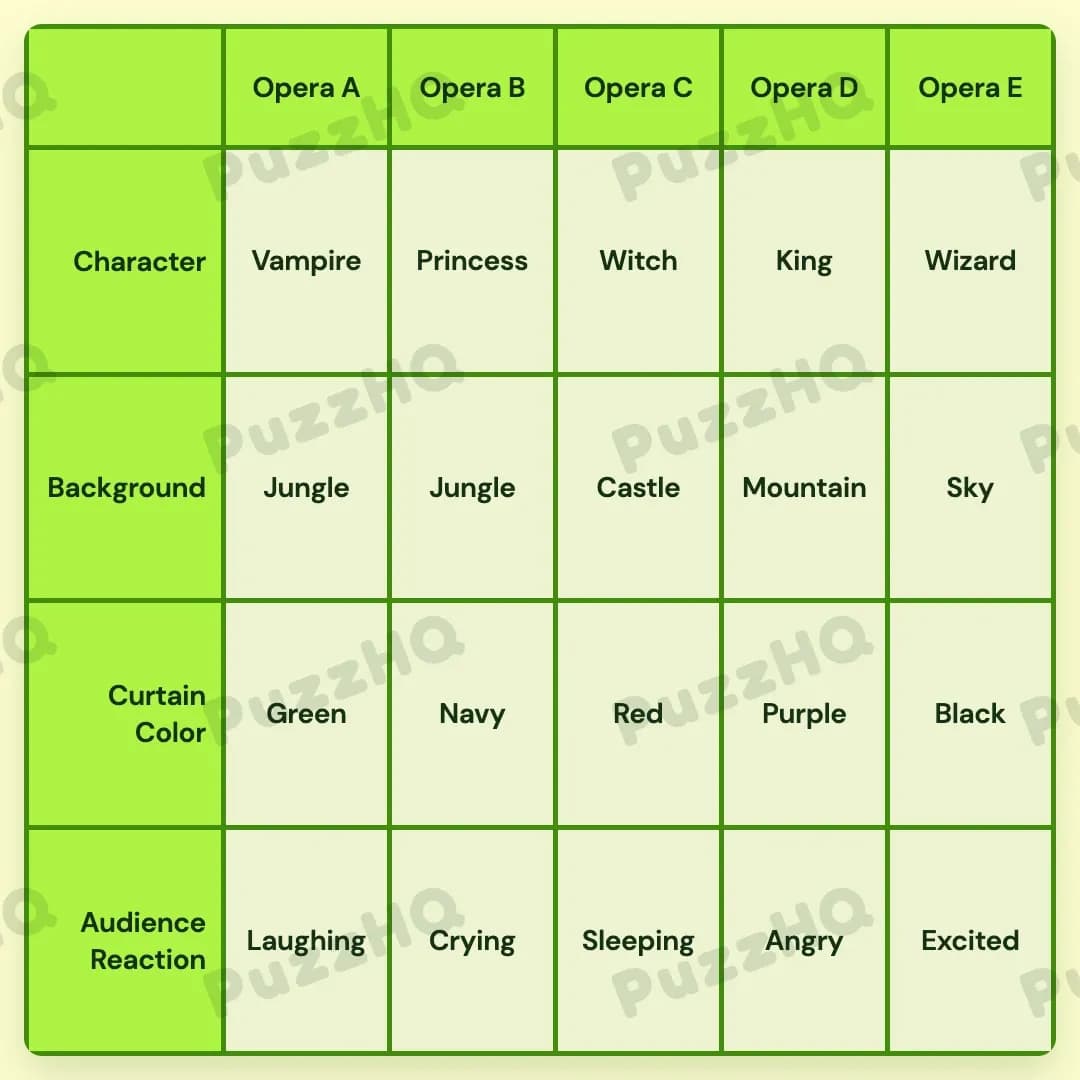
A dramatic night at the theater comes together once the middle performance establishes the anchor for all five productions.
| Trait | Opera A | Opera B | Opera C | Opera D | Opera E |
|---|---|---|---|---|---|
| Character | Vampire | Princess | Witch | King | Wizard |
| Background | Jungle | Jungle | Castle | Mountain | Sky |
| Curtain Color | Green | Navy | Red | Purple | Black |
| Audience Reaction | Laughing | Crying | Sleeping | Angry | Excited |
The Logic Behind Profile Perfect Level 384
This puzzle is built entirely outward from its center. Rather than scattering isolated pairs across the lineup, the clues establish a complete set of traits for the third opera first. Once that central pillar is locked down, relative position clues constrain the left side of the stage, leaving the remaining theatrical elements to fill the right flank through direct pairings and elimination.
The Middle Stage Sets The First Fixed Marks
Solving begins by looking directly at the center slot, Opera C. We are told that the Witch is the main antagonist of the middle opera, giving her an immediate home. Another clue notes that the audience in the middle show is not paying attention, which translates to a Sleeping audience for Opera C.
The Witch also conceals herself behind a Red curtain. With those three details combined, Opera C instantly holds the Witch, the Red curtain, and a Sleeping audience. Having three traits fixed in the exact middle of the board provides an immediate point of reference for every directional and neighboring clue on the sheet.
Positional Clues Squeeze The Left Flank
With Opera C defined, the puzzle pivots to spatial relationships. We know that the Red and Navy curtains are neighbors. Since Opera C has the Red curtain, Navy must belong to either Opera B or Opera D. At the same time, we know the Crying audience sits somewhere to the left of the Sleeping audience. Because the Sleeping audience is in Opera C, the Crying audience must belong to either Opera A or Opera B.
The character assignments clarify where everything lands. The show featuring the Princess lost in the Jungle gives us a direct character and background link, while another clue notes that one of the Jungle backgrounds uses a Green curtain. We also learn that the Vampire successfully cracked his joke, which clearly pairs the Vampire with a Laughing audience reaction.
Because the Vampire laughs and the Princess is lost in the Jungle, neither of them fits the middle slot, which already belongs to the Witch. If the Green curtain belongs to a Jungle background, and Opera A takes the Green curtain with the Vampire, then Opera B takes the Navy curtain, the Princess, the second Jungle background, and the Crying audience reaction. This leaves Opera A with the Laughing reaction, neatly satisfying the condition that Crying sits to the left of Sleeping while placing the Navy curtain directly beside the Red one.
The Remaining Cast Takes Their Cues
Once the first three operas are arranged, only Opera D and Opera E remain unresolved. The remaining clues provide straightforward trait pairings that quickly find their proper positions.
We are told that the Mountain background is revealed behind a Purple curtain. Since Opera C already has the Red curtain and Opera A and B use Green and Navy, the Purple curtain and Mountain pairing must belong to Opera D or Opera E.
Next, we look at the emotional reactions tied to specific roles. The audience is Angry because the ruler played his role poorly, matching the King with an Angry reaction. Another clue tells us that the audience is Excited watching the flying aerial battle scene, which connects the Excited reaction to the Sky background.
Since Opera C is Sleeping, Opera A is Laughing, and Opera B is Crying, the Angry and Excited reactions must distribute between Opera D and Opera E. Opera D takes the King, the Angry audience, the Mountain background, and the Purple curtain. This leaves Opera E with the Wizard, the Sky background, the Black curtain, and the Excited audience. With that final placement, the remaining traits like the Castle background for Opera C fall into place by clean elimination.
The Clue I Would Read Twice
The most deceptively simple clue in the set is the note that the Crying audience is to the left of the Sleeping one. On a first glance, it is easy to assume this means immediately to the left, which would force Crying into Opera B without checking other possibilities. While Crying does ultimately land in Opera B, recognizing that the clue only specifies relative position prevents hasty assumptions before the curtain colors and character traits confirm the full arrangement.
Final Thoughts
The theatrical framing makes this puzzle particularly neat to untangle. What looks like an open set of independent opera productions becomes rigid the moment the central stage is pinned down. From there, the logic moves across the stage like a spotlight, resolving each act until the entire evening program is complete.
Comments