
Profile Perfect Level 510 Answer
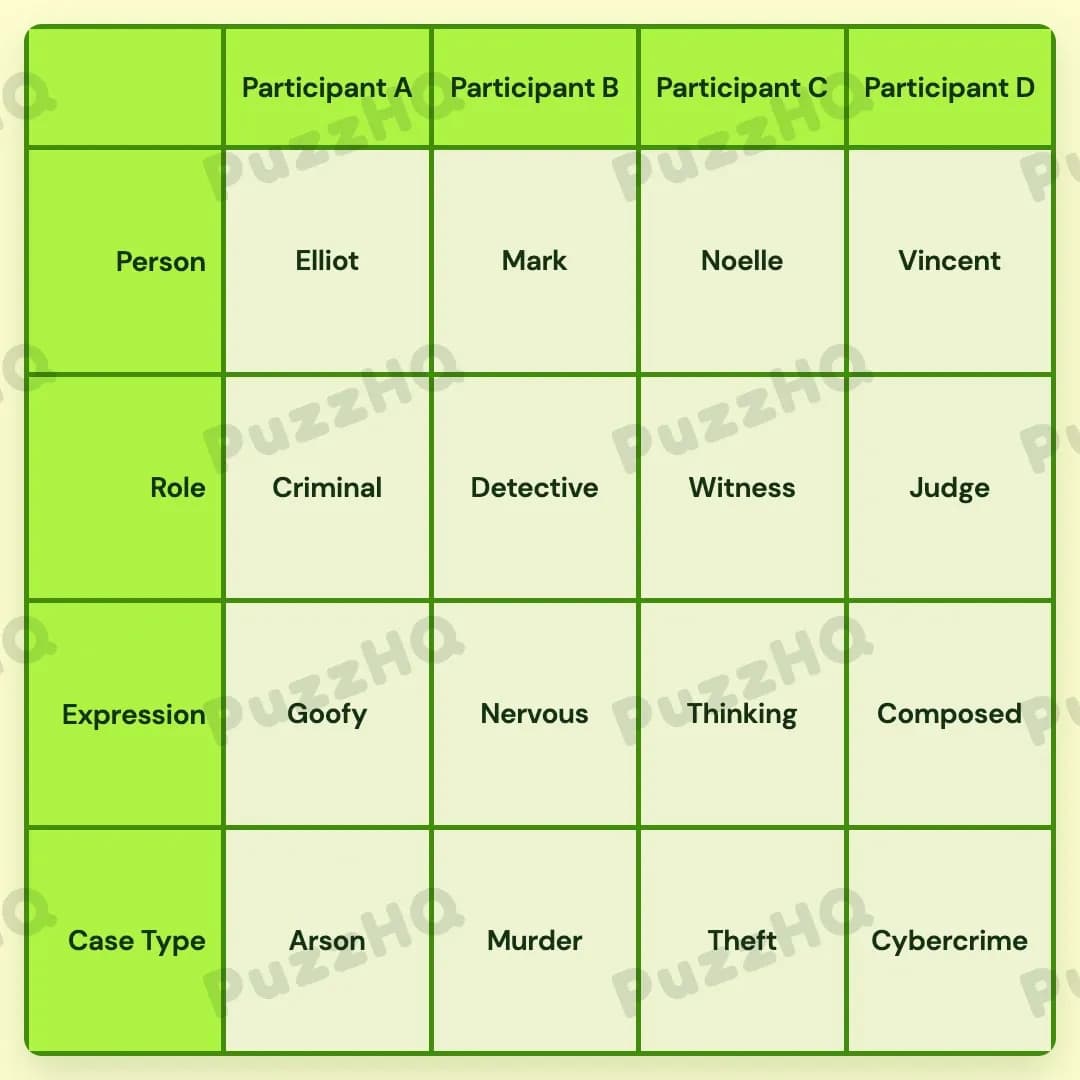
A careful look at courtroom spacing and neighborly accusations reveals who sits in each chair.
| Trait | Participant A | Participant B | Participant C | Participant D |\n| --- | --- | --- | --- |\n| Person | Elliot | Mark | Noelle | Vincent |\n| Role | Criminal | Detective | Witness | Judge |\n| Expression | Goofy | Nervous | Thinking | Composed |\n| Case Type | Arson | Murder | Theft | Cybercrime |
The Logic Behind Profile Perfect Level 510
Courtroom layouts are rigid by nature, and this puzzle uses that rigid architecture as its primary puzzle engine. Everything flows from physical layout and relative spacing, beginning with a strict column distance that locks the roles in place and cascading straight down into case files and expressions. Once you identify where the legal roles fall along the bench, the identities and crimes sort themselves out almost automatically.
Spacing Establishes The Courtroom Axis
The key to unlocking the entire scene is the separation between the Criminal and the Witness. We are told the Criminal stands exactly two columns away from the Witness. That gap immediately restricts both roles to very specific pairings across the four columns: either positions A and C, or positions B and D.
The direction becomes clear the moment you bring in the evil hacker. The clue specifies that the case farthest from the Criminal involves an evil hacker. In a four column lineup, a participant only has a unique farthest column if they occupy one of the outer edges. If the Criminal were in column B, column D would be two spaces away, but if the Criminal sat in an interior seat, the symmetry of the board would blur. Placing the Criminal in Participant A makes Participant D the uncontested farthest position, setting Cybercrime firmly in the rightmost seat.
This assignment forces the Witness into Participant C, sitting two columns to the right of the Criminal. At this stage, the extremes of the board are decided. Participant A holds the Criminal, Participant C holds the Witness, and Participant D hosts the Cybercrime case.
Roles And Crimes Fall In Line
With two roles planted, the remaining two roles are Detective and Judge, which must belong to Participant B and Participant D. We are told that Mark is not responsible for the final verdict, which promptly disqualifies him from being the Judge. Meanwhile, another clue reveals that the Judge remains Composed despite having no idea what is going on. This pairs the Judge role directly with the Composed expression.
Now consider the people involved. Vincent is mentioned as being on trial despite lacking any tech knowledge, tying him directly to the Cybercrime accusation over in Participant D. That leaves Participant D holding Vincent, the Cybercrime case, and by necessity the Judge role, alongside the Composed expression. It is a delightfully absurd legal situation, but the structural placement is undeniable.
Because Participant D is fully occupied by Vincent as the Composed Judge on the Cybercrime docket, Participant B can only be the Detective. Mark cannot be the Judge, so Mark must be the Detective in Participant B.
The cases wrap up quickly once Mark takes his seat. A clue notes that Mark is innocent of the arson, but his neighbor is not. Sitting in Participant B, Mark has neighbors in Participant A and Participant C. However, we already know from the Witness clue that the Witness swore to tell the truth about a pickpocket, which fixes Theft to Participant C. With Participant C occupied by Theft, Mark's guilty neighbor can only be Participant A, assigning Arson to the Criminal. Mark is left with the only unassigned crime, Murder, completing the Case Type row.
Expressions And Identities Close The Record
With the board mostly filled, the remaining empty spaces are easy to clean up through straightforward elimination.
We learn that Noelle is thinking deeply to formulate an answer. Because Participant C is the only available slot that can take both the person and that specific expression, Noelle and Thinking settle comfortably into the Witness chair. That leaves only one spot left in the Person row: Participant A.
The very first clue mentioned a leftmost blonde man who spent hours perfecting his hairstyle. With Participant A being the leftmost seat, Elliot steps in to fill that identity. His expression can only be Goofy, which is the sole facial expression left without an owner.
That leaves one final vacancy in Participant B. Mark is already the Detective handling the Murder case, and the only expression left unassigned is Nervous. It fits his predicament rather well, considering he is seated between an arsonist and a witness. The entire four column layout locks together cleanly, without any guesswork required.
The Clue I Would Read Twice
The fifth clue, noting that Vincent is on trial despite not being tech-savvy, is easily the most deceptive sentence in the puzzle.
On a casual first pass, you might assume this clue means Vincent must take the Criminal role for Cybercrime. In logic grids, clues often use playful irony or thematic humor, and reading this line too literally could trick you into forcing Vincent into the Criminal seat. The grid, however, already assigned the Criminal role to Participant A based on the distance to the Witness and the hacker case being farthest away.
What the clue actually does is establish a direct association between Vincent and the cybercrime theme, regardless of which role he formally occupies. Recognizing that Vincent belonged in the Cybercrime column without assuming he had to be the defendant is the exact mental pivot that keeps the solve moving smoothly.
Final Thoughts
What makes this particular grid stick in memory is the chaotic picture it paints of a legal proceeding. You have a judge who understands nothing about technology overseeing a cybercrime matter, an alleged criminal with a meticulously styled haircut, and a detective looking visibly nervous between them. It proves that even when the underlying deduction follows strict, orderly geometry, the resulting scenario can be wonderfully lively.
Comments