
Profile Perfect Level 565 Answer
By uncovering how the physical stone composition locks in the inscriptions and luminous colors, every attribute falls into place with absolute certainty.
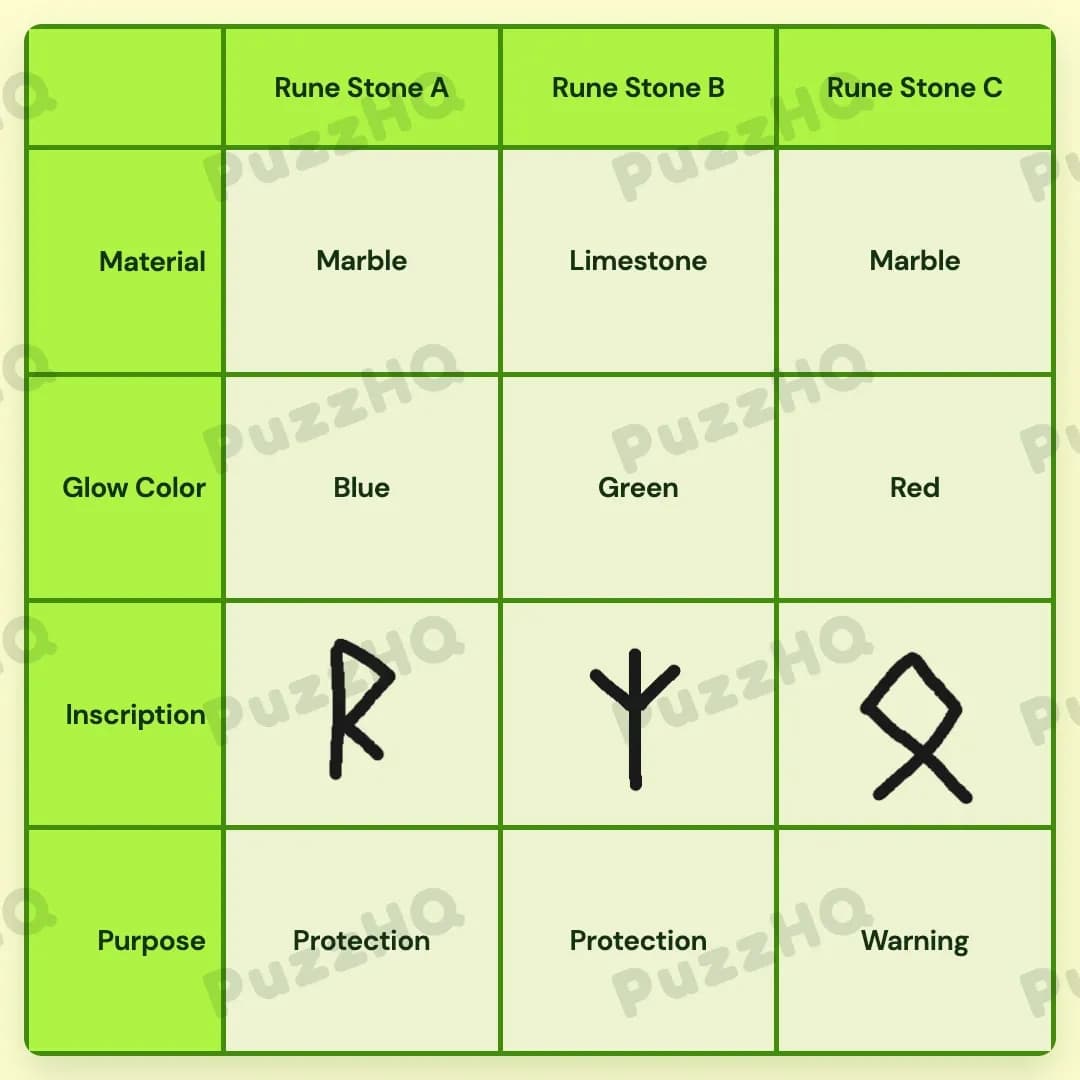
| Trait | Rune Stone A | Rune Stone B | Rune Stone C |
|---|---|---|---|
| Material | Marble | Limestone | Marble |
| Glow Color | Blue | Green | Red |
| Inscription | Row1Col5 | Row2Col7 | Row3Col8 |
| Purpose | Protection | Protection | Warning |
Building The Grid By Trait
Solving this arrangement becomes straightforward when we begin by pairing the material composition with the carved inscriptions. Rather than scattering our focus across individual stones, observing how the stone types dictate the carvings yields the primary anchors for the entire board.
Material And Inscription Establish The Subject Identities
The physical makeup of the three artifacts contains an immediate split: exactly two of the items are composed of marble, leaving just a single specimen made of limestone. Identifying which rune stone is the solitary limestone artifact instantly unlocks the remaining marble pair.
To locate this unique limestone stone, we turn directly to the inscriptions. The limestone carving branches into three parts, represented by Row2Col7. At the same time, one of the two marble stones features written text, represented by Row1Col5. Crucially, Rune Stone C displays an inscription resembling a fish, represented by Row3Col8.
Because Rune Stone C bears the fish carving, it cannot possess the three-branch design reserved exclusively for limestone. This guarantees that Rune Stone C is made of marble. With Rune Stone C accounted for as one of the marble stones with a fish marking, the second marble stone must be the one bearing the written text. That written text belongs to Rune Stone A, because Rune Stone B must hold the limestone carving.
Consequently, Rune Stone A is fixed as marble with written text (Row1Col5). Rune Stone B must therefore be the unique limestone artifact, which naturally assigns it the three-branch carving (Row2Col7). With that single deduction, both the Material row and the Inscription row become completely filled. Rune Stone A is marble, Rune Stone B is limestone, and Rune Stone C is marble, while their respective carvings align neatly across all three columns.
Glow Color Follows Positional Constraints
Once the stone types are established, the illumination colors can be deduced through a combination of material links and horizontal positioning. We know that the limestone rune radiates a
Comments