
Profile Perfect Level 594 Answer
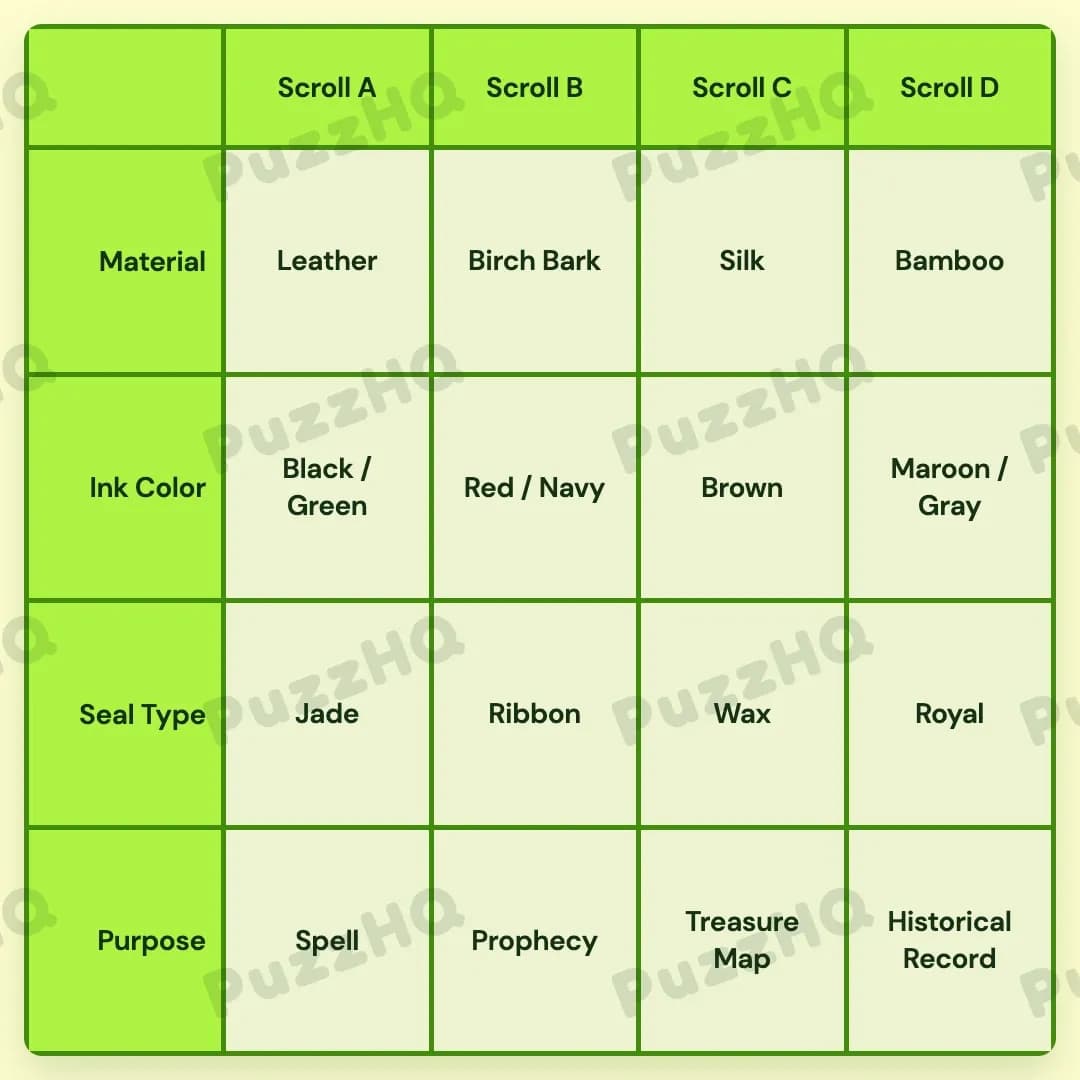
Scroll A is a Leather spell scroll sealed in Jade with Black and Green ink, Scroll B is a Birch Bark prophecy sealed with Ribbon in Red and Navy ink, Scroll C is a Silk treasure map with a Wax seal in Brown ink, and Scroll D is a Bamboo historical record bearing the Royal seal in Maroon and Gray ink.
| Trait | Scroll A | Scroll B | Scroll C | Scroll D |
|---|---|---|---|---|
| Material | Leather | Birch Bark | Silk | Bamboo |
| Ink Color | Black / Green | Red / Navy | Brown | Maroon / Gray |
| Seal Type | Jade | Ribbon | Wax | Royal |
| Purpose | Spell | Prophecy | Treasure Map | Historical Record |
How To Think Through Profile Perfect Level 594
The key to solving this layout smoothly is learning how to pin down structural anchors before chasing flexible clues. When a puzzle gives you four ordered columns, locating exact positions early narrows down all future spatial relationships like adjacency, betweenness, and minimum column distance.
Anchor Definite Facts First: Establishing Scroll C And Column One
Direct identity statements give you stable footholds that require no interpretation. Starting with these clues prevents unnecessary guesswork later in the solve.
You are told that the Wax seal on Scroll C shows no signs of tampering. This directly secures the Wax seal under Scroll C.
Next, examine the positional anchor: the leftmost scroll is written in Black and Green ink. Because Scroll A represents the leftmost column, you can immediately lock Black / Green ink into Scroll A.
These two direct placements give you fixed reference points on both the left side and the right center of the grid. Every neighboring clue can now be measured against these concrete anchors.
Use Edge Adjacency To Force Placements: Birch Bark Next To Green Ink
Adjacency clues that touch an outer edge are twice as restrictive as normal neighbor clues. An interior column has two neighbors, but an edge column has only one.
You know from your first step that Green ink sits on Scroll A, which is the leftmost column. The clue stating that the scroll written on Birch Bark is next to the Green ink can only point in one direction. Scroll A has no left neighbor, so Birch Bark must belong to Scroll B.
Whenever a neighbor clue points to an edge slot, treat it as an automatic assignment. This single observation locks down the material for Scroll B without needing any additional comparisons.
Test Polar Endpoints Against Blocked Slots: Resolving The Jade Seal
When a clue states an item sits on either end of the grid, it creates a simple fork with only two options. Rather than guessing between the ends, check which end has valid space for the item's neighbors.
The Jade seal must sit on either Scroll A or Scroll D. At the same time, another clue notes that there is no scroll between the Jade and Ribbon seals, meaning Jade and Ribbon must be immediate neighbors.
Now test both ends:
- If Jade is on Scroll D, its only neighbor is Scroll C. That would force Ribbon onto Scroll C. However, Scroll C already holds the Wax seal. This creates an impossible conflict.
- Therefore, Jade cannot be on Scroll D. Jade must belong to Scroll A.
With Jade established on Scroll A, Ribbon must take the adjacent spot on Scroll B. This leaves only one unassigned seal category for Scroll D: the Royal seal created by the king.
Pair Multi-Trait Descriptions With Unfilled Slots: King And Pirate Clues
Multi-trait clues describe relationships between traits rather than names of scrolls. These clues become trivial once earlier deductions have cleared out competing options.
The clue noting that the scroll sealed by the king himself is written in Gray ink links the Royal seal directly to Gray ink. Because Scroll D holds the Royal seal, Scroll D receives the Maroon / Gray ink combination.
Similarly, thematic identity clues pair traits cleanly. The clue stating that pirates would find the Wax scroll especially useful connects the Wax seal with a Treasure Map. Because Scroll C already holds the Wax seal, Scroll C must have the Treasure Map purpose.
By handling these paired traits right after your seal deductions, you fill two complex cells without doing any cross-referencing math.
Resolve Betweenness With Material Attributes: The Prodigy Seer
Betweenness clues establish a three-column sequence, but they often leave the outer edges ambiguous until another clue differentiates them.
You learn that the scroll written by a prodigy seer is between Leather and Silk. Scroll B is the only available column that sits directly between two open material positions (Scroll A and Scroll C). This locks Prophecy into Scroll B as its purpose.
That leaves Leather and Silk split across Scroll A and Scroll C. To assign them correctly, look at the clue stating that Scroll C is made of a softer material than Scroll A. Because Silk is softer than Leather, Scroll C receives Silk, and Scroll A receives Leather.
By process of elimination, the fourth material, Bamboo, must belong to Scroll D.
Distribute Remaining Options Using Directional Ordering: Red Before Brown
When only two items in a category remain, directional clues settle their final order instantly.
For the purpose row, only Spell and Historical Record remain open. Scroll D represents a royal document sealed by the king, which aligns with Historical Record, leaving Spell as the only possible purpose for Scroll A.
For ink color, you still need to place Red / Navy and Brown. The clue stating that the scroll with Red ink is to the left of the one with Brown ink resolves this immediately. Scroll B sits to the left of Scroll C. Therefore, Scroll B gets Red / Navy ink, and Scroll C gets Brown ink.
Checking the distance requirement confirms everything: Maroon ink on Scroll D sits three columns away from Green ink on Scroll A, easily satisfying the rule that it must be at least two columns away. The entire grid is completely filled and verified.
What This Level Teaches You
- Edge positions turn neighbor clues into exact placements. When Green ink was fixed to the leftmost edge, its neighbor Birch Bark had only one available spot instead of two.
- Corner possibilities can be eliminated by inspecting adjacent restrictions. The Jade seal could not sit on Scroll D because its required Ribbon neighbor conflicted with the Wax seal on Scroll C.
- Comparison clues clarify ambiguous boundaries. The sequence placing the prodigy seer between Leather and Silk left the left and right order uncertain until the material softness clue separated them.
Final Thoughts
The most effective solving habit in this level was letting strict boundaries do the heavy lifting. By anchoring the edge items and testing neighbor conflicts against existing seals, every subsequent trait fell into place through clean deduction instead of trial and error.
Comments