
Profile Perfect Level 624 Answer
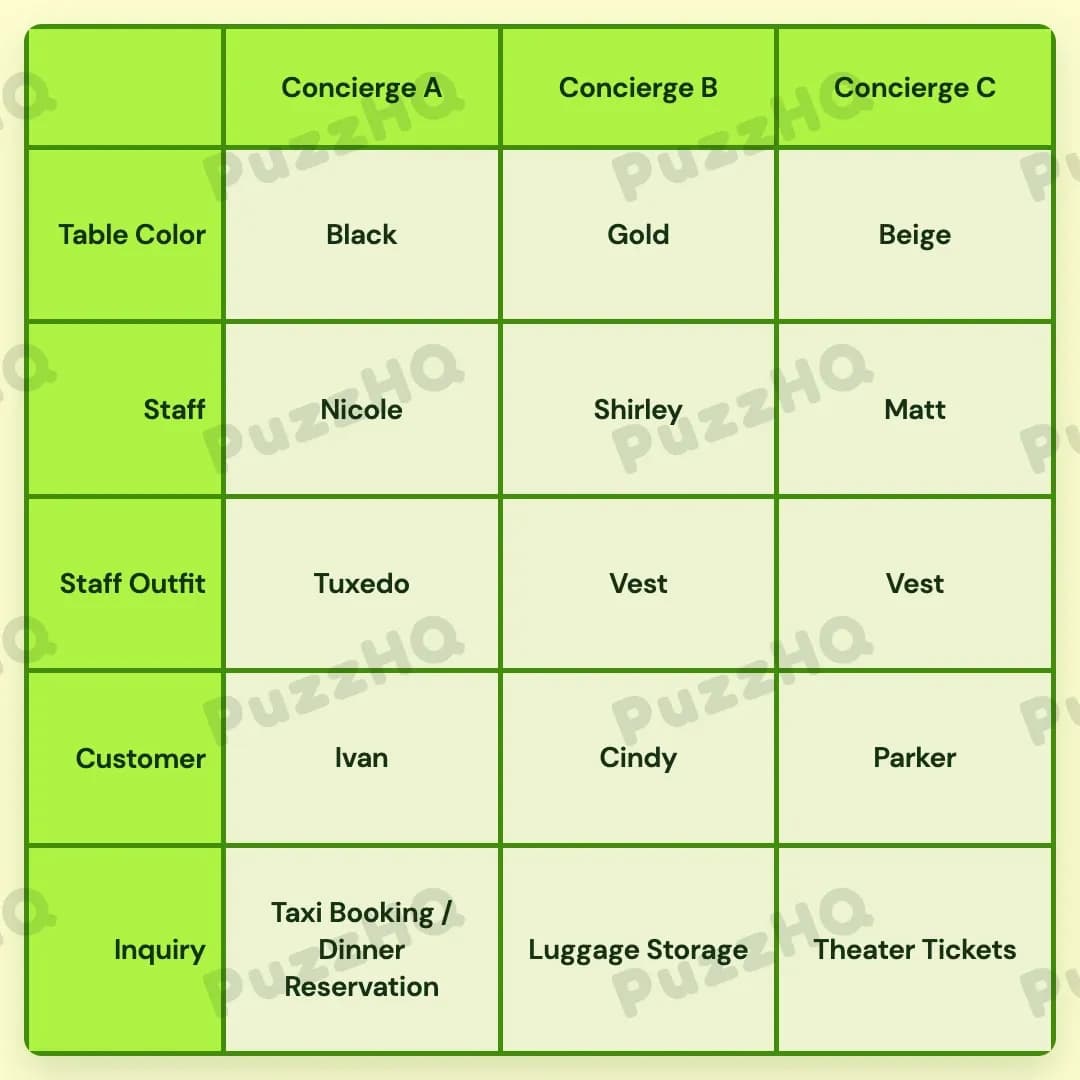
Before diving into the breakdown, here is the complete roster for the hotel concierge desk.
| Trait | Concierge A | Concierge B | Concierge C |
|---|---|---|---|
| Table Color | Black | Gold | Beige |
| Staff | Nicole | Shirley | Matt |
| Staff Outfit | Tuxedo | Vest | Vest |
| Customer | Ivan | Cindy | Parker |
| Inquiry | Taxi Booking / Dinner Reservation | Luggage Storage | Theater Tickets |
The Logic Behind Profile Perfect Level 624
This grid is governed almost entirely by relative geometry. While hotel lobbies often feel lively and unpredictable, this desk functions under strict horizontal order. With three distinct stations lined up across the floor, spacing constraints and neighbor alignments give the board its structure well before you can pin down who is ordering theater tickets or storing their bags. Once you recognize that the physical layout dictates who can stand where, the social details fall neatly into place.
Anchoring The Counters From The Flanks
The first breakthrough comes from taking advantage of the three-station width. When a clue specifies that Nicole serves two columns away from Parker, it imposes an immediate structural boundary. In a three-column setup, being separated by two full columns means one person must be at Concierge A on the far left, while the other must be at Concierge C on the far right. They cannot be anywhere near the middle.
That single distance relationship immediately divides the grid into anchors and leaves the middle open. Clues about the center station immediately gain extra traction. We learn that the middle customer wants to explore the city without heavy luggage. That directly assigns Concierge B the inquiry for Luggage Storage, giving the central station an explicit operational role.
At the same time, we have to determine who is stationed at each counter. We know Shirley is situated to the left of the male staff member. Because Shirley must have someone to her right, she cannot be stuck at Concierge C. Furthermore, since Nicole and Parker hold down the outer edges, Shirley is naturally steered toward the interior desk. Placing Shirley at Concierge B means the male staff member, Matt, must occupy Concierge C to her right. With Matt at the far right and Shirley anchored in the center, Nicole claims Concierge A on the far left.
Following Nicole's placement at Concierge A, the initial flank constraint resolves itself. Parker, who sits two columns away from Nicole, must be the customer standing at Concierge C.
Color And Uniforms Fall Into Place
Once the personnel are locked into their physical spots, the furniture and dress codes follow quickly. We are told that the staff member at the Gold table wears an outfit similar to her right Beige neighbor. This single observation yields several key deductions. First, the Gold table has a neighbor to its immediate right, which means Gold can only be Concierge A or Concierge B. Second, that neighbor to the right must be Beige.
Notice the pronoun in that clue as well. The staff member at the Gold table is referred to as female. Nicole at Concierge A and Shirley at Concierge B are both women, but look at the pairing of colors. If Gold were at Concierge A, Beige would sit at Concierge B, which leaves Black for Concierge C. However, another condition states that the tuxedo-wearing staff member stands behind the Black table. If Black were at Concierge C, Matt would be wearing a tuxedo. But the Gold table staff shares a similar outfit with her right Beige neighbor. If Gold and Beige share matching garments, those two adjacent staff members must share the same outfit type.
Placing the Gold table at Concierge B and the Beige table at Concierge C harmonizes every requirement. Shirley at Concierge B sits at the Gold table, while Matt at Concierge C occupies the Beige table. Shirley and Matt both wear vests, satisfying the observation that their outfits are similar. That leaves Concierge A with the Black table, which fits Nicole perfectly. Because the tuxedo belongs behind the Black table, Nicole is the one wearing the tuxedo.
Matching Requests Across The Counter
With the tables, uniforms, and staff completely settled, attention shifts across the counter to the visitors. We already know Parker is at Concierge C and that the middle customer at Concierge B requested Luggage Storage. Only two customers remain unplaced: Ivan and Cindy.
We learn that Ivan is planning a sweet date at the hotel restaurant tonight. That intention ties directly to an evening dinner booking. Concierge B is already reserved for luggage assistance, which leaves only Concierge A open for Ivan. At Concierge A, Ivan pairs his dining plans with transport, registering the combined inquiry for Taxi Booking / Dinner Reservation. With Ivan placed on the left and Parker on the right, Cindy becomes the customer at Concierge B, the traveler who simply needed to leave her bags behind.
That leaves Parker's inquiry at Concierge C. We are told that the bald customer only wants to know about one single thing, and that this single thing is not about transport. Ivan asked about two things at once, and Cindy's request at the center desk was already resolved. Parker is therefore the bald customer. Since his lone interest cannot involve travel or vehicles, the remaining option on the board fits his profile. Parker is inquiring about Theater Tickets.
The entire desk closes its ledger with every staff member, station color, uniform, and visitor aligned.
The Clue I Would Read Twice
The prompt noting that the Gold table staff's outfit is similar to her right Beige neighbor is the linchpin of the puzzle. It is easy to skim past the phrasing and treat it merely as a color pairing. In reality, that sentence packs three distinct pieces of logic into a single observation.
First, it establishes a rigid spatial relationship by stating that Beige is positioned to the right of Gold. Second, the feminine pronoun confirms that whoever works the Gold desk is a woman. Third, the word similar points toward shared clothing categories across adjacent desks, forcing two matching uniforms side by side. Without carefully tracking how that clue limits both the layout and the wardrobe, the middle and right desks remain ambiguous far longer than they should.
Final Thoughts
What makes this visit to the concierge counter distinct is how neat the symmetry feels once the desks are populated. Rather than relying on complicated schedules or convoluted trade-offs, the board rewards anyone who respects basic physical geometry. Once the two ends of the hall are established, the rest of the lobby practically organizes itself.
Comments