
Profile Perfect Level 619 Answer
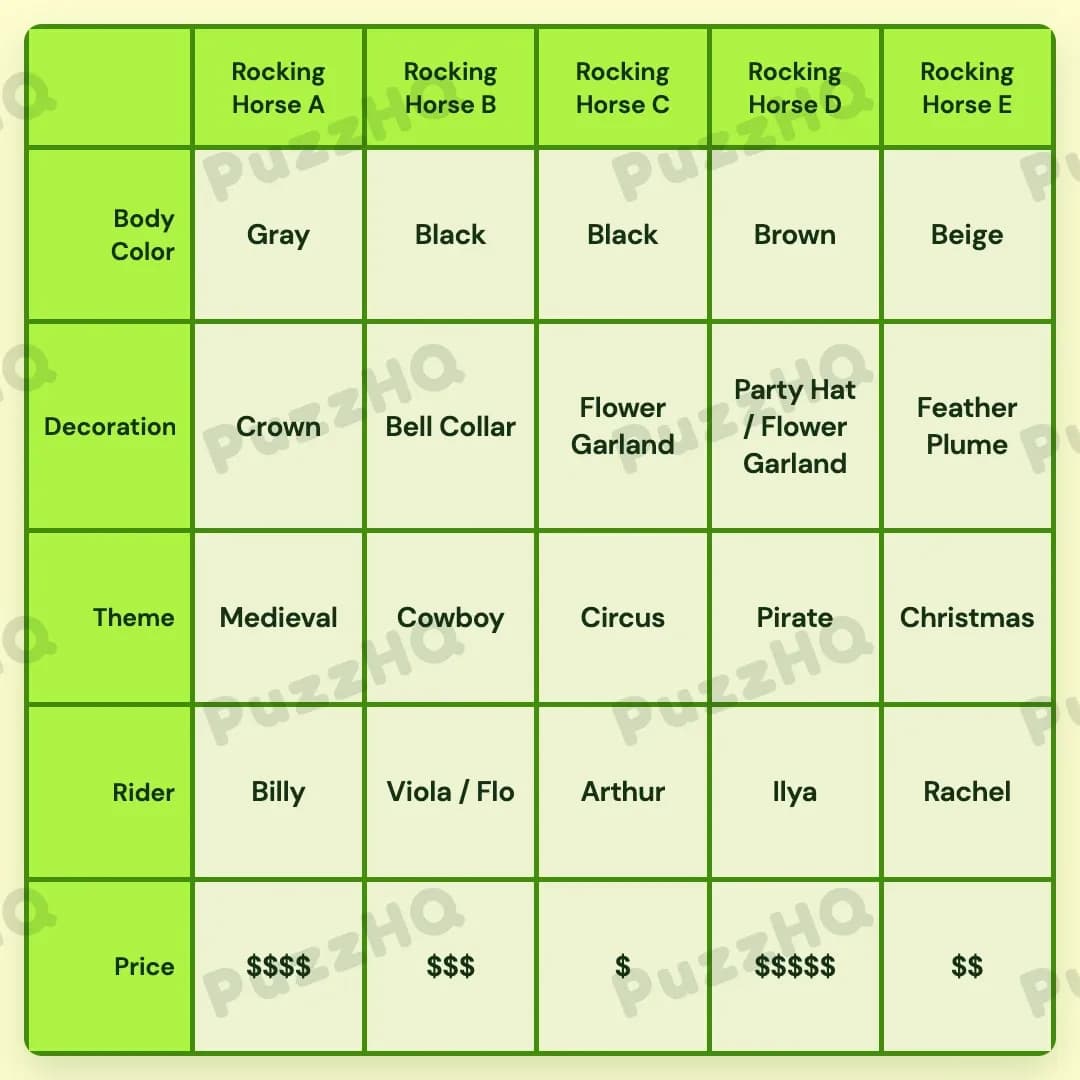
A neat balance of numerical pricing and neighborly comparisons puts every rocking horse back in its proper stable.
| Trait | Rocking Horse A | Rocking Horse B | Rocking Horse C | Rocking Horse D | Rocking Horse E |
|---|---|---|---|---|---|
| Body Color | Gray | Black | Black | Brown | Beige |
| Decoration | Crown | Bell Collar | Flower Garland | Party Hat / Flower Garland | Feather Plume |
| Theme | Medieval | Cowboy | Circus | Pirate | Christmas |
| Rider | Billy | Viola / Flo | Arthur | Ilya | Rachel |
| Price | $$$$ | $$$ | $ | $$$$$ | $$ |
The Logic Behind Profile Perfect Level 619
At first glance, a lineup of decorative wooden rocking horses looks like a purely aesthetic puzzle, but the actual heart of this board is arithmetic. A mathematical constraint between horse prices locks the financial tiers into place, providing a reliable framework that coordinates with spatial cues across the five pedestals. Once the pricing hierarchy stabilizes, decorative flourishes and rider preferences fill in the gaps without much resistance.
Numerical Averages Anchor The Cost Structure
The most dependable starting point does not involve horse colors or riders at all, but rather the straightforward math governing their values. We are told that the beige horse has a price equal to the mathematical average of Horse B and Horse C. In a five-tier pricing ladder ranging from a single dollar sign up to five, finding an exact whole integer average limits the field immediately.
Horse B and Horse C must sit on values that average cleanly into another tier. Looking at the pairings, putting Horse B at three signs and Horse C at one sign gives an average of two signs, perfectly pointing to Horse E as the beige horse.
This deduction gains immediate reinforcement from the note regarding the second cheapest horse, which carries a feather plume. Since two dollar signs represents the second cheapest position in the five-tier scale, Horse E claims both the beige coat and the feather plume decoration.
Positional clues quickly build on this foundation. Looking across the row from right to left, the second horse from the right is Rocking Horse D, and that horse is assigned the festive party hat. Meanwhile, the gray horse is noted as being slightly pricier than its immediate neighbor. With Horse B settled at three dollar signs, Horse A comfortably slots in as the gray horse at four dollar signs, neatly fulfilling that slight price bump. That leaves the priciest tier of five dollar signs to Horse D, finishing the entire price column before most riders have even selected their mount.
Coat Colors And Spatial Neighbors
Once the financial structure is established, the palette of the carousel begins to resolve itself. We already know that Horse A is gray and Horse E is beige. Two horses in the middle share a black coat, which cleanly satisfies the requirement that both the three-dollar and one-dollar horse toys are painted black. That means Horse B and Horse C are the two black rocking horses.
By elimination across the color spectrum, only one slot remains empty for coat color. Rocking Horse D takes the rich brown finish, often referred to as humus.
This specific color assignment immediately pulls the rider clues into focus. Rachel is said to ride a horse that is a paler version of her neighbor. With Horse D painted brown and Horse E painted beige, they sit side by side as direct neighbors, and beige is undeniably a paler shade of brown. Rachel therefore takes her seat on Horse E.
Arthur also makes his preference simple by insisting on a horse that matches his favorite color, black. Because Horse B is already tied to other specific narrative conditions, Arthur claims Horse C, enjoying both the black finish and the baseline price point.
Assigning The Remaining Riders And Accents
With Rachel and Arthur settled, the remaining three children find their places through straightforward elimination. Viola is accompanied on her ride by her little sister, Flo. This pairing fits naturally on Horse B.
Billy is known to avoid the humus-colored horse, which keeps him completely away from Horse D. Since Horse E, Horse C, and Horse B are occupied, Billy must take the gray mount at Horse A. That leaves Horse D open for Ilya, completing the rider tier across the board.
Themes and accessories follow these identities in quick succession. The crowned horse belongs to either a medieval or pirate setting. With Horse A wearing the royal crown, it takes the medieval banner, which leaves the pirate theme to claim Horse D.
A chiming sound when rocked points straight to the bells on Horse B, harmonizing with a classic cowboy theme. Arthur's horse at position C, fragrant and celebratory, adopts the circus motif along with a flower garland, a decoration that also shares space with the party hat on Horse D. Finally, Horse E wraps up the collection with a festive Christmas theme. Every horse is accounted for, fully decorated, and priced to match.
The Clue I Would Read Twice
The clue stating that the beige horse toy is the average price of Horses B and C is the one that demands a careful second look.
At a casual glance, an average in a logic puzzle can feel vague if you do not know which values are available. If you skip over it, you miss the foundational anchor of the entire run. Because the pricing tiers in this setting are strictly sequential integers from one to five dollar signs, an average can only produce a valid whole number from very specific pairings.
Recognizing that three and one average cleanly to two does not just identify the beige horse. It establishes the cost of Horse B, the cost of Horse C, and sets up the second cheapest position for the feather plume clue to latch onto. Without giving that simple average a moment of deliberate calculation, the middle of the board remains stalled.
Final Thoughts
What makes this particular visit to the toy workshop memorable is how smoothly the arithmetic interacts with the physical layout of the toys. Rather than relying entirely on complex chains of narrative eliminations, the puzzle invites you to treat the prices as real measurements that support the visual details. When a grid allows math and aesthetics to work together this cleanly, watching the final row of themes fall into place feels like closing the lid on a well-crafted music box.
Comments