
Profile Perfect Level 620 Answer
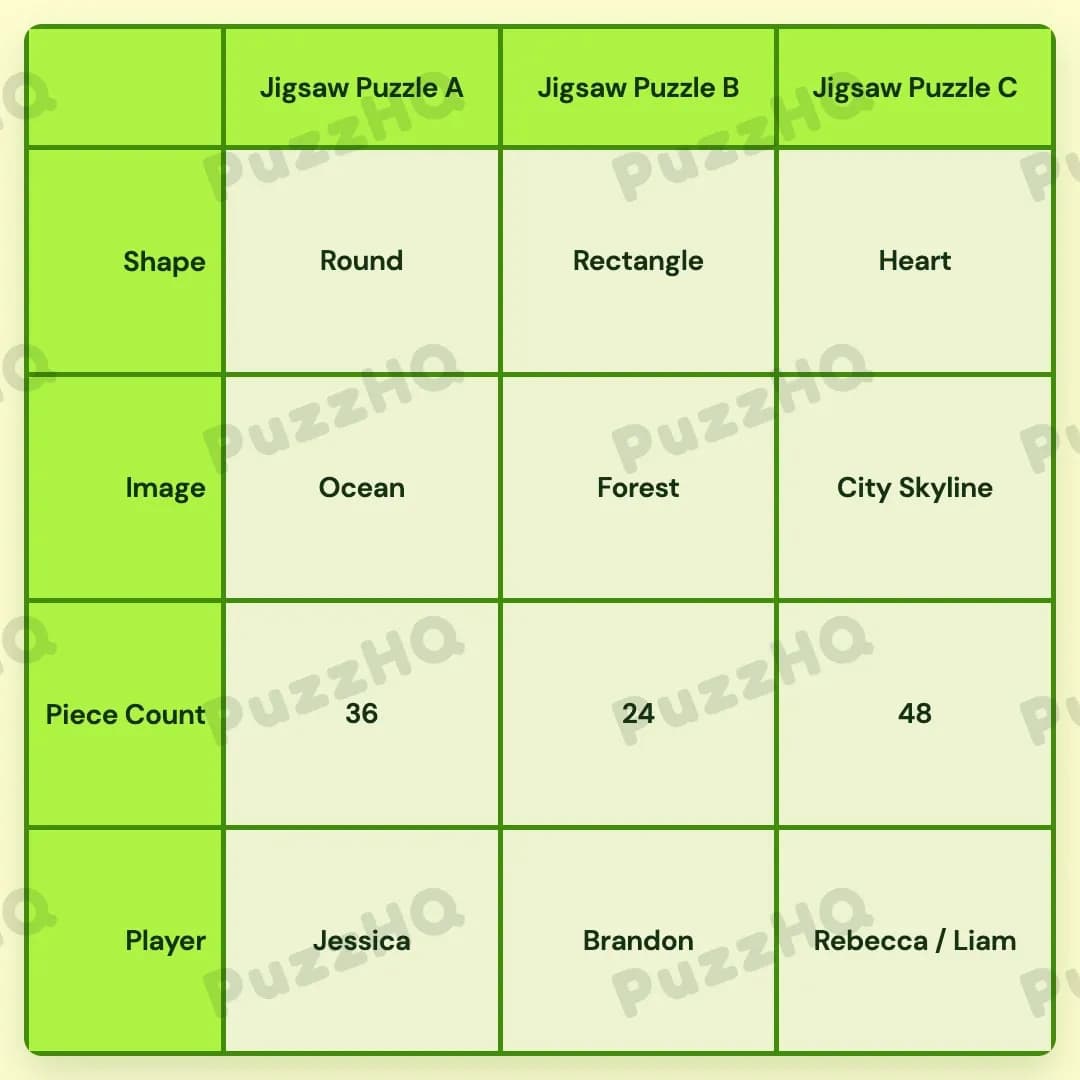
To solve the puzzle, place Round Ocean with 36 pieces for Jessica on Jigsaw Puzzle A, Rectangle Forest with 24 pieces for Brandon on Jigsaw Puzzle B, and Heart City Skyline with 48 pieces for Rebecca and Liam on Jigsaw Puzzle C.
| Trait | Jigsaw Puzzle A | Jigsaw Puzzle B | Jigsaw Puzzle C |
|---|---|---|---|
| Shape | Round | Rectangle | Heart |
| Image | Ocean | Forest | City Skyline |
| Piece Count | 36 | 24 | 48 |
| Player | Jessica | Brandon | Rebecca / Liam |
How To Think Through Profile Perfect Level 620
The key habit for solving this puzzle is anchoring fixed positions before attempting relative comparisons. When a board is organized in an orderly row from left to right, identifying which subjects occupy the left, middle, and right slots gives you immediate landing spots for otherwise floating clues. Once positions are grounded, clues about relationships and piece counts fall into place through direct deduction rather than guesswork.
Anchor Through Cooperative Clues: Rebecca, Liam, And The Rightmost Puzzle
Start by scanning for clues that mention specific board locations. One clue notes that the brown-haired man helps solve the rightmost puzzle. Looking across the three puzzles in sequence, Jigsaw Puzzle C sits on the far right. This immediately tells you that the rightmost puzzle involves two people working together, specifically a man helping another solver.
Another clue states that Rebecca needs her friend's help to solve the Heart puzzle. Because Rebecca requires assistance from a friend, her puzzle must be the one with two solvers. Linking these two clues together locks in several key facts at once. Jigsaw Puzzle C belongs to Rebecca and Liam, Liam is the brown-haired friend assisting her, and the shape of Jigsaw Puzzle C is Heart.
This cooperative connection is an effective starting move because it turns two vague statements into a single concrete anchor. You now have both the player and the shape resolved for Jigsaw Puzzle C before looking at piece counts or pictures.
Match Direct Thematic Descriptions: The Complex Water Pattern
Direct identity clues should be resolved as early as possible because they remove options from later elimination steps. One clue states that Puzzle A is the hardest to solve due to its complex water pattern.
Examine the available image themes: Ocean, Forest, and City Skyline. The only image featuring water is Ocean. Because the clue explicitly names Puzzle A, you do not need to compare positions or deduce anything further. You can assign Ocean directly to Jigsaw Puzzle A.
Resolving this early leaves only two possible images for the remaining two puzzles: Forest and City Skyline.
Deduce Physical Traits By Position: The Middle Puzzle's Pointy Edges
The next clue to evaluate points to the middle slot: the middle puzzle's shape has a lot of pointy edges.
The middle subject on the board is Jigsaw Puzzle B. The three possible shapes in this puzzle are Round, Rectangle, and Heart. You already know from the opening step that Jigsaw Puzzle C is the Heart puzzle. That leaves only Round and Rectangle. A round puzzle has no corners or edges at all, while a rectangular puzzle features four distinct, sharp corners. Therefore, the shape with pointy edges must be Rectangle.
Assigning Rectangle to Jigsaw Puzzle B automatically resolves the final shape. Jigsaw Puzzle A must take the only remaining shape, which is Round. In just a few direct steps, the entire Shape category is complete: Jigsaw Puzzle A is Round, Jigsaw Puzzle B is Rectangle, and Jigsaw Puzzle C is Heart.
Connect Known Traits To Numeric Ranks: The Fewest Pieces Clue
When a clue mentions a ranking like fewest or most, check whether the trait it points to is already placed. One clue specifies that the Rectangular jigsaw puzzle has the fewest pieces.
Because the previous step proved that Jigsaw Puzzle B is the Rectangle, you can connect this piece count directly to Puzzle B. The available piece counts are 24, 36, and 48. The lowest number in that set is 24.
Place 24 pieces into Jigsaw Puzzle B. Now two numbers remain unplaced: 36 and 48.
Use Relative Direction To Separate Players And Numbers: The Thirty-Six Piece Puzzle
Relative directional clues become simple once one adjacent spot is already occupied. One clue states that the 36-piece puzzle is to the left of a male player.
Consider where the 36-piece puzzle could sit:
- It cannot be Jigsaw Puzzle B because Puzzle B already has 24 pieces.
- It cannot be Jigsaw Puzzle C because Jigsaw Puzzle C is the rightmost slot and cannot be to the left of any puzzle.
- Therefore, the 36-piece puzzle must be Jigsaw Puzzle A.
Since Jigsaw Puzzle A is to the left of a male player, the puzzle immediately to its right (Jigsaw Puzzle B) must belong to a solo male player. The player options are Jessica, Brandon, and Rebecca / Liam. Rebecca / Liam already belongs to Puzzle C, leaving Jessica and Brandon. Brandon is the only individual male solver, so Brandon must be the player for Jigsaw Puzzle B.
With Brandon at Puzzle B and Rebecca / Liam at Puzzle C, the only remaining player is Jessica, who belongs to Jigsaw Puzzle A.
Furthermore, with 24 assigned to Puzzle B and 36 assigned to Puzzle A, the final remaining piece count of 48 must belong to Jigsaw Puzzle C. Both the Player and Piece Count categories are now fully resolved.
Resolve The Final Category With Negative Constraints: The Heart And The Forest
Only two image slots remain open: Jigsaw Puzzle B and Jigsaw Puzzle C must split Forest and City Skyline.
Look at the negative clue: the Heart jigsaw puzzle does not feature a Forest image. You already proved earlier that Jigsaw Puzzle C is the Heart puzzle. Because Jigsaw Puzzle C cannot be Forest, it must be City Skyline.
By elimination, the Forest image must belong to Jigsaw Puzzle B. Every cell in the grid is now securely filled without making any unsupported guesses.
What This Level Teaches You
Cross-referencing complementary descriptions creates an anchor. Clue 1 described a man helping solve the rightmost puzzle, while Clue 5 described Rebecca needing help to solve the Heart puzzle. Neither clue gave a complete name or position on its own, but noticing the shared theme of cooperative teamwork allowed you to fuse them into an immediate match for Jigsaw Puzzle C.
Relative positional clues narrow rapidly when adjacent cells are already filled. Clue 4 placed the 36-piece puzzle to the left of a male solver. Because the middle puzzle already had 24 pieces locked into place, the 36-piece puzzle had only one possible home on the far left. Always check what has already been claimed before testing relative placements.
Negative clues work best at the end of a category. The clue stating that the Heart puzzle does not feature a Forest image is weak at the start when all three images are open. Once Puzzle A claimed Ocean, the negative rule acted on a simple fifty-fifty choice, locking City Skyline to Puzzle C instantly.
Final Thoughts
The most important solving habit in this level was establishing fixed positional anchors early. By identifying Jigsaw Puzzle C on the right and Jigsaw Puzzle B in the middle, every subsequent relational clue had a solid foundation, allowing the entire board to resolve smoothly from left to right.
Comments