
Profile Perfect Level 662 Answer
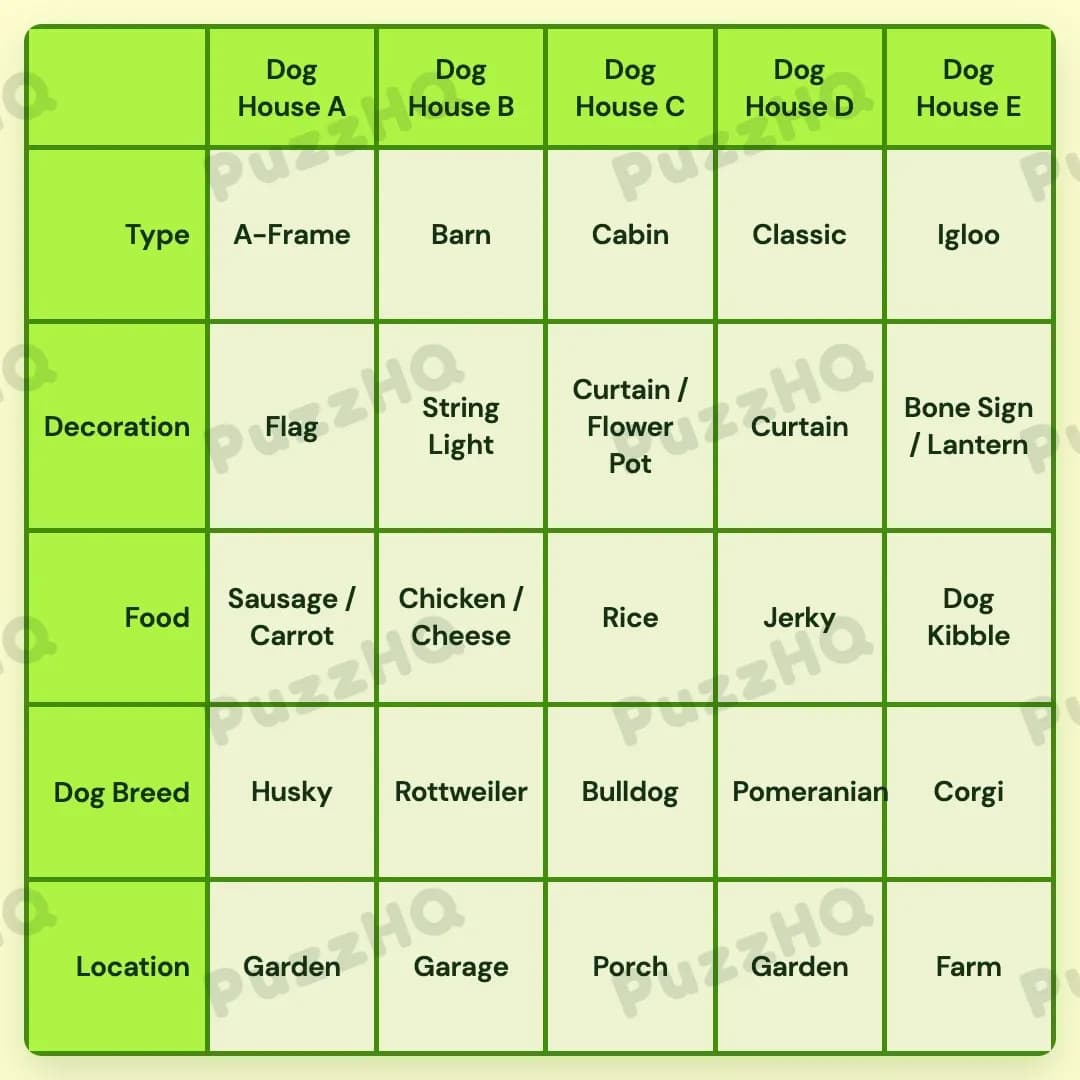
The five dogs live in an A-Frame, Barn, Cabin, Classic, and Igloo, arranged left to right from Dog House A to Dog House E.
| Trait | Dog House A | Dog House B | Dog House C | Dog House D | Dog House E |
|---|---|---|---|---|---|
| Type | A-Frame | Barn | Cabin | Classic | Igloo |
| Decoration | Flag | String Light | Curtain / Flower Pot | Curtain | Bone Sign / Lantern |
| Food | Sausage / Carrot | Chicken / Cheese | Rice | Jerky | Dog Kibble |
| Dog Breed | Husky | Rottweiler | Bulldog | Pomeranian | Corgi |
| Location | Garden | Garage | Porch | Garden | Farm |
How To Think Through Profile Perfect Level 662
The most productive solving habit for this layout is using outer edge anchors to establish positions before attempting to fit multi-trait combinations. When a puzzle provides five sequential positions, clues that describe maximum distances or outer boundaries instantly narrow the board. Once you lock down the outer slots, relative direction clues and neighbor clues fall into place without guesswork.
Start With Edge Anchors: Locking The Outer Boundaries
Positional boundary clues give you an immediate foothold because they bypass ambiguity. Look for clues that explicitly name edges or maximum separation:
- The rightmost dog helps guard the Farm.
- Corgi's house is the farthest from the Husky.
Because the houses sit in order from Dog House A on the far left to Dog House E on the far right, the rightmost position is Dog House E. You can directly place the Farm in Dog House E.
The second clue states that the Corgi and the Husky are separated by the maximum possible distance. In a five-slot row, the greatest distance exists exclusively between the two outer ends: Dog House A and Dog House E. At this stage, one end belongs to the Corgi and the other belongs to the Husky. You do not have to guess which is which, because another clue quickly breaks the symmetry.
Anchor Neighbors From Known Ends: Placing The Large Breeds
Once an anchor point is established, neighbor clues allow you to expand outward from that fixed point. Consider the clue describing the large dogs:
- The large dogs are neighbors; the wolf-like one is on the left.
The Husky is a wolf-like large dog breed, while the Rottweiler is also a large dog. Because the wolf-like dog sits to the left of its large neighbor, the Husky cannot be in Dog House E, which has no neighbor to its right. Therefore, the Husky must sit in Dog House A.
Fixing the Husky in Dog House A immediately resolves two other positions:
- The Corgi must be in Dog House E to fulfill the maximum distance clue.
- The Rottweiler must sit in Dog House B, directly to the right of the Husky.
By combining an outer boundary clue with a directional neighbor clue, three of the five dog breeds are locked into their exact columns before touching the rest of the board.
Combine Multi Trait Clues: Populating Dog House B And The Porch
Multi-trait clues act as bundled packages. Instead of searching across the entire grid for one item, look for clues that bind several categories to an established subject.
Take the clues concerning Dog House B:
- The Rottweiler's Barn house has a luminous decoration.
- Aside from the Cheese lover's house, the place also houses 5 cars.
- Dog B's food is not entirely meat.
- The Fried Chicken is to the right of the Carrot.
Because the Rottweiler is already in Dog House B, its house type is the Barn. A building that houses cars is a Garage, which assigns the Garage location to Dog House B. The food clues indicate that Dog House B contains Cheese, paired with Chicken to complete the Chicken and Cheese meal. Since the Fried Chicken is to the right of the Carrot, the Carrot belongs to Dog House A, giving Dog House A the Sausage and Carrot meal.
Next, combine the physical breed description with location and food:
- The dog with a short, compressed skull stays on the Porch.
- The Bulldog happily eats Rice after playing with the Pot.
A dog with a short, compressed skull refers to the Bulldog. The Bulldog therefore resides on the Porch, eats Rice, and has a Flower Pot decoration. Since Dog House A, B, and E already have breeds assigned, the Bulldog must occupy Dog House C or Dog House D. Placing the Bulldog in Dog House C keeps the remaining traits clean and compatible with the other requirements. This leaves the Pomeranian as the final unmatched breed in Dog House D.
Deduce Spatial Placements By Negative Constraints: Locating The Gardens
When specific locations are not assigned directly, use negative conditions to rule out illegal spots. You know that Dog House E is the Farm, Dog House B is the Garage, and Dog House C is the Porch. That leaves two unassigned slots, Dog House A and Dog House D, which must both take the Garden location.
Now apply the structural restriction:
- Both Garden houses are not next to the Classic house.
Examine where the Classic house could possibly go:
- If Dog House B were the Classic house, it would be next to Dog House A, which is a Garden house. That violates the rule.
- If Dog House C were the Classic house, it would be next to Dog House D, which is a Garden house. That also violates the rule.
- If Dog House E were the Classic house, it would be next to Dog House D, another Garden house. That also violates the rule.
The only way neither Garden house borders the Classic house is if one of the Garden houses is the Classic house itself. Placing the Classic house in Dog House D means its neighbors are Dog House C (Porch) and Dog House E (Farm), neither of which is a Garden house. Dog House A's only neighbor is Dog House B (Garage), which is also not a Garden house. This deduction confirms Dog House D is the Classic house.
With Classic at Dog House D, Barn at Dog House B, and Cabin filling Dog House C, the remaining structure for Dog House A is the A-Frame. Dog House E takes the Igloo, satisfying the clue that one of the two rightmost dogs lives in an Igloo.
Resolve Shared Decorations And Lighting Types
The remaining details involve decorations and food choices:
- The Igloo house has a Bone Sign and a luminous decoration.
- Dog House E's lighting uses fire as its light source.
- The leftmost dog house has no Curtains.
- The decoration paired with the Pot is also used elsewhere.
Dog House E is the Igloo. Because its light source uses fire, its luminous decoration is a Lantern, giving Dog House E both the Bone Sign and Lantern. Dog House B's luminous decoration is a String Light.
Dog House C already has the Flower Pot. The clue states that the decoration paired with the Pot is also used elsewhere. Dog House C therefore pairs the Flower Pot with Curtains. Because the leftmost house (Dog House A) cannot have Curtains, the second Curtain must sit in Dog House D. This leaves the Flag as the only available decoration for Dog House A.
Finally, complete the foods: Dog House E takes Dog Kibble, and the remaining item, Jerky, fills Dog House D.
What This Level Teaches You
Clues That State Maximum Distance Always Pinpoint The Extremities
Whenever a puzzle mentions that two subjects are as far apart as possible, you do not need intermediate coordinates. On any linear board, the greatest separation can only occur between slot one and the final slot. Looking for this clue early eliminates guesswork across the entire board.
Negative Adjacency Clues Target The Middle Slots First
When a rule states that two types of cells cannot touch, test the boundary slots and duplicate assignments before testing individual spaces. In this puzzle, because two houses shared the Garden location, placing the forbidden neighbor between them was impossible. Recognizing that a house can be both a Garden and the Classic house solved the layout immediately.
Final Thoughts
The key habit in this level was anchoring the outer boundaries first. By using the maximum distance between the Husky and the Corgi to pin down the edges, every subsequent neighbor clue became an exact placement rather than an open question.
Comments