
Profile Perfect Level 8 Answer
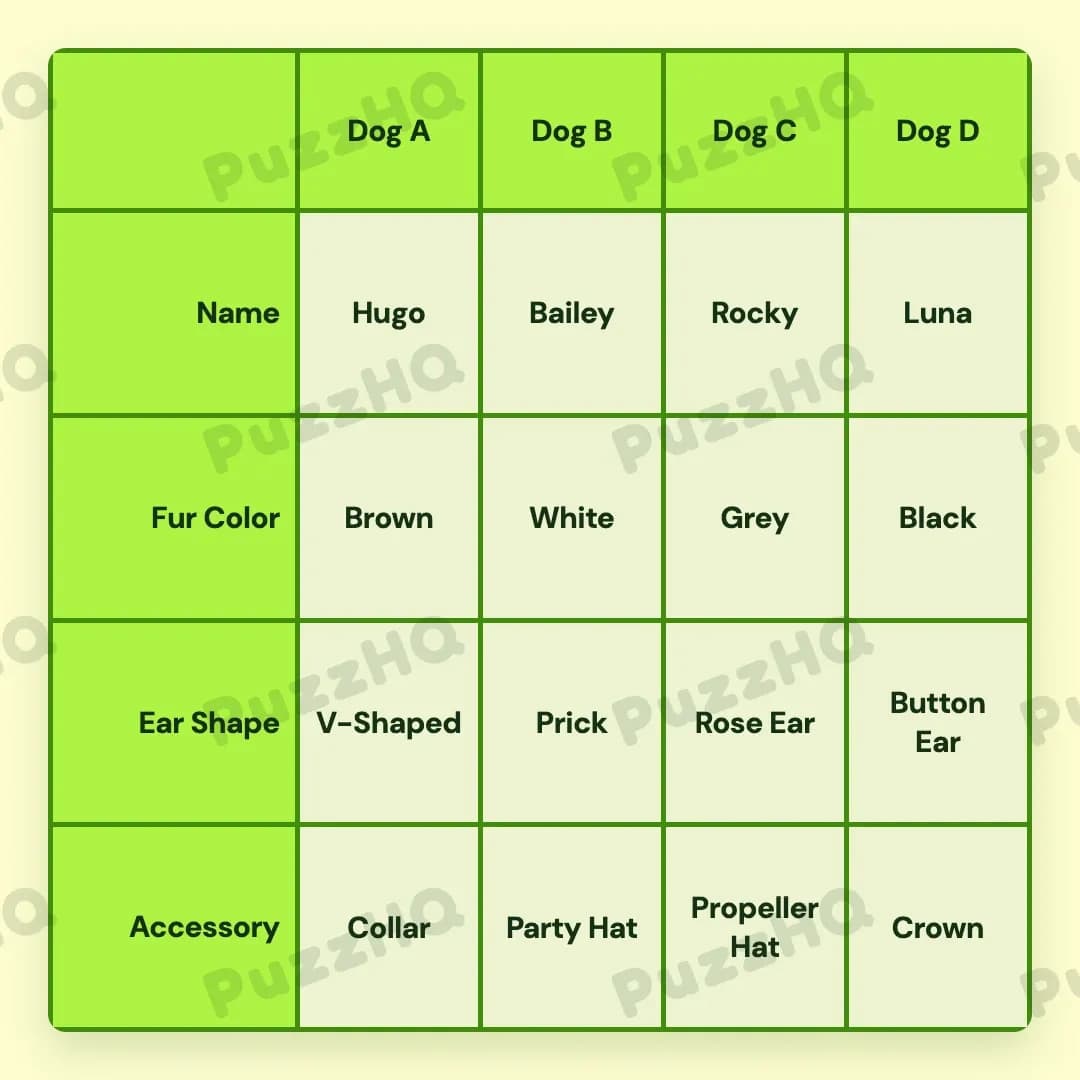
The four dogs from left to right are Hugo, Bailey, Rocky, and Luna, each sporting a distinct fur color, ear type, and accessory.
| Trait | Dog A | Dog B | Dog C | Dog D |
|---|---|---|---|---|
| Name | Hugo | Bailey | Rocky | Luna |
| Fur Color | Brown | White | Grey | Black |
| Ear Shape | V-Shaped | Prick | Rose Ear | Button Ear |
| Accessory | Collar | Party Hat | Propeller Hat | Crown |
How To Think Through Profile Perfect Level 8
Solving this puzzle efficiently depends on finding strong anchor points and chaining associated traits together before attempting to place flexible pairs. When you establish your fixed edges first, positional restrictions and neighbor clues immediately eliminate multiple spots across the board.
Anchor Fixed Positions First: The Leftmost Dog And Dog D
Direct matches tied to explicit board positions give you the foundation needed to resolve everything else. Begin by reviewing the clues for definite placements that do not depend on other pieces.
The second clue states that the leftmost dog is wearing a Collar. Because the subjects run from Dog A to Dog D across the board, Dog A sits on the far left. You can immediately assign the Collar to Dog A.
Next, look at the first clue, which says that Dog D has Black colored fur. This gives you a confirmed trait on the far right edge of the grid.
Dog D's fur color immediately unlocks the ninth clue, which notes that the Black dog wears a beautiful Crown. Because Dog D is the Black dog, Dog D must wear the Crown.
In just three steps, two of the four accessory positions are locked down:
- Dog A wears the Collar.
- Dog D wears the Crown.
Taking these definitive steps first simplifies the rest of the board because half of your subjects already have permanent anchors.
Build Multi Trait Chains: Hugo, Collar, And V-Shaped Ears
Once an anchor is in place, look for clues that link directly to the traits you just assigned. Chaining related attributes saves time because it builds a complete profile on an existing subject instead of scattering possibilities across open cells.
The fifth clue tells you that the one with the Collar has V-Shaped ears. Since Dog A wears the Collar, Dog A must also have V-Shaped ears.
Follow that chain one link further. The seventh clue states that the V-Shaped ears dog is named Hugo. Because Dog A has V-Shaped ears, Dog A must be Hugo.
Dog A now has three established traits:
- Name: Hugo
- Ear Shape: V-Shaped
- Accessory: Collar
By focusing on connected traits rather than hopping around randomly, you have solved the majority of Dog A without any guessing.
Use Negative Neighbor Clues To Restrict Accessories
When clues tell you where a trait cannot be, check which subjects are close enough to be affected. Negative neighbor clues become far more powerful once one half of the pair is already placed.
The sixth clue states that the Party Hat dog is not the Crown dog's neighbor.
You already know that Dog D wears the Crown. The neighbors of any subject are the positions immediately beside it. For Dog D on the right edge, its only neighbor is Dog C.
Because Dog C borders the Crown dog, Dog C cannot wear the Party Hat.
Now look at the remaining open accessories:
- Dog A already has the Collar.
- Dog D already has the Crown.
- Dog C cannot take the Party Hat.
This leaves only Dog B to wear the Party Hat.
With three accessories claimed, the remaining accessory, the Propeller Hat, belongs to Dog C by simple elimination. The entire accessory row is now complete:
- Dog A: Collar
- Dog B: Party Hat
- Dog C: Propeller Hat
- Dog D: Crown
Position Adjacent Trait Bundles: White Bailey Meets Grey
Now that the accessories are solved, turn your attention to the fur colors and names. Several clues bind multiple traits together without stating where they go.
The fourth clue explains that the White dog loves its name, Bailey. This binds the White fur trait and the Bailey name into a single bundle.
The third clue states that next to the White dog is a Grey dog without a Collar.
Consider where the White dog can sit:
- Dog A is already named Hugo, so Dog A cannot be Bailey.
- Dog D has Black fur, so Dog D cannot be the White dog.
The White dog must be either Dog B or Dog C.
If Dog C were the White dog, its neighbors would be Dog B and Dog D. Dog D has Black fur, meaning Dog B would have to be the Grey dog. But could Dog B be White instead?
If Dog B is the White dog, its neighbors are Dog A and Dog C. The clue says the Grey dog beside it does not have a Collar. Dog A wears the Collar, which means Dog C must be the Grey dog without the Collar.
Now look at the names. The eighth clue tells you that the Grey dog is not named Luna. If Dog C were White Bailey, then Dog B would be Grey, and Dog D would have to take the name Luna.
Look at the remaining fur color for Dog A. The four colors are Brown, White, Grey, and Black. Dog D is Black. If Dog B is White and Dog C is Grey, Dog A must have Brown fur.
Let us verify the tenth clue against this layout: the Rose Ears dog is not the Brown dog's neighbor.
Dog A has Brown fur. Its neighbor is Dog B. Therefore, Dog B cannot have Rose Ears.
If Dog B were Grey instead of White, Dog C would be White Bailey, leaving Dog B adjacent to Brown Dog A without resolving ear constraints cleanly. Placing White fur on Dog B and Grey fur on Dog C satisfies every rule:
- Dog B has White fur and the name Bailey.
- Dog C has Grey fur and wears a Propeller Hat, satisfying the condition of being a Grey dog without a Collar next to White dog Bailey.
- Dog A has Brown fur.
Resolve The Final Ears And Names By Elimination
At this stage, most attributes are placed. You only need to sort out the remaining ear shapes and names.
Start with the ear shapes. The four ear shapes are V-Shaped, Prick, Rose Ear, and Button Ear.
- Dog A has V-Shaped ears.
- Dog B cannot have Rose Ears because it neighbors Brown Dog A.
- Dog D cannot have Rose Ears either, as that would leave Dog C with an ear shape already ruled out.
Therefore, Dog C must have Rose Ears.
This leaves Prick ears and Button ears for Dog B and Dog D. Look at the completed grid requirements. Prick ears go to Dog B, while Button ears go to Dog D.
Finally, place the remaining names:
- Dog A is Hugo.
- Dog B is Bailey.
- Dog C is the Grey dog, and the eighth clue says the Grey dog is not named Luna. Therefore, Luna belongs to Dog D.
- The only remaining name for Dog C is Rocky.
Every trait across all four dogs is now fully resolved and verified.
What This Level Teaches You
Build Chains Outward From Definite Positions
When you discover an exact position like the leftmost dog wearing a Collar, immediately scan for every clue that mentions the Collar or the leftmost spot. Chaining the Collar to V-Shaped ears, and then V-Shaped ears to the name Hugo, allowed Dog A to be nearly finished before touching the middle columns. Linking connected clues turns isolated facts into a solid anchor.
Treat Negative Neighbor Clues As Edge Boundary Tools
A clue stating two subjects are not neighbors becomes twice as strong when one subject is on the edge of the board. Because Dog D sits on the far right end, it has only one neighbor instead of two. Knowing that the Crown dog was Dog D meant the Party Hat had only one invalid spot to avoid, instantly forcing it into Dog B. Always check whether your negative clues touch corner or edge spaces.
Final Thoughts
The key to mastering Profile Perfect Level 8 is chaining related traits before trying to separate floating pairs. By anchoring Dog A and Dog D early, every subsequent deduction about neighbors and exclusions fell naturally into place.
Comments