
Profile Perfect Level 12 Answer
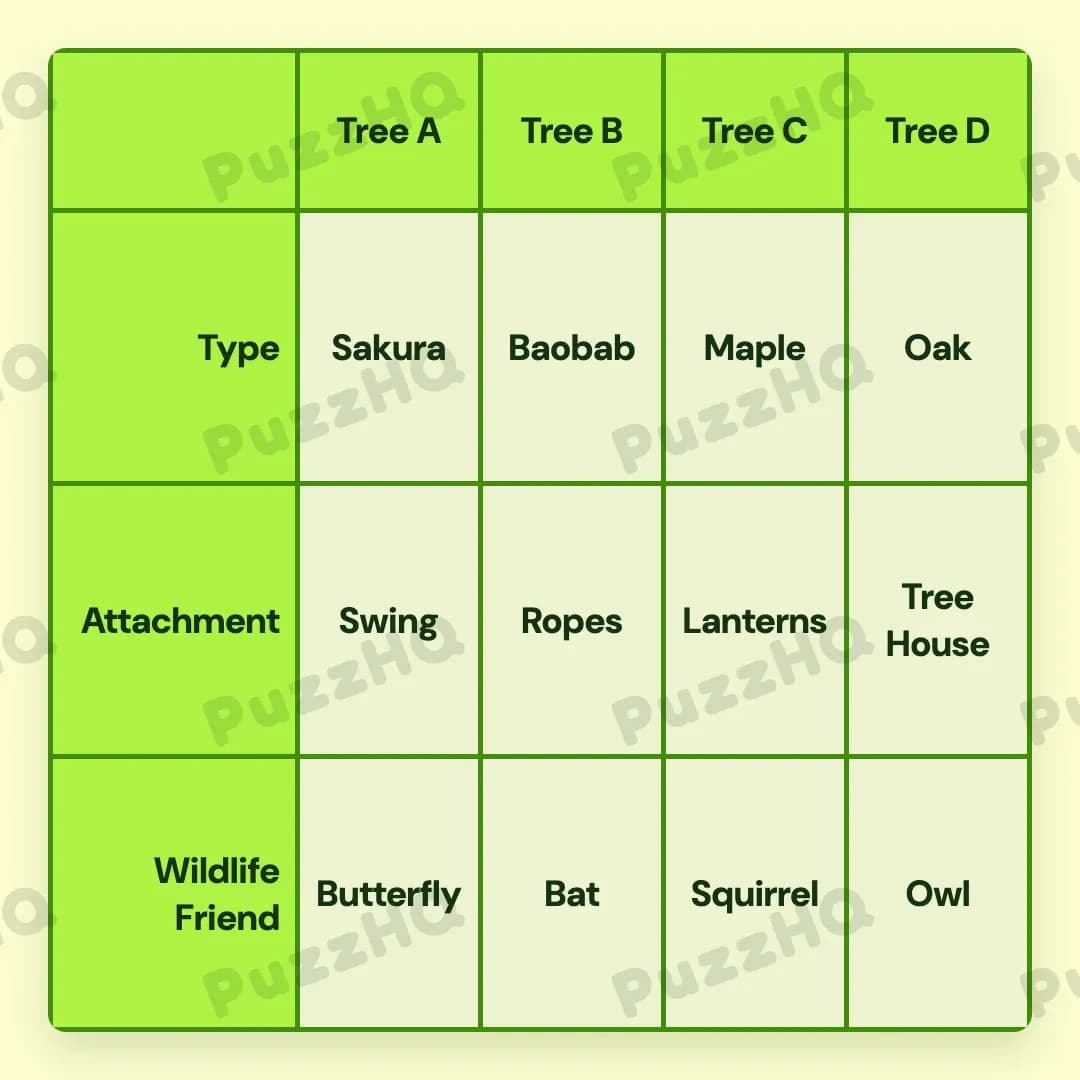
Here is the complete solution for this woodland lineup before we break down the path to getting there.
| Trait | Tree A | Tree B | Tree C | Tree D |
|---|---|---|---|---|
| Type | Sakura | Baobab | Maple | Oak |
| Attachment | Swing | Ropes | Lanterns | Tree House |
| Wildlife Friend | Butterfly | Bat | Squirrel | Owl |
The Logic Behind Profile Perfect Level 12
The structural backbone of this puzzle is a four-position horizontal line where tree varieties establish an immediate geographic framework. Because several clues reference positional relationships like left, between, and adjacent, setting the correct order of the tree species opens the board and allows the wildlife and attachments to fall cleanly into place.
Anchoring The Left And Unpacking The Lineup
Every solve needs a firm starting square, and here it arrives right at the start of the row. We are told directly that the Sakura tree stands on the leftmost position. That hands Tree A its identity immediately, leaving only three trees to account for across the rest of the grove.
Right alongside that botanical placement, we learn that butterflies frequent the Sakura tree. Without needing to look at any other column, the first slot is already two-thirds complete with a Sakura tree and a Butterfly companion.
With Tree A occupied by the Sakura, the remaining three slots from left to right are Trees B, C, and D. A key clue specifies that the Maple tree stands between the Baobab and the Oak. In a row of four where the first spot is already taken, three contiguous positions remain. To sit between two trees, the Maple must occupy the middle of that remaining three-tree stretch.
That means Tree C is definitely the Maple tree.
At this juncture, the positions of the Baobab and the Oak are narrowed down to a binary pair. One of them is Tree B and the other is Tree D, though we do not yet know which side of the Maple each one claims.
Wildlife Clues Settle The Forest Order
The breakthrough that resolves the positions of the Baobab and Oak comes from looking at the animals inhabiting the branches. We know from a straightforward clue that a Bat loves to hang around Tree B.
Another clue tells us that an old Owl lives specifically in the Oak tree. If the Oak were located at Tree B, Tree B would have to host the Owl. But Tree B is already occupied by the Bat.
Because two distinct wildlife friends cannot occupy the same tree, the Oak cannot possibly be Tree B.
This single realization resolves the entire sequence of species across the board. The Oak must sit at Tree D, leaving Tree B to be the Baobab. With the Oak placed at Tree D, the Owl takes up residence at Tree D as well.
At this point, three of the four tree types and three of the four wildlife companions are firmly locked into their columns. The only tree species unaccounted for was already placed, and the only remaining wildlife friend on the list is the Squirrel, which naturally moves into the vacant spot at Tree C under the Maple.
Placing The Attachments Without Proximity Conflicts
With all four trees and their respective animal inhabitants settled, attention turns to the attachments.
Two attachments link directly to known markers. We are told that ropes are attached to the tree where the Bat stays. Since the Bat is at Tree B, the Ropes belong on Tree B. We also learn that the Maple tree is decorated with Lanterns for the event, placing the Lanterns securely on Tree C.
Only two attachments remain to be placed: the Swing and the Tree House. The final positional clue dictates that the Tree House is not next to the Baobab tree.
Looking across the grid, the Baobab sits at Tree B. The positions immediately next to Tree B are Tree A to its left and Tree C to its right. Therefore, the Tree House cannot be placed on Tree A, nor can it be placed on Tree C, which already holds the Lanterns anyway.
The only available position on the entire board that is not adjacent to Tree B is Tree D.
Assigning the Tree House to Tree D leaves only one spot left in the attachment category. The Swing neatly completes the board by taking its place at Tree A.
The Clue I Would Read Twice
The clue stating that the Tree House is not next to the Baobab tree is the one that deserves a closer look.
In a linear logic puzzle, negative proximity clues can sometimes feel vague if you try to apply them too early in the solve. If you attempt to place the Tree House before knowing where the Baobab is located, the restriction offers several different configurations. But once the tree types are ordered, the phrase not next to operates as a sharp double elimination. Because the Baobab sits in an interior position at Tree B, it has two immediate neighbors. Disqualifying both neighbors from holding the Tree House leaves only the far end of the row open.
Final Thoughts
What makes this level neat is how the horizontal geography of the trees does all the heavy lifting early on. Rather than relying on complicated cross-referencing between all three categories at once, the puzzle lets you map the physical forest first. Once the trees are rooted in their proper order from Tree A to Tree D, every animal and decoration slides into place through straightforward deduction.
Comments