
Profile Perfect Level 13 Answer
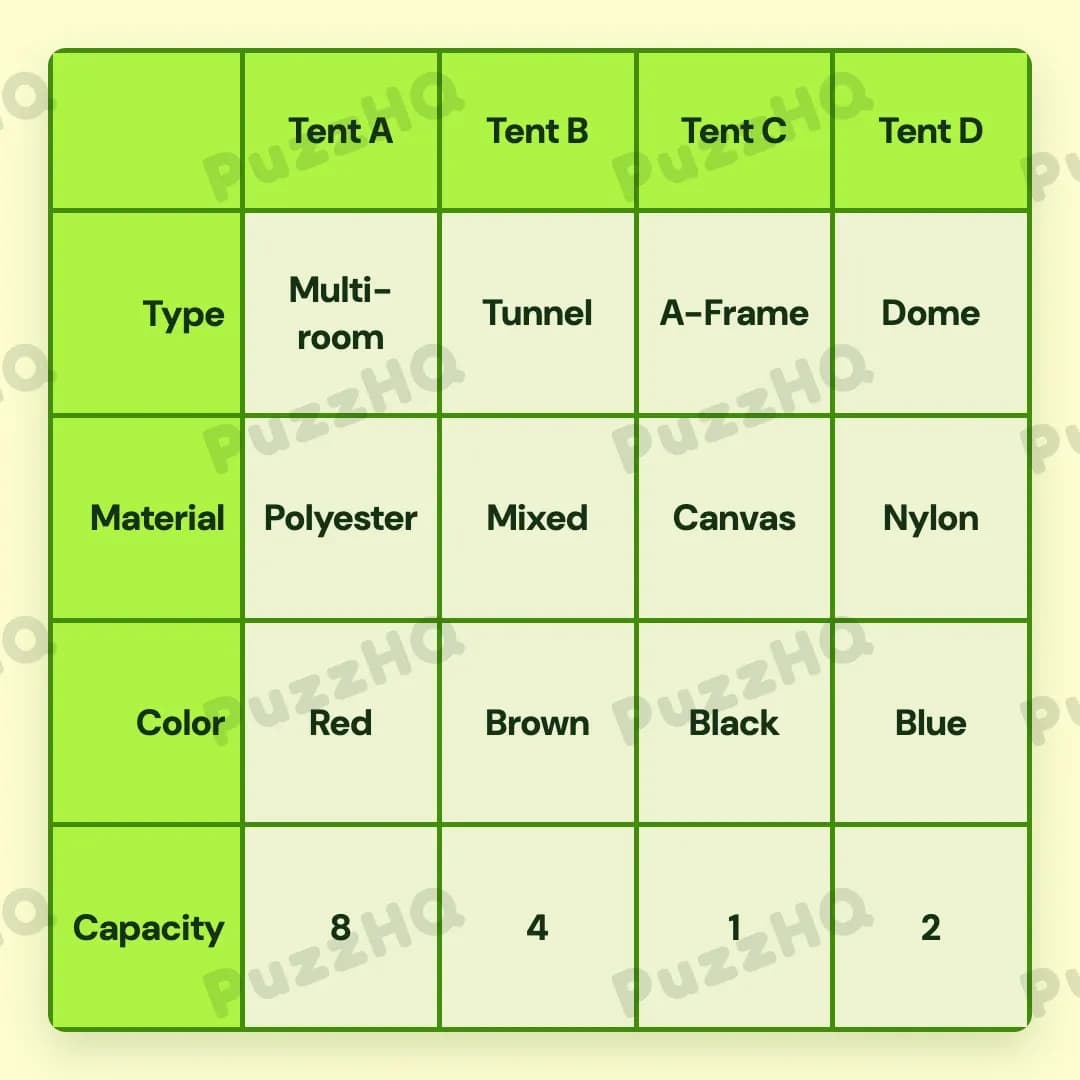
Tent A is a Red Multi-room tent made of Polyester holding 8 people, Tent B is a Brown Tunnel tent made of Mixed materials holding 4 people, Tent C is a Black A-Frame tent made of Canvas holding 1 person, and Tent D is a Blue Dome tent made of Nylon holding 2 people.
| Trait | Tent A | Tent B | Tent C | Tent D |
|---|---|---|---|---|
| Type | Multi-room | Tunnel | A-Frame | Dome |
| Material | Polyester | Mixed | Canvas | Nylon |
| Color | Red | Brown | Black | Blue |
| Capacity | 8 | 4 | 1 | 2 |
How To Think Through Profile Perfect Level 13
Solving logic puzzles efficiently requires you to categorize clues by how quickly they can be applied. In this level, the most effective approach is to combine direct trait pairings into portable bundles first, resolve the mathematical capacity chain, and then test positional spacing constraints on the grid.
Build Portable Trait Bundles Before Assigning Columns
When a clue connects two traits together without naming a specific subject column, do not ignore it. Instead, treat those traits as a single locked unit that will move together onto the grid later.
Three clues in this level form instant bundles:
- The Black tent is an A-Frame type. This ties Black and A-Frame into one unit.
- Blue tent is made from Nylon. This ties Blue and Nylon into a second unit.
- 1 person can snug into the Canvas tent. This ties a capacity of 1 to Canvas.
These pairings narrow down the open slots significantly. For example, any tent column that receives the Blue color must also be able to receive Nylon as its material.
Resolve Relative Capacities to Determine Fixed Numbers
Look at the capacity clues as an isolated math problem. The available capacity values on the grid are 8, 4, 2, and 1.
- Multi-room fits the most people, which means Multi-room must have a capacity of 8.
- Tunnel tent fits half of Multi-room's capacity, which means Tunnel must have a capacity of 4.
- Canvas has a capacity of 1 based on our earlier bundle.
- By basic numerical elimination, the remaining capacity value of 2 must belong to the Dome tent.
At this point, you have defined the exact capacity for all four tent types:
- Multi-room has 8
- Tunnel has 4
- Dome has 2
- Canvas has 1
Because Canvas has a capacity of 1, and the Black A-Frame bundle needs a capacity, we can check how they interact. The remaining type that is not Multi-room, Tunnel, or Dome is A-Frame. This proves that the Canvas tent is the A-Frame tent, which is also Black and holds 1 person.
Anchor the Fixed Subject and Place the Neighbor Pair
Now bring these bundled traits onto the subject columns.
Start with the single direct subject clue: Tent B is made from Mixed materials.
Because Tent B has Mixed materials, it cannot be the Nylon bundle (Tent D) or the Canvas bundle (Tent C). Tent B is also not the Polyester tent.
Now look at the color and positioning clues:
- Brown tent is next to the Red tent.
- Multi-room tent is not beside A-Frame.
The only adjacent columns that can hold the Red and Brown pair without violating other constraints are Tent A and Tent B. If Tent B is Brown, then Tent A must be Red.
Because Multi-room cannot be placed beside the A-Frame tent, Tent A cannot be next to Tent B if Tent B were an A-Frame. Placing Multi-room in Tent A keeps it at the far left edge. If Tent A is Multi-room, then Tent C can safely hold the A-Frame tent. Placing A-Frame in Tent C leaves Tent B as a buffer between Tent A and Tent C, satisfying the rule that Multi-room is not beside A-Frame.
Assign Types and Capacities to Match the Subjects
With Tent A established as Multi-room and Tent C established as A-Frame, the rest of the type row falls into place cleanly:
- Tent A is Multi-room, so its capacity is 8.
- Tent C is A-Frame, so its material is Canvas, its color is Black, and its capacity is 1.
- Tent B has Mixed material, so it takes the Tunnel type with a capacity of 4.
- Tent D is the only remaining slot for the Dome type, giving it a capacity of 2.
Use Remaining Bundles to Finish the Grid
All that remains is placing the final colors and materials into the remaining empty cells:
- Tent D requires the Dome type, which holds 2 people. The Blue and Nylon bundle fits naturally into Tent D.
- Tent D's color becomes Blue, and its material becomes Nylon. This also respects the rule that the Dome tent is not Black.
- Tent A is already assigned as Red, Multi-room, and capacity 8. The only unused material left for Tent A is Polyester.
- Tent B is already assigned as Brown, Mixed, Tunnel, and capacity 4.
Every trait row is now completely and logically filled.
What This Level Teaches You
Mathematical Dependencies Unlock Entire Trait Categories
When multiple clues describe ratios or rankings, such as maximum size or half capacity, solve those numerical relationships together before trying to place them in columns. Establishing that Multi-room is 8 and Tunnel is 4 immediately narrowed the identities of every tent type.
Separation Clues Narrow Down Column Placement
Negative adjacency clues, such as Multi-room not being beside A-Frame, are powerful positional filters. When two subjects cannot touch, at least one other subject must sit between them. Using Tent B as a physical barrier between Tent A and Tent C instantly resolved the layout.
Final Thoughts
Success on this level relies on bundling related traits together before worrying about which column they belong to. Once you link colors, materials, and capacities into solid units, the positional and adjacency clues quickly lock each tent into its correct place.
Comments