
Profile Perfect Level 103 Answer
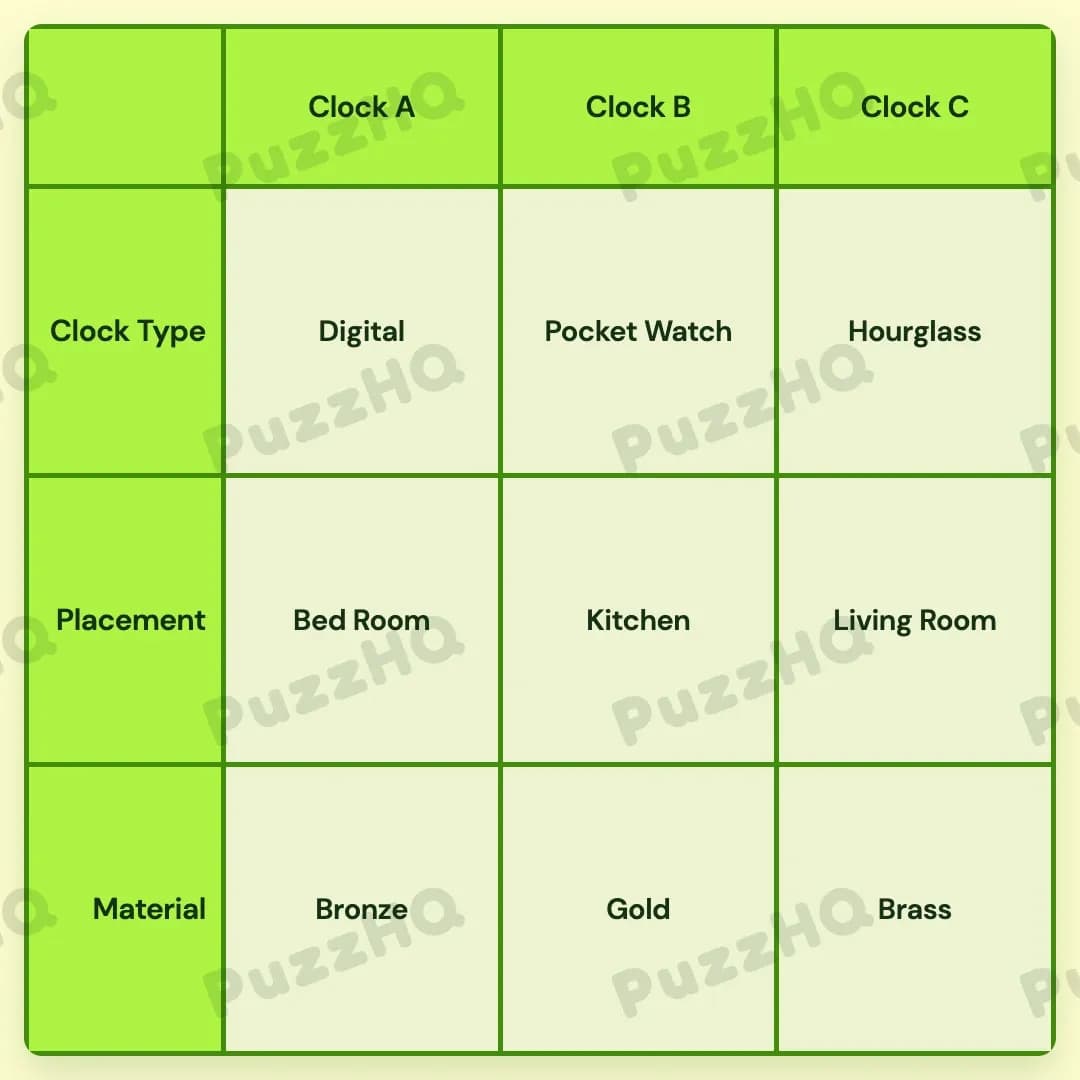
Every clock is uniquely identified by deducing room placements, precision types, and manufacturing metals across the trio.
| Trait | Clock A | Clock B | Clock C |
|---|---|---|---|
| Clock Type | Digital | Pocket Watch | Hourglass |
| Placement | Bed Room | Kitchen | Living Room |
| Material | Bronze | Gold | Brass |
Building The Grid By Trait
Starting with Placement gives the clearest foothold because everyday room functions directly isolate Clock A, establishing a layout sequence that quickly locks down the other subjects. From there, comparing clock precision organizes Clock Type, which in turn unlocks the Material row through specific material restrictions.
Placement Defines The Physical Layout
The room placements provide immediate spatial clarity across the columns. We learn that Clock A is located in the specific room where people go to rest. Resting describes sleep and relaxation, pointing directly to the Bed Room. With Clock A assigned to the Bed Room, only two placement options remain for Clock B and Clock C: Kitchen and Living Room.
The puzzle notes that the Kitchen is not located to the right of the Living Room. Looking at the horizontal order of our items, Clock B sits to the left of Clock C. If Clock B were in the Living Room and Clock C were in the Kitchen, the Kitchen would be positioned to the right of the Living Room, which violates the condition. Therefore, Clock B must be in the Kitchen, and Clock C must be in the Living Room. This completely resolves the Placement category across all three clocks without needing any clock types or materials beforehand.
Clock Type Organizes Timekeeping Precision
Once the subjects have established room locations, we turn to the Clock Type trait. The options available across the puzzle are Digital, Pocket Watch, and Hourglass.
A critical comparison tells us that Clock A is strictly more precise than Clock C. Comparing the inherent precision of an ancient sand timer, a mechanical pocket watch, and a modern digital clock makes the ranking clear. An hourglass is the least precise instrument here, measuring rough spans of time rather than exact moments, whereas a digital clock represents high electronic precision. Placing the modern Digital clock at Clock A and the traditional Hourglass at Clock C satisfies this relationship cleanly.
With Digital assigned to Clock A and Hourglass assigned to Clock C, the remaining clock type is Pocket Watch. By process of elimination, Clock B receives Pocket Watch. All three subjects now have definitive clock types attached to them.
Material Resolves Through Systematic Exclusions
With Clock Type firmly established across Clock A, Clock B, and Clock C, the final trait row of Material can be filled by applying two negative constraints. The possible metals are Gold, Bronze, and Brass.
First, we are told that neither the Hourglass nor the Digital clock is made of Gold. Because Clock A is the Digital clock and Clock C is the Hourglass, neither Clock A nor Clock C can be Gold. This leaves only Clock B, the Pocket Watch in the Kitchen, to take the Gold material.
Next, another restriction states that the Hourglass clock is not made of Bronze. Clock C is our Hourglass, so Clock C cannot be Bronze. We also know Clock B is already assigned to Gold. This leaves Clock A as the only valid candidate for Bronze.
Finally, with Gold assigned to Clock B and Bronze assigned to Clock A, the only unassigned material is Brass. Clock C, the Hourglass in the Living Room, takes Brass to complete the entire board.
Where The Trait Rows Intersect
Solving logic puzzles becomes much simpler when observing how clues bridge two separate categories. Rather than treating each trait as an isolated list, cross category interactions reveal why certain items fall into place so quickly.
Connecting Clock Type To Material Exclusions
The clue excluding Gold from both the Hourglass and the Digital clock demonstrates the strong dependency between Clock Type and Material. Rather than mentioning Clock A or Clock B by name, the clue references the functional design of the clocks. Once the Clock Type row was filled, this clue instantly eliminated Gold from two out of the three columns. It transformed what looked like a three way material choice into an instant placement for Clock B, demonstrating how one solved row accelerates the next.
Pairing Precision Clues With Physical Rooms
The precision clue operates across the subject spectrum while aligning smoothly with room environments. Clock A, resting in the Bed Room, represents modern digital accuracy, while Clock C, located in the Living Room, holds the classic Hourglass. The directional condition on the rooms ensured Clock B and Clock C were placed correctly in the sequence, allowing the precision comparison between Clock A and Clock C to sit on a stable structural foundation.
Final Grid Check
Reviewing the solved board confirms that every clue is satisfied without contradiction. Clock A in the Bed Room is a Digital clock of Bronze, outmatching the precision of Clock C, which is a Brass Hourglass in the Living Room. Clock B sits in the Kitchen as a Gold Pocket Watch, ensuring the Kitchen is not to the right of the Living Room. Gold is completely avoided by both the Digital clock and the Hourglass, and the Hourglass avoids Bronze. Every trait row meshes into a cohesive, fully validated solution.
Comments