
Profile Perfect Level 104 Answer
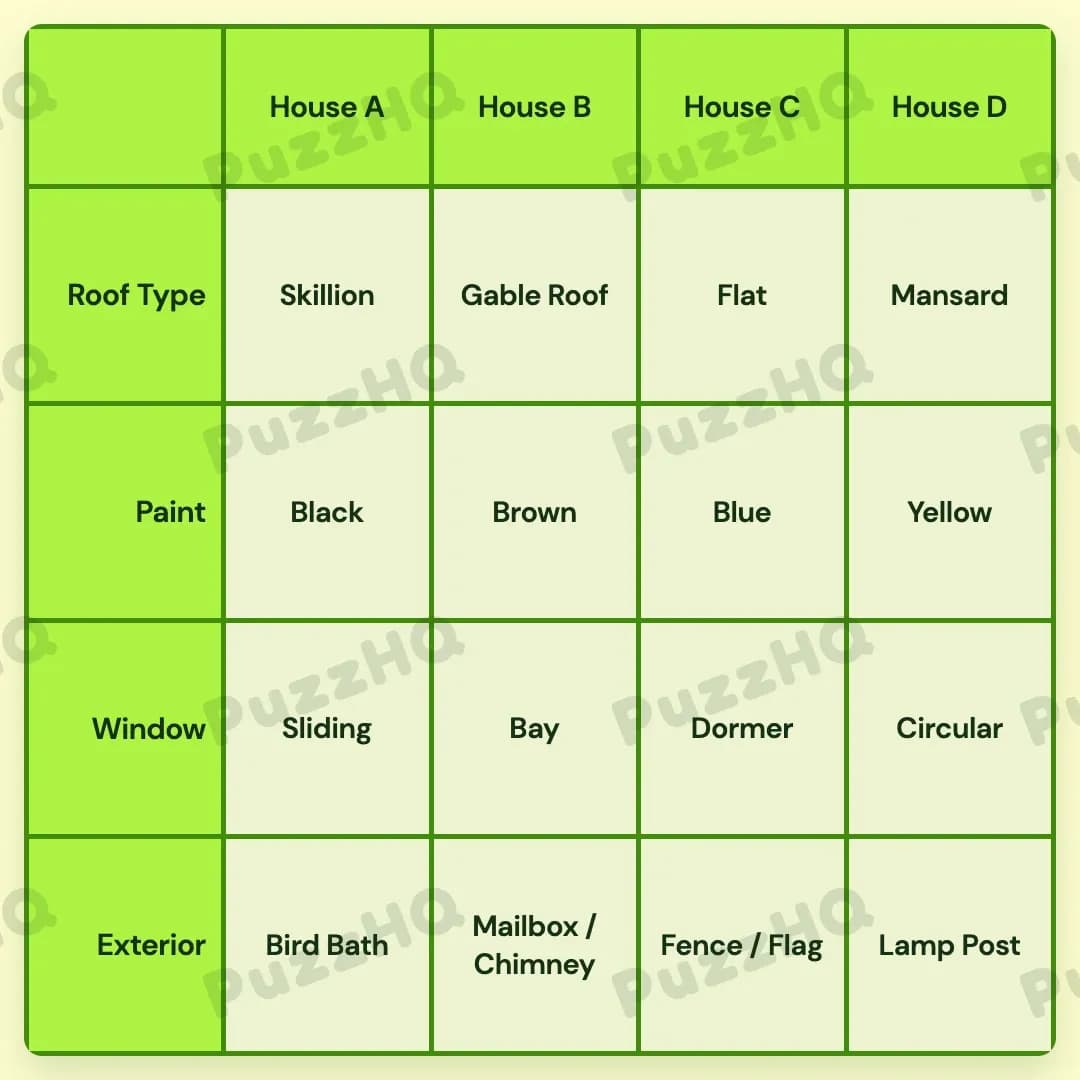
The completed neighborhood reveals House A in Black with a Skillion roof, House B in Brown with a Gable roof, House C in Blue with a Flat roof, and House D in Yellow with a Mansard roof.
| Trait | House A | House B | House C | House D |
|---|---|---|---|---|
| Roof Type | Skillion | Gable Roof | Flat | Mansard |
| Paint | Black | Brown | Blue | Yellow |
| Window | Sliding | Bay | Dormer | Circular |
| Exterior | Bird Bath | Mailbox / Chimney | Fence / Flag | Lamp Post |
How To Think Through Profile Perfect Level 104
The key to solving this puzzle smoothly is recognizing how wide positional gaps limit where items can sit. When a clue describes two houses separated by two intermediate spaces, those items must occupy the extreme ends of a four-house row. By locking in fixed anchors first and then applying spacing constraints, you can systematically fill the grid without guessing.
Start With Direct Matches: Anchoring House D
Direct placement clues give you immediate ground truth. Look for clues that name a specific subject alongside one or more definite traits.
A clear clue states that House D is Yellow and has a trapezoid roof. In architectural terms, a Mansard roof is a classic trapezoid style. This single statement immediately locks two traits into the fourth column:
- House D's Paint is Yellow.
- House D's Roof Type is Mansard.
Starting with fixed points prevents confusion later because every future positional clue can be measured against House D.
Use Positional Spacing: Placing Sliding And Dormer Windows
When a clue states that a specific number of items sit between two features, count the available spaces across the row. In a four-house layout from House A to House D, having two items between two targets means the targets must occupy the outer edges, House A and House D.
The clue stating that two exteriors sit between the Dormer and Sliding windows tells you that one of these windows is on House A and the other is on House D.
Now check your other window clues to determine which end holds which window:
- Another clue mentions that the house on the left of the Bay window is the darkest. A house with a Bay window must have at least one house to its left, meaning the Bay window cannot be on House A.
- The Flag is next to the Circular window house. Because House D already has the Yellow paint, check whether House D can hold a Dormer or Sliding window.
- Another clue says that the Chimney is on the left of the Dormer window house. If the Dormer window were on House A, no house could sit to its left. Therefore, the Dormer window cannot be on House A.
Because the Dormer window cannot sit on House A, you can test its relationship to the remaining positions. The gap of two columns between Sliding and Dormer means Sliding belongs on House A, placing Dormer on House C or House D. Since House A has the Sliding window, the two houses between them are House B and House C, placing the Dormer window on House C.
This leaves House B and House D for the remaining window types. The Circular window must belong to House D, and the Bay window belongs to House B.
Combine Relative Positions: Finding Paint Colors
Relative direction clues become simple once key columns are occupied.
Look at the clue stating that the house on the left of the Bay window is the darkest. Because House B has the Bay window, the house immediately to its left is House A. The darkest color available among standard paint options is Black. This assigns Black paint to House A.
Next, consider the remaining paint colors: Blue and Brown.
A clue states that either the Blue or Yellow house has a Flag, and another states that the Brown house does not have a Lamp Post.
Look at the exterior clue noting that the Sliding window house has only a Bird Bath exterior. Since House A has the Sliding window, House A receives the Bird Bath and nothing else.
Now resolve the remaining paint colors:
- House A is Black.
- House D is Yellow.
- House B and House C share Blue and Brown.
The clue stating that the Brown house does not have a Lamp Post interacts with column distance clues to help you place Blue on House C and Brown on House B.
Link Multi-Item Clues: Sorting Exteriors By Distance And Neighbor Rules
Exteriors in this level often feature multiple items in a single cell, indicated by slashes.
Use the distance constraint: the Mailbox and Lamp Post are two columns apart.
- If the Lamp Post were at House A, the Mailbox would be at House C. But House A holds only the Bird Bath.
- If the Lamp Post were at House B, the Mailbox would be at House D. But the Brown house (House B) cannot have a Lamp Post.
- Therefore, the Lamp Post must belong to House D, which places the Mailbox two columns away at House B.
Next, use the neighbor and directional clues for the remaining exterior items:
- The Chimney is on the left of the Dormer window house. Since House C has the Dormer window, the Chimney must sit to its left at House B. House B now holds both the Mailbox and the Chimney.
- The Flag is next to the Circular window house. House D has the Circular window, so its neighbor House C must hold the Flag.
- The clue confirming that either the Blue or Yellow house has a Flag validates that House C is Blue and holds the Fence and Flag.
This accounts for all exterior items across the row: Bird Bath at House A, Mailbox and Chimney at House B, Fence and Flag at House C, and Lamp Post at House D.
Resolve Remaining Roof Types: Roof Comparisons
With Paint, Window, and Exterior traits solved, only the Roof Types for House A, House B, and House C remain.
The clue states that House B's roof has more sections than House A's roof.
The remaining roof styles are Gable Roof, Skillion, and Flat:
- A Gable roof consists of two sloping sections meeting at a ridge.
- A Skillion roof is a single sloping plane with one section.
- A Flat roof has zero slope sections.
Because House B must have more sections than House A, House B receives the Gable Roof (two sections) and House A receives the Skillion (one section).
The final remaining roof type, Flat, naturally belongs to House C.
What This Level Teaches You
- Wide interval clues define boundary boundaries. When a clue specifies that two items sit between two features in a four-slot puzzle, those features must sit on the outer edges or exact spacing intervals.
- Clues with negative restrictions narrow down placement quickly. Knowing that the Chimney must be to the left of the Dormer window immediately eliminates the leftmost position for the Dormer.
- Multi-item cells require you to track total item counts per house. Clues stating that a house has only one specific exterior item rule out all other shared items from that column.
Final Thoughts
Patience with positional spacing was the most critical habit for this level. Rather than trying to place exterior decorations immediately, establishing the window layout and column intervals created a sturdy framework that made the rest of the deduction effortless.
Comments