
Profile Perfect Level 186 Answer
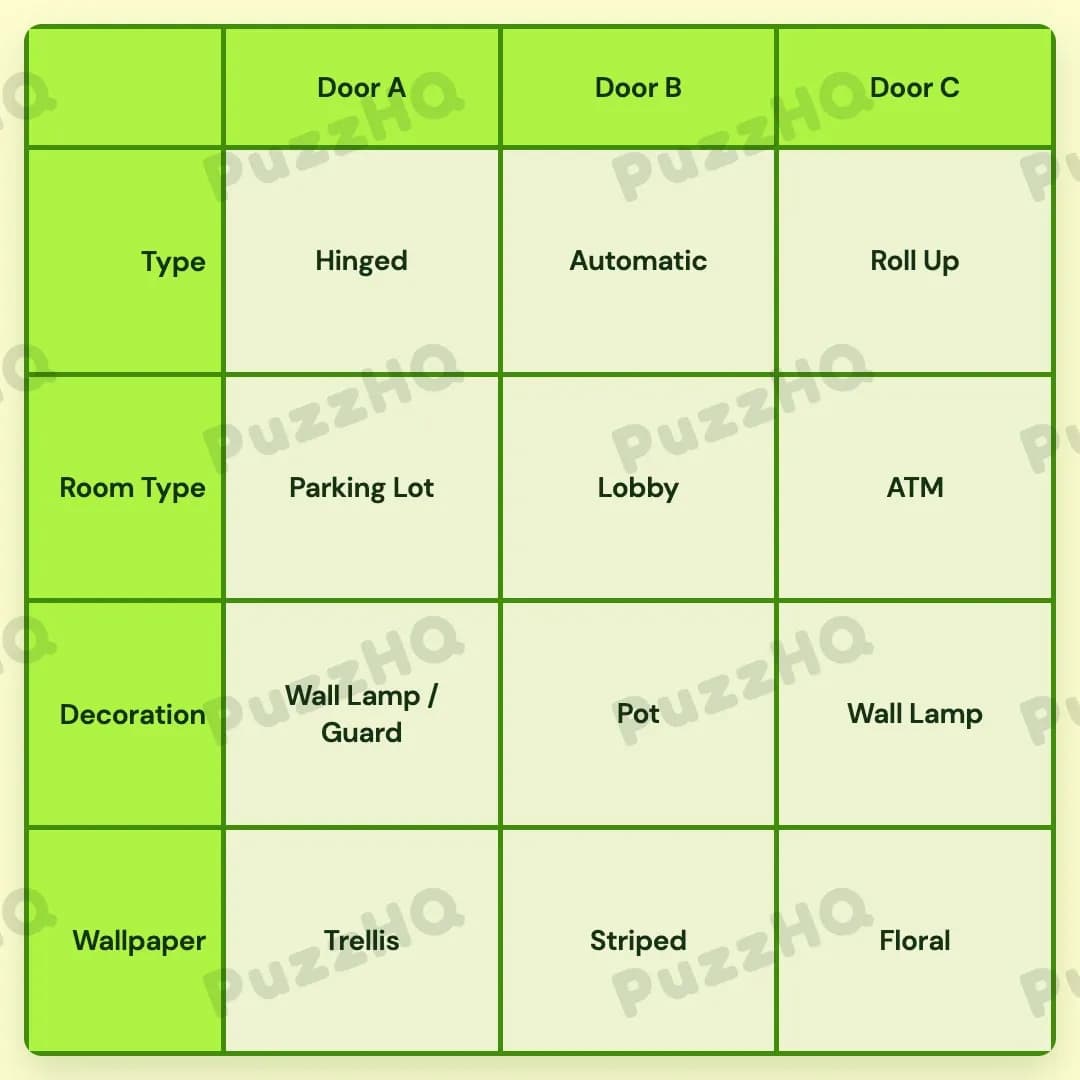
Here is the complete solution for the three entryways and their accompanying features.
| Trait | Door A | Door B | Door C |
|---|---|---|---|
| Type | Hinged | Automatic | Roll Up |
| Room Type | Parking Lot | Lobby | ATM |
| Decoration | Wall Lamp / Guard | Pot | Wall Lamp |
| Wallpaper | Trellis | Striped | Floral |
The Logic Behind Profile Perfect Level 186
The entire structure of this puzzle hinges on how people move through physical thresholds. Rather than overwhelming you with dozens of cross-referenced traits right away, the puzzle uses door mechanisms to pin down room identities before asking you to worry about interior decor. Once you establish what kind of barrier separates each space from the outside world, the rest of the venue falls neatly into place.
The Mechanics Reveal the Map
Your entry point into the solve is the kinetic behavior of Door B. When a clue mentions that Door B opens on its own as customers approach, it firmly establishes that Door B is an Automatic door. That single detail provides a solid structural anchor on the board.
From there, you can turn your attention to the ATM. We know from the rules that the ATM cannot sit behind a Hinged door or an Automatic door. Because there are only three door types available in the puzzle, ruling out both Hinged and Automatic leaves only one viable option: the ATM must be positioned behind a Roll Up door.
This creates an immediate downstream effect. Because Door B is Automatic, the ATM cannot possibly be located at Door B. The ATM belongs behind the Roll Up door, which leaves Door B open for one of the other destinations.
Sorting the Rooms Across the Entrances
With the door mechanisms actively narrowing the options, the next task is placing the destinations. We learn that people coming from the Parking Lot do not use an Automatic door. Since Door B is Automatic, the Parking Lot cannot belong to Door B.
At this stage, consider the state of the three doors. Door B is Automatic. The ATM requires the Roll Up door. That means the Parking Lot cannot be Door B, nor can it share space with the ATM. The only place left for the Parking Lot is the remaining slot, Door A, which takes the Hinged door.
That single deduction resolves the entire layout of the rooms. Door A is the Parking Lot with a Hinged door. Door C takes the ATM alongside the Roll Up door. Door B, operating its Automatic entrance, naturally becomes the Lobby.
Finishing the Surfaces and Security
Once the rooms and their door types are locked down, the decorative traits quickly fall in line around them. The clues supply direct visual links for several spaces. The ATM is explicitly noted as sitting behind Floral wallpaper, which ties Floral wallpaper directly to Door C.
Security and lighting handle the remaining gaps. We are told that a Guard is watching the Parking Lot, placing the Guard at Door A. At the same time, we know that no lamps can be found at the Lobby. Since Wall Lamps appear across the other locations, Door B cannot have any lighting fixtures of that kind, receiving the Pot instead. That leaves the Wall Lamps to be placed at Door A alongside the Guard, as well as at Door C.
With Floral wallpaper claimed by Door C, the remaining patterns settle cleanly. Door A takes the Trellis wallpaper, and Door B receives the Striped pattern. Every room receives its complete set of traits without any ambiguity.
The Clue I Would Read Twice
The clue that quietly does the heavy lifting is the note that the ATM is not placed behind a Hinged nor Automatic door.
On a casual read, negative clues feel like minor speed bumps that simply delay a positive match. Here, however, that double elimination does something decisive. Because the puzzle only contains three door types, ruling out two of them instantly defines the ATM as a Roll Up door before you even know whether it belongs to Door A, Door B, or Door C.
Pairing that elimination with the description of Door B opening automatically creates a fast chain reaction. It stops you from wasting time guessing where the ATM might go and immediately forces the entire room layout into clarity.
Final Thoughts
What makes this level memorable is how practical the deductions feel. Nothing here relies on abstract number crunching or arbitrary trait pairing. A motion-sensing door naturally suits a main lobby, a security guard keeps watch over the parking lot, and a roll-up shutter protects an ATM. When a logic puzzle grounds its rules in believable architectural details, reaching the final grid feels less like filling boxes and more like surveying a real building.
Comments