
Profile Perfect Level 194 Answer
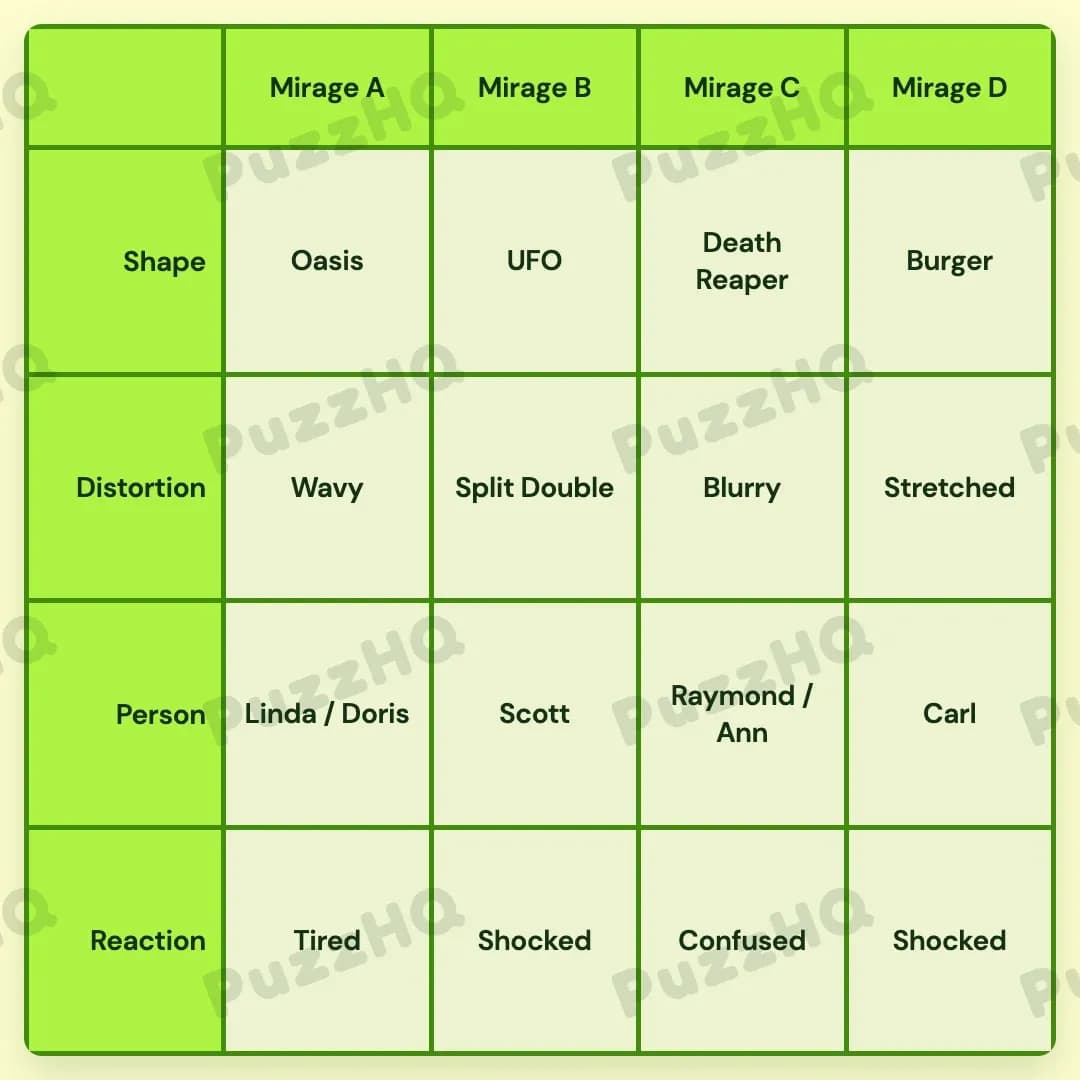
To solve the puzzle, place each mirage, person, reaction, and distortion into their exact spots across all four columns.
| Trait | Mirage A | Mirage B | Mirage C | Mirage D |
|---|---|---|---|---|
| Shape | Oasis | UFO | Death Reaper | Burger |
| Distortion | Wavy | Split Double | Blurry | Stretched |
| Person | Linda / Doris | Scott | Raymond / Ann | Carl |
| Reaction | Tired | Shocked | Confused | Shocked |
How To Think Through Profile Perfect Level 194
Solving logic puzzles efficiently requires you to identify rigid positional constraints first before tackling more flexible descriptive clues. When you anchor items that have only one possible spot on the board, the remaining clues become much easier to test and place without guessing.
Use Extreme Column Distances: Anchor The Outer Edges
A four-column layout provides a very strong structural constraint whenever a clue mentions maximum distance. When a clue specifies that two items are three columns apart, those two items must occupy the outer edges at Mirage A and Mirage D.
In this level, one clue states that the Stretched mirage is three columns away from the Wavy mirage. This immediately establishes that one of these distortions belongs in Mirage A and the other belongs in Mirage D. You do not need to guess which is which yet. Simply marking both outer ends as the only possible locations for Wavy and Stretched removes those two distortions from consideration for the middle columns, Mirage B and Mirage C.
Analyze Neighbor Counts: Locate Center Positions And Edges
Linear board layouts give interior positions two adjacent neighbors, while edge positions only have one adjacent neighbor. You can use clues that count neighbors to isolate which subject sits in the middle versus the outer edges.
Look at the clues concerning the people in the scene:
- Ann has more neighbors than Doris.
- Scott has three female neighbors.
Because interior slots have two neighboring columns while edge slots only have one, Ann must be positioned in one of the interior columns (Mirage B or Mirage C), while Doris must be at an outer edge (Mirage A or Mirage D).
Next, look at the composition of the groups. Linda and Doris are a pair of women, while Ann is paired with Raymond. If Scott is placed at Mirage B, his immediate neighbors are the occupants of Mirage A and Mirage C. With Linda and Doris at Mirage A (two females) and Raymond and Ann at Mirage C (one female), Scott has exactly three female neighbors. This locks Scott directly into Mirage B, places Linda and Doris at Mirage A, and places Raymond and Ann at Mirage C. By elimination, Carl must occupy the remaining spot at Mirage D.
Connect Positional Clues To Your Established Anchors
Once you lock subjects into specific columns, relative distance clues become direct placements.
Now that Carl is confirmed at Mirage D, look at the clue stating that the alien mirage is two columns away from Carl. Counting two columns to the left from Mirage D lands directly on Mirage B. Therefore, the alien mirage (the UFO shape) belongs to Mirage B.
Next, consider the clue stating that Scott is next to the Blurry mirage. Scott sits at Mirage B, meaning the Blurry distortion must be in either Mirage A or Mirage C. Because the outer slots are already reserved for Wavy and Stretched, Blurry cannot go to Mirage A. Blurry must therefore belong to Mirage C.
This leaves only one distortion unassigned among the inner columns. With Blurry at Mirage C, the Split Double distortion must belong to Scott at Mirage B.
Separate The Outer Pair Using Descriptive Clues
Earlier, the extreme distance clue showed that Wavy and Stretched occupy Mirage A and Mirage D. Now you can resolve which goes where by checking the clue about Raymond's neighbor.
The clue states that the mirage next to Raymond seems not proportional. Raymond sits at Mirage C, so his neighbors are Mirage B and Mirage D. Mirage B is already established as Split Double. Therefore, the disproportionate mirage next to Raymond must be the Stretched mirage at Mirage D. This automatically resolves the outer pair, placing the Wavy distortion at Mirage A and the Stretched distortion at Mirage D.
Match Shapes And Reactions Through Thematic Clues
With all positions and distortions fully locked down, you can complete the remaining shapes and emotional reactions.
Consider the needs of the travelers: Linda is parched, and Carl is famished. A parched traveler at Mirage A seeks water, giving Mirage A the Oasis shape. A famished traveler at Mirage D seeks food, giving Mirage D the Burger shape.
The only remaining shape trait is Death Reaper, which must fill the vacant shape slot at Mirage C.
Finally, place the emotional reactions:
- The Confused couple is not next to the Oasis mirage. The couple at Mirage C (Raymond and Ann) is not adjacent to the Oasis at Mirage A, so Raymond and Ann receive the Confused reaction.
- The clue notes that someone is Shocked after seeing creatures with three eyes, linking an alarming sight to the Shocked reaction. Both the UFO at Mirage B and the Burger at Mirage D leave their observers Shocked.
- By elimination, the exhausted traveler Linda at Mirage A receives the Tired reaction.
Every trait across all four columns is now completely verified.
What This Level Teaches You
Maximize Distance Clues Immediately
When a puzzle has four slots, any clue requiring a distance of three columns can only apply to the first and last slots. Recognizing this pattern right away lets you partition the puzzle into outer edge traits and inner traits, narrowing down possibilities before you read descriptive clues.
Count Group Composition When Evaluating Neighbor Clues
When a clue mentions a specific number of neighbors, check whether cells contain multiple individuals. Scott having three female neighbors is only possible because one of his neighboring cells holds two women (Linda and Doris) and the other holds one woman (Ann). Always account for combined cells when calculating neighbor totals.
Resolve Directional Ambiguity Through Elimination
When a trait could theoretically sit to the left or to the right of an anchor, check which neighbor slots have already been claimed by other constraints. Scott being next to the Blurry mirage could have meant Mirage A or Mirage C, but knowing Mirage A was already reserved for an edge distortion made Mirage C the only valid choice.
Final Thoughts
The most effective habit for Level 194 is using structural constraints like maximum distances and neighbor counts to build a solid framework before interpreting thematic clues. Once the people and distortions are anchored to specific columns, the rest of the puzzle solves smoothly through straightforward elimination.
Comments