
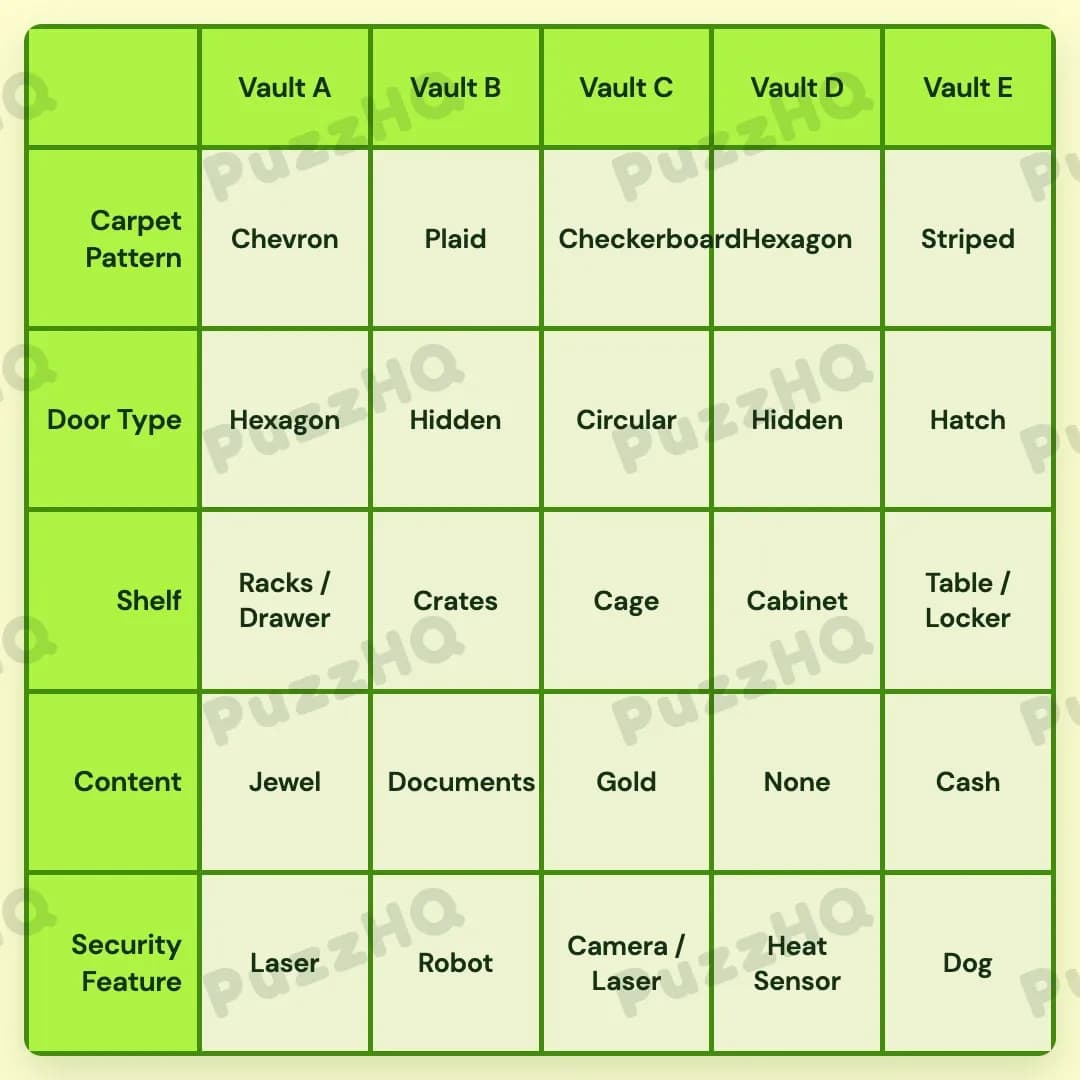
Profile Perfect Level 188 Answer
Vault C holds the Gold and Camera, while Vault B stores the Documents behind a Hidden door.
| Trait | Vault A | Vault B | Vault C | Vault D | Vault E |
|---|---|---|---|---|---|
| Carpet Pattern | Chevron | Plaid | Checkerboard | Hexagon | Striped |
| Door Type | Hexagon | Hidden | Circular | Hidden | Hatch |
| Shelf | Racks / Drawer | Crates | Cage | Cabinet | Table / Locker |
| Content | Jewel | Documents | Gold | None | Cash |
| Security Feature | Laser | Robot | Camera / Laser | Heat Sensor | Dog |
How To Think Through Profile Perfect Level 188
Solving this puzzle efficiently depends on finding a strong anchor subject and using relative positional clues to lock in the rest of the layout. When a puzzle gives you a specific named column, use that fixed point immediately to resolve adjacent traits before attempting more distant deductions.
Start With Direct Anchors: Vault C Identifies The Camera
Direct identity clues are always the best starting point because they eliminate guesswork across multiple columns. Clue 3 states that only Vault C records all activities inside. A device that records activities is a Camera.
Placing the Camera in Vault C immediately activates Clue 4, which states that the Plaid carpet vault is to the left of the Camera. Because Vault C is in the third column, the vault directly to its left must be Vault B. You can now lock Plaid carpet into Vault B without needing to know any other carpet locations yet.
Use Multi-Trait Neighbor Clues: Placing Gold And Lasers
Once an anchor point is established, look for clues that connect several traits to that known location. Clue 5 tells you that the Plaid carpet vault's neighbor stores Gold and is guarded by Laser.
Vault B has two neighbors: Vault A and Vault C. Clue 3 already established that Vault C records activity, but security features can combine in dual-trait vaults or share duties. Vault C stores the Gold and holds the Laser alongside its Camera. Vault A also receives a Laser security feature. Placing Gold in Vault C directly fulfills the requirement that a neighbor of Vault B stores Gold under Laser protection.
Read Positional Spacing Clues: Aligning Doors And Carpets
Relative distance clues help map out entire rows across the grid. Clue 15 says the Circular door is 2 columns away from the Striped carpet.
Looking at the layout, if the Circular door is placed in Vault C, moving two columns to the right places the Striped carpet in Vault E. This spacing leaves Vault A, Vault C, and Vault D to complete the carpet pattern. Clue 16 specifies that the Chevron carpet vault stores its contents in a Rack. Clue 14 states that the Cabinet is between the Checkerboard carpet and Cash.
Because the Cabinet must sit between two other traits, it must occupy an interior column. Placing the Checkerboard carpet in Vault C and the Cabinet in Vault D allows Cash to land naturally in Vault E. This also leaves Hexagon carpet for Vault D and Chevron carpet for Vault A, perfectly matching Clue 17, which notes that the Hexagon carpet is to the left of the Table.
Evaluate Structural Layouts: Shelf Neighbors And Hidden Doors
Some clues describe topological positions rather than specific names. Clue 9 notes that both Crates and Cabinet have the most shelf neighbors. In a five-column layout, the outer columns (Vault A and Vault E) have only one neighbor each, while the inner columns (Vault B, Vault C, and Vault D) have two neighbors. Therefore, Crates and Cabinet must belong to the inner columns. With Cabinet already assigned to Vault D, Crates must go to Vault B.
Next, Clue 8 states that both Table and Drawer are neighbors of a Hidden door. Placing Hidden doors on Vault B and Vault D satisfies this rule cleanly:
- The Drawer in Vault A sits next to the Hidden door in Vault B.
- The Table in Vault E sits next to the Hidden door in Vault D.
Clue 1 confirms that one of the Hidden door vaults stores Documents, which fits Vault B. Clue 7 mentions that a bankrupt bank has a Heat Sensor left in the vault, which assigns the Heat Sensor and an empty Content slot (None) to Vault D.
Separate The Remaining Values: Security And Contents
With the majority of the grid filled, use negative conditions and simple elimination to place the final traits:
- Clue 6 states there are 2 security features between the Heat Sensor and Robot. Since Vault D holds the Heat Sensor and Vault C holds two features (Camera and Laser), placing the Robot in Vault B creates the exact required gap.
- The remaining security slot in Vault E takes the Dog. Clue 12 confirms that the vault with the Dog does not have a Cage, which is consistent with the Cage being in Vault C.
- Clue 13 notes that the Jewel is not inside the Cage. Because Vault C holds the Cage and Gold, the Jewel easily goes to Vault A.
- Clue 11 states that none of the Laser vaults have a Hatch door. This ensures the Hatch door belongs in Vault E, leaving the Hexagon door for Vault A.
- Clue 2 notes that the vault with the Locker stores either Gold or Cash. Placing the Locker in Vault E matches the Cash stored there.
What This Level Teaches You
Fixed Column Clues Create Immediate Chain Reactions
Clue 3 directly named Vault C. Whenever a clue names an exact column, treat it as the foundation of your solve. Linking Clue 3 directly to Clue 4 allowed you to identify the Plaid carpet in Vault B in two simple steps.
Between Clues Define Relative Order Across Three Columns
Clue 14 stated that the Cabinet is between the Checkerboard carpet and Cash. A sandwich clue like this immediately restricts the middle item to an interior position. Recognizing that the Cabinet had to sit in an inner column quickly constrained the Checkerboard carpet and Cash to their respective sides.
Neighbor Count Identifies Interior Versus Edge Columns
Clue 9 pointed out that Crates and Cabinet have the most shelf neighbors. In linear Profile Perfect grids, interior subjects always have two neighbors while end subjects have only one. Recognizing this structural property lets you instantly rule out the edge columns without checking every item individually.
Final Thoughts
The key habit for Level 188 is working outward from fixed points. Naming Vault C early provided the anchor needed to unravel neighbor clues, positional spacing, and structural shelf limits across the entire grid.
Comments