
Profile Perfect Level 222 Answer
Before reading through the full breakdown below, keep in mind that the entire layout resolves once the physical descriptions and central positions establish the three manhole destinations.
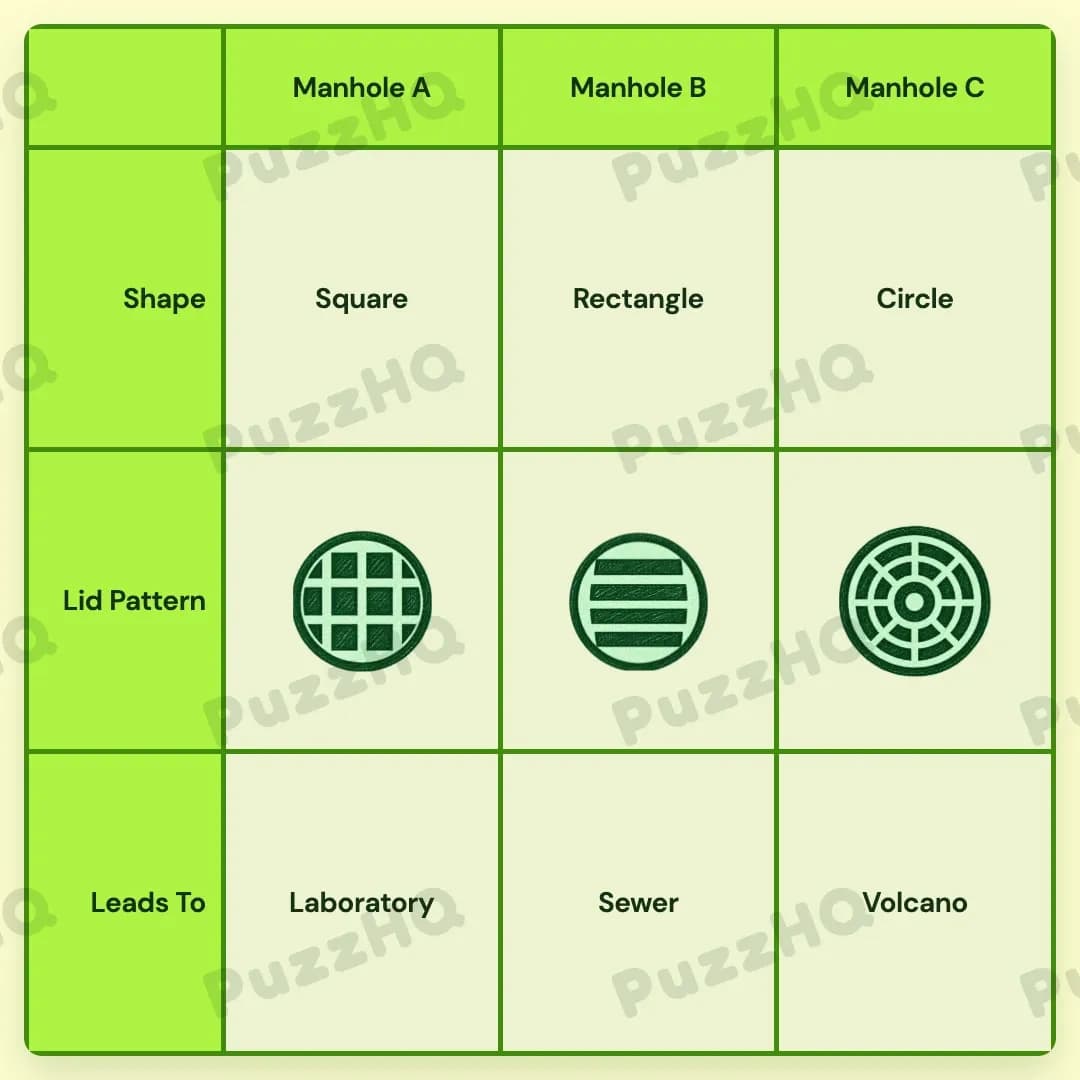
| Trait | Manhole A | Manhole B | Manhole C |
|---|---|---|---|
| Shape | Square | Rectangle | Circle |
| Lid Pattern | Row2Col2 | Row1Col4 | Row1Col2 |
| Leads To | Laboratory | Sewer | Volcano |
The Logic Behind Profile Perfect Level 222
The structural backbone of this puzzle rests on physical geometry and central placement. Rather than scattering hints across unrelated categories, the solve asks you to identify the physical silhouette of the covers first, use positional clues to fix the underground networks, and then let the remaining lid patterns fall into place through direct elimination. Once you see how neatly the central slot defines the middle destination, the remaining options narrow down quickly.
Geometry Anchors The First Outlines
The most immediate entry point is the physical shape of the manhole covers. We are told directly that Manhole C is the only one without any edges. Among the possible geometric profiles in this setting, a circle is the sole shape lacking corners or straight edges. That gives Manhole C the Circle shape right away.
With the circle committed to Manhole C, the remaining shapes for Manhole A and Manhole B must be divided between the Square and the Rectangle. At this stage, neither is fully locked down by shape clues alone, but pinning the circle to the third subject reduces the scope of every future deduction.
Underground Destinations Fall In Line
With Manhole C defined as the circle, attention shifts naturally to the middle position. We learn that the middle subject leads directly to the underground water network, which represents the Sewer. In a three-subject lineup arranged sequentially, Manhole B sits squarely in the center, immediately claiming the Sewer destination.
This placement does double duty. We know from the clue set that the square-shaped cover does not lead to the Sewer. Since Manhole B is confirmed as leading to the Sewer, Manhole B cannot be the square cover. That leaves Manhole B with the Rectangle shape, which in turn forces Manhole A to take the Square shape.
The destinations now unravel in rapid succession. The clues specify that the Laboratory sits beneath a specific lid configuration. Because the Sewer belongs to Manhole B, the Laboratory can only belong to Manhole A or Manhole C. However, we already know where the remaining pieces lie. Placing the Laboratory under Manhole A leaves only one destination unaccounted for, which means the Volcano destination must sit beneath the circular opening of Manhole C.
Patterns Lock Into Their Final Slots
Once the shapes and destinations are fully mapped across all three subjects, the remaining task is sorting out the specific lid patterns. The grid includes three distinct pattern codes: Row2Col2, Row1Col4, and Row1Col2.
The positional clues and neighbor constraints dictate how these patterns interact horizontally across the layout. Because certain lids cannot sit immediately adjacent to one another and specific patterns must appear to the right of others, the distribution of coordinates follows a tight spatial sequence. Row1Col2 settles onto Manhole C, while Row1Col4 matches with Manhole B. That leaves Row2Col2 as the sole remaining pattern for Manhole A. Every subject now holds a complete, non-conflicting profile across all three categories.
The Clue I Would Read Twice
The clue stating that the middle one leads to the underground water network is the quiet pivot point of the whole solve. On a quick first glance, it looks like a simple destination note that might apply anywhere. But because it relies on the physical middle position in a three-item sequence, it immediately fastens the Sewer to Manhole B.
Once Manhole B takes the Sewer, the negative clue about the square cover not leading to the Sewer suddenly has a concrete target. That single interaction eliminates the square from Manhole B, assigns the rectangle, and hands the square to Manhole A in one smooth motion. It is an unassuming sentence that does a surprising amount of heavy lifting.
Final Thoughts
What makes this level neat is how cleanly it moves from exterior shapes to underground destinations. You begin on the surface by identifying an edgeless circle, drop down into the central sewer network, and finish by aligning the lid patterns overhead. Everything stays grounded in spatial logic from start to finish.
Comments