
Profile Perfect Level 3 Answer
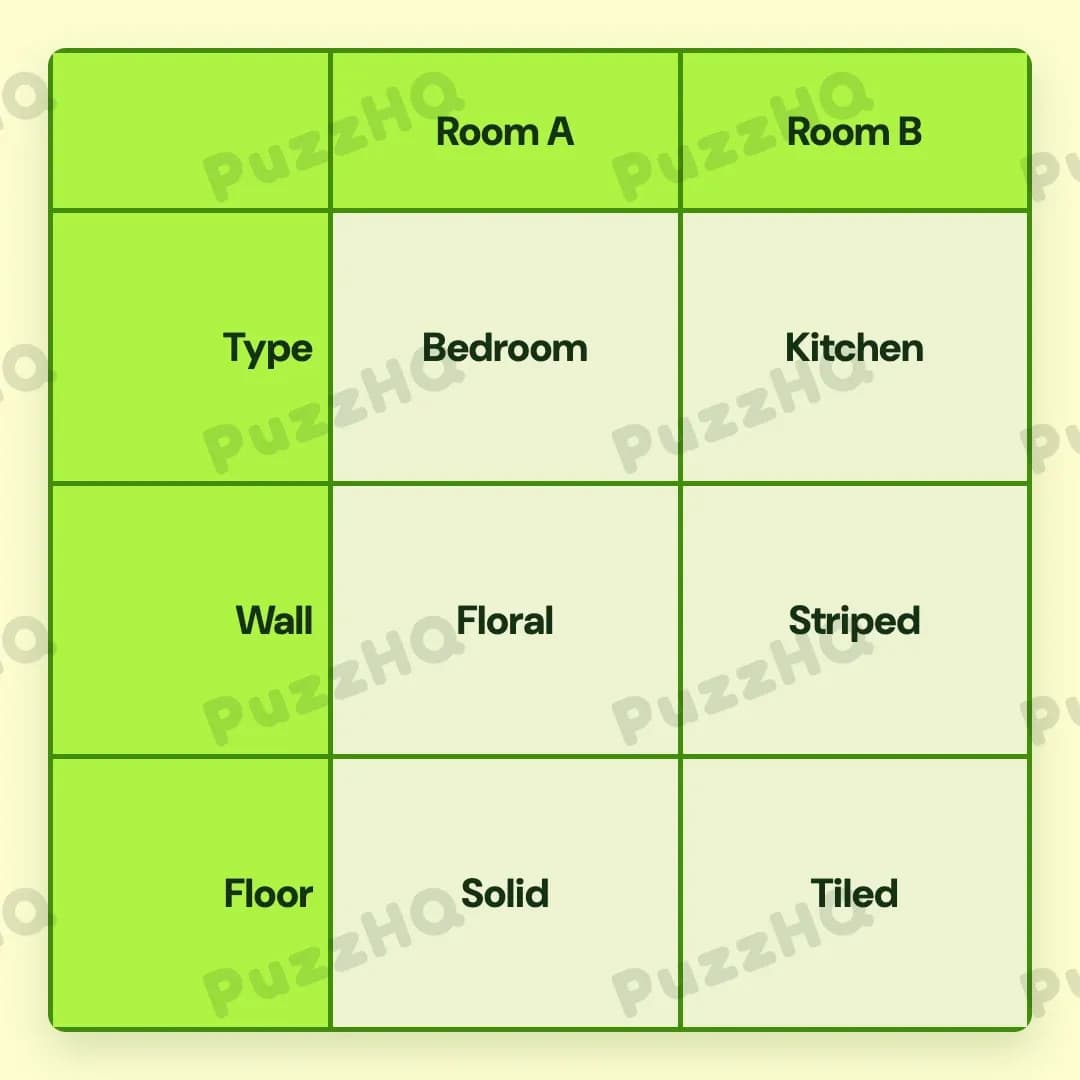
Room A is the Bedroom with a Floral wall and Solid floor, while Room B is the Kitchen with a Striped wall and Tiled floor.
| Trait | Room A | Room B |
|---|---|---|
| Type | Bedroom | Kitchen |
| Wall | Floral | Striped |
| Floor | Solid | Tiled |
How To Think Through Profile Perfect Level 3
The most useful solving habit on this level is building an anchor chain, where you use a direct clue to secure one known position, then use that anchor to resolve connected neighbor clues immediately. When you connect clues step by step from a solid foundation, you avoid unnecessary guessing and keep every trait assignment grounded in clear facts.
Start With Direct Identification: Room B Contains Cooking Tools
Direct clues give you an unshakeable starting point because they name a specific room and describe its function without requiring any outside context. In this level, the first clue states that tools to make food can be found in Room B.
Food preparation tools belong in a kitchen. That means Room B's room type must be the Kitchen.
Placing the Kitchen in Room B does two important things right away:
- It fills one of the two slots for the room type category.
- It turns Room B into a known reference point for any clues that describe nearby spaces.
Whenever a puzzle gives you a clue that pins an item to a named subject, resolve it before looking at conditional or relational clues. A single known subject dramatically simplifies the rest of the board.
Use Neighbor Reasoning: The Bedroom Sits Beside The Kitchen
Once an anchor subject is in place, neighbor clues become simple direct placements. Clue 3 tells you that next to the Kitchen is the room where people sleep.
A room where people sleep is a bedroom. Because you already know that Room B is the Kitchen, you only have to look at the room adjacent to it. In this layout, Room A is the only neighbor to Room B. Therefore, Room A must be the Bedroom.
This step shows why anchor subjects are so valuable. If you had tried to interpret clue 3 before identifying Room B, you would only know that the Kitchen and the Bedroom sit side by side. By securing Room B first, that relative relationship instantly turned into a definitive placement for Room A. The room type row is now completely solved.
Link New Traits To Established Subjects: The Floral Wall In Room A
Clue 4 states that the Bedroom has a Floral pattern on the wall. This is a multi-trait link. It connects a specific room type directly to a specific wall pattern.
Because you have already proved that Room A is the Bedroom, you can apply this wall trait directly to Room A. You do not need to guess or hold the clue in reserve. Room A receives the Floral wall trait immediately.
Multi-trait clues work best when you have already established one of the traits mentioned. If you see a clue that combines two traits, always check whether you have already placed either one on the board. The moment one side of the clue is anchored, the other side locks into place.
Finish Categories By Elimination: The Striped Wall Belongs In Room B
After assigning the Floral wall pattern to Room A, only one wall option remains for Room B. The puzzle features two wall styles: Floral and Striped.
Because Room A takes Floral, Room B must take Striped.
Elimination is a basic tool, but tracking it systematically keeps you from overlooking easy deductions. As soon as all but one option in a category has been placed, fill the remaining slot right away. Doing this completes the wall row and leaves only the floor row left to resolve.
Evaluate Neighbor Pairs: Placing The Floor Options
Clue 2 states that the room beside the Tiled floor has Solid color. This establishes that the two floor traits in the puzzle, Solid and Tiled, sit directly next to each other.
Because the puzzle consists of Room A and Room B side by side, one room must have the Solid floor and the other must have the Tiled floor. Room A receives the Solid floor, which leaves the Tiled floor in Room B beside it.
When dealing with two adjacent rooms and a neighbor clue that mentions both available traits, the clue confirms how the remaining pair distributes across the board. Combined with the full layout, this finishes the final row.
What This Level Teaches You
Anchor Placements Turn Relational Clues Into Direct Placements
A clue that says one item is next to another cannot solve a grid on its own if neither position is known. In this level, clue 3 told you that the room where people sleep is next to the Kitchen. That statement only became useful because clue 1 had already anchored the Kitchen in Room B. By prioritizing direct clues first, you transform vague neighbor clues into exact answers.
Descriptive Definitions Require Practical Translation
Puzzle clues often use everyday descriptions rather than the exact label from the grid. Clue 1 described tools to make food instead of using the word Kitchen, and clue 3 described the room where people sleep instead of using the word Bedroom. Recognizing that these phrases define the specific categories on your board is an essential habit for reading clues accurately.
Exhausting A Category Immediately Narrows Future Choices
As soon as Room A claimed the Floral wall pattern through clue 4, Striped wall became the only possible choice for Room B. Paying attention to completed categories prevents you from re-reading clues you no longer need and ensures that your deduction path remains clear.
Final Thoughts
The key habit that solved this level was working sequentially from an anchored position. Establishing Room B as the Kitchen unlocked the neighbor deduction for Room A, which in turn unlocked the wall pattern and cleared the path for the remaining traits. Building deductions in an unbroken chain ensures you never have to guess.
Comments