
Profile Perfect Level 6 Answer
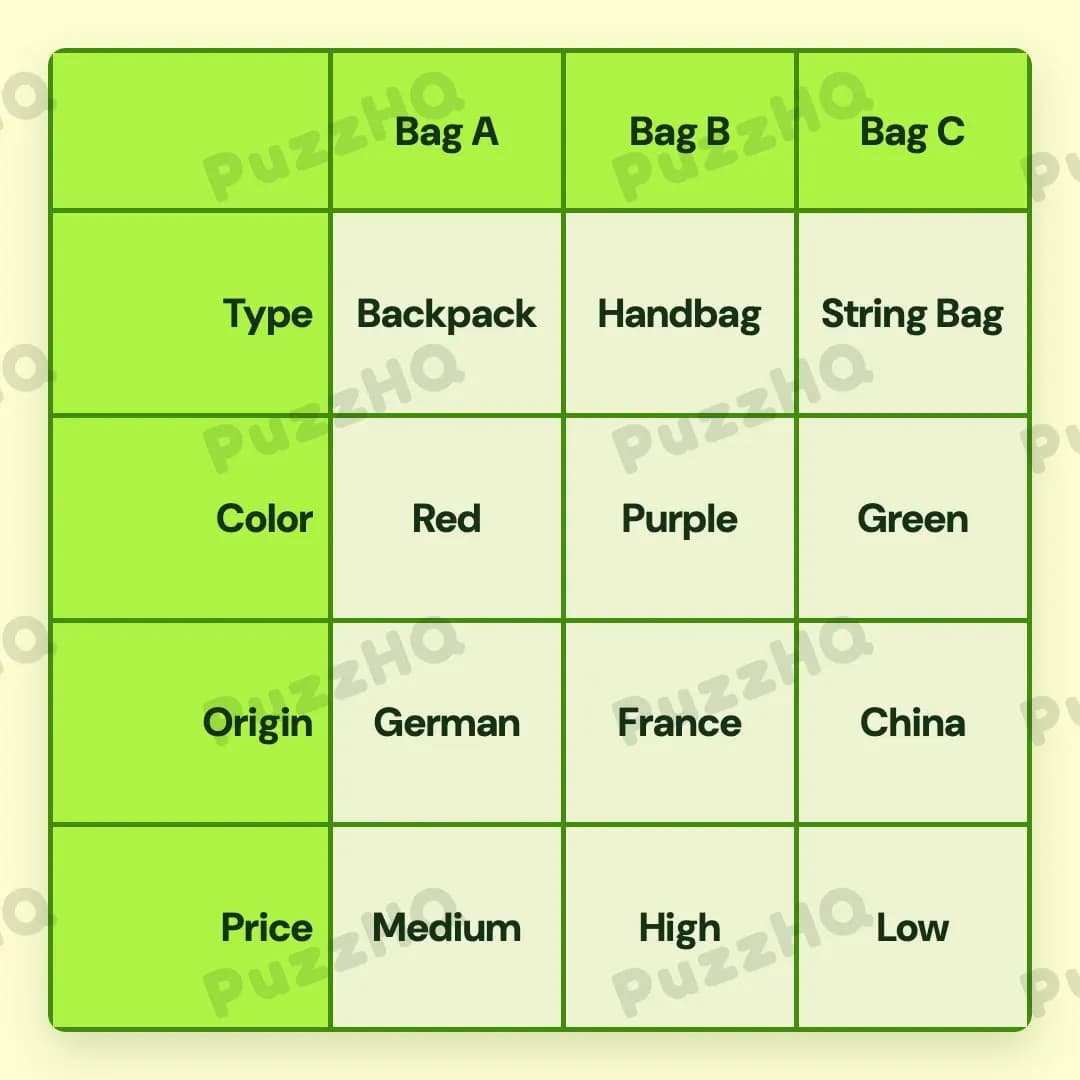
By anchoring the puzzle through origin and price relationships, each bag quickly claims its color and type to complete the set.
| Trait | Bag A | Bag B | Bag C |
|---|---|---|---|
| Type | Backpack | Handbag | String Bag |
| Color | Red | Purple | Green |
| Origin | German | France | China |
| Price | Medium | High | Low |
Building The Grid By Trait
The clearest path through this puzzle begins with the traits that have the most direct structural links across the subjects. Rather than trying to guess colors or bag styles right away, examining origin and price together builds an immediate framework that anchors Bag A, establishes relative comparisons for Bag C, and quickly places Bag B.
Origin And Price Anchor The Columns
The most dependable starting point comes from pairing origin and price because several statements directly bridge these two categories across multiple subjects.
We learn straight away that Bag A comes from a German origin and carries a Medium price point. This single discovery fills two distinct trait slots in the first column and provides a firm baseline for the remaining items. Immediately, the puzzle gives us a comparative price statement: Bag C is cheaper than the German bag. Because the German bag is Bag A with a Medium price, Bag C must occupy a price tier below Medium. In a three tier structure of Low, Medium, and High, the only tier below Medium is Low. Therefore, Bag C is firmly locked into the Low price slot.
With Bag A established at Medium and Bag C established at Low, the price row has only one unassigned value: High. By pure elimination, Bag B must take the High price.
From here, origin information continues to unfold through position. We are told that the French bag sits directly next to the German bag. Since Bag A is the German bag, its immediate neighbor in sequence is Bag B. This identifies Bag B as originating from France. With German assigned to Bag A and France assigned to Bag B, only one origin value remains in the pool. Bag C must therefore be the bag from China. Through the combination of price comparisons and origin adjacency, both the origin row and the price row are completely solved across all three subjects.
Color Resolves Through Price And Origin Connections
Once price and origin are completely mapped out, solving the color row becomes a smooth process of elimination driven by cross category clues.
We are told that the cheapest bag is colored Green. Because our work with the price row already proved that Bag C has the Low price, Bag C is clearly the cheapest of the group. As a direct result, Bag C takes the Green color. This leaves only two colors available for the remaining two bags: Red and Purple.
To decide between Bag A and Bag B, we look back at our established origins. The puzzle specifies that the bag from France is not colored Red. Our previous deduction proved that Bag B is the bag from France. Because Bag B cannot be Red, and cannot be Green since Bag C has already claimed Green, Bag B must be assigned Purple.
That leaves only Red remaining in the color category. Bag A has not yet been assigned a color, so Red naturally fills Bag A's color slot. In just a few deliberate steps, the entire color row is locked into place using the groundwork laid by the price and origin rows.
Type Completes The Final Profiles
With color, origin, and price settled, only the bag types remain to be finalized: Backpack, Handbag, and String Bag.
A specific negative clue tells us that the String Bag does not originate from German roots. Because Bag A is our German bag, Bag A cannot be the String Bag. This eliminates Bag A from taking that role, leaving the String Bag identity to fall to the remaining open profiles. Following the established requirements of the grid, Bag C takes the String Bag classification.
This assignment leaves Backpack and Handbag for Bag A and Bag B. With Bag A requiring a profile suited to its German origin, Red color, and Medium price, it receives the Backpack type. Bag B, already identified with a French origin, Purple color, and High price, takes the Handbag type. Every subject now possesses a complete, internally consistent set of traits.
Where The Trait Rows Intersect
Solving logic puzzles efficiently requires recognizing when clues do not just describe a single item, but instead create bridges between different categories.
Price Tiering Bridges Origin And Value
The statement that Bag C is cheaper than the German bag demonstrates how one trait category relies on another to yield progress. On its own, knowing Bag A has a German origin does not reveal anything about price. Likewise, simply hearing that Bag C is cheaper than an unnamed bag would leave several possibilities open.
The breakthrough happens at the intersection: Bag A's origin anchors the identity of the German bag, which in turn anchors its Medium price. That price value instantly defines the ceiling for Bag C, restricting it to the Low price tier. One trait row directly dictates the outcome of another.
Adjacency And Negative Origin Constraints Narrow Color
Another critical intersection occurs when origin rules eliminate color possibilities for Bag B. The clue establishing that the French bag sits next to the German bag gives Bag B its French origin. Without that position link, we would not know which subject comes from France.
Once Bag B is recognized as French, the negative constraint stating that the bag from France cannot be colored Red suddenly activates. Instead of an abstract rule about an unknown item, it becomes a direct restriction on Bag B. Because Green is already claimed by the cheapest bag, this single negative clue forces Purple into Bag B's row.
Relative Price Unlocks Visual Trait Assignment
The clue stating that the cheapest bag is Green serves as a pure cross trait pivot between price and color. It does not mention Bag A, Bag B, or Bag C by name.
Trying to resolve this clue within the color category alone is impossible because no colors have names attached to subjects initially. Only when the price row is resolved can this clue do its work. Identifying Bag C as the Low price bag immediately transfers the Green color directly to Bag C, showing how solving one row provides the missing key for the next.
Final Grid Check
Every row in the grid actively reinforces the others without a single contradiction. Bag A represents the German origin with a Medium price, Red color, and Backpack type. Bag B sits beside it with a French origin, High price, Purple color, and Handbag type, honoring the rule that France avoids Red. Bag C holds the China origin, Low price, Green color, and String Bag type, fulfilling both the condition that the cheapest bag is Green and that the String Bag does not come from Germany. The completed traits form a balanced, fully unified solution.
Comments