
Profile Perfect Level 642 Answer
Before reading ahead, make sure you want the full sanctuary revealed, as the complete arrangement of temples, patron gods, and architectural details is detailed below.
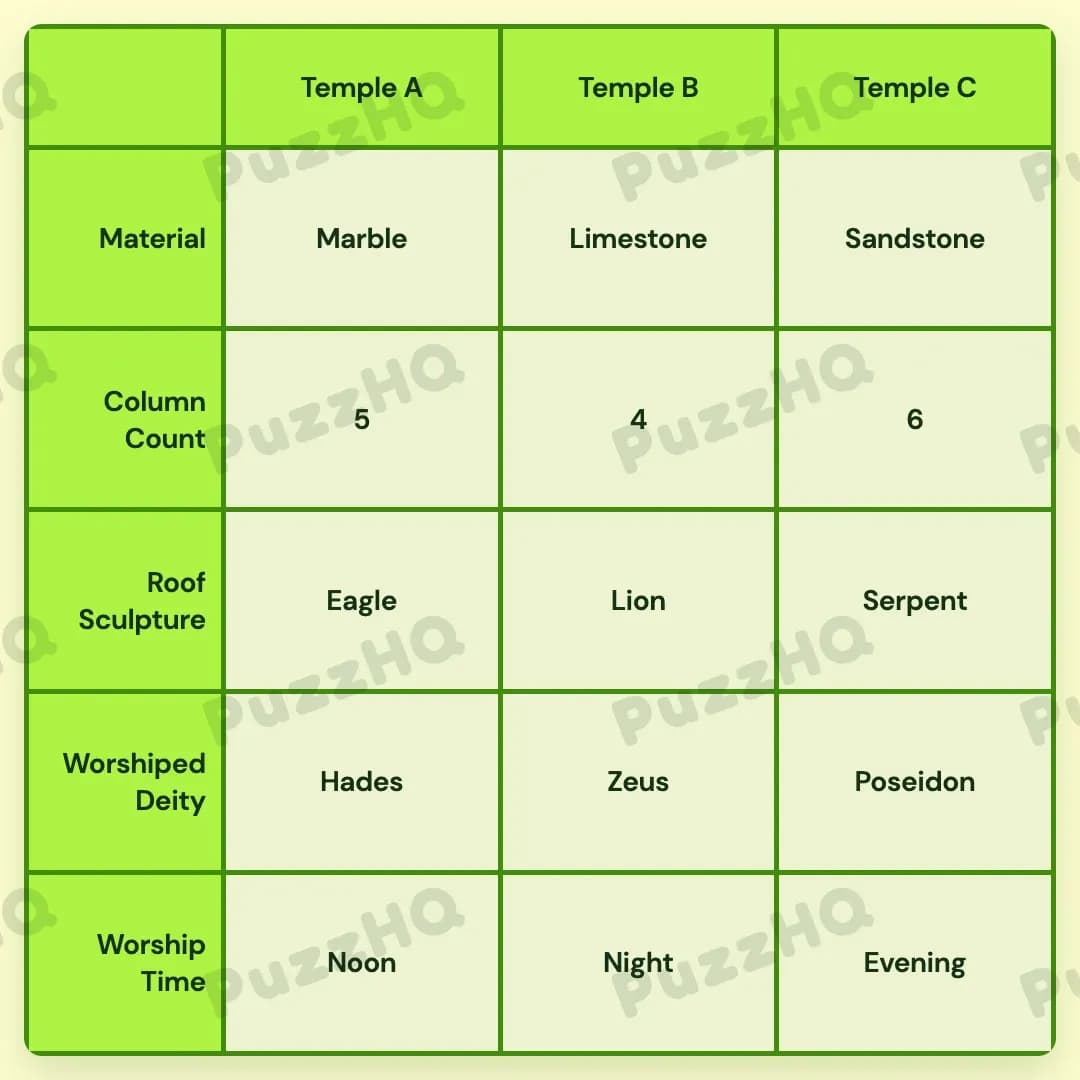
| Trait | Temple A | Temple B | Temple C |
|---|---|---|---|
| Material | Marble | Limestone | Sandstone |
| Column Count | 5 | 4 | 6 |
| Roof Sculpture | Eagle | Lion | Serpent |
| Worshiped Deity | Hades | Zeus | Poseidon |
| Worship Time | Noon | Night | Evening |
The Logic Behind Profile Perfect Level 642
At its core, this puzzle is an exercise in reading a landscape from left to right. Rather than overwhelming you with endless trait pairings, the grid relies on physical geometry and sibling rivalry to anchor everything in place. Once the physical positions of the three sanctuaries are clear, the architectural traits fall into line with remarkable speed.
Zeus Anchors The Center Line
The quickest entry point sits in the family tree. When you are told that Zeus has a temple situated next to both of his brothers, you immediately know where the king of Olympus has to be. In a trio of temples arranged in a line, only the central structure borders two neighbors at once. That makes Temple B the domain of Zeus, leaving Temple A and Temple C to divide the remaining brother gods between them.
With Zeus planted firmly in the middle, his surroundings begin to assemble around him. We are told directly that high-quality limestone went into the construction of his shrine, which takes care of the material for Temple B right away. At the same time, an architectural detail provides his column count. The middle temple has three gaps between its columns. Counting architectural intervals is a classic fencepost calculation: three spaces between pillars means Temple B must feature four columns in total.
Just like that, the central profile holds a patron deity, a building stone, and an exact column tally.
The Brothers Stake Out Their Ground
Establishing Temple B as the four-column limestone shrine does far more than solve the center. It unlocks the surrounding territory. We learn that Poseidon frequently visits the sanctuary situated directly to the right of the four-column temple. Since the four-column temple is Temple B in the middle, the sanctuary to its right can only be Temple C.
Poseidon claims Temple C, which neatly leaves the leftmost structure, Temple A, for Hades.
From here, the column math ripples outward. Temple A is noted as having slightly more columns than its neighbor. Since its lone neighbor is Temple B with four columns, Temple A must possess five. With counts of four and five already assigned to Temple A and Temple B, the remaining total of six columns belongs solely to Temple C.
In just a few clean logical steps, the entire row of shrines has names, positions, and structural frameworks.
Sculptures And Schedules Fall Into Place
Once the gods and columns are locked down, the daily rituals and roof ornamentation can be determined. Sunlight directs our attention to the schedule. The leftmost temple begins worship at the hottest time of day. Naturally, the hottest hour is noon, handing Temple A its ritual hour. That leaves night and evening to be divided between Temple B and Temple C.
Next comes the pairing between stonework and statuary. We know the eagle sculpture shines brightly because it is crafted from marble. This single observation ties two traits together as an inseparable package. Temple B is already spoken for with limestone, which means the eagle and marble combination must belong to either Temple A or Temple C.
The deciding factor is the serpent temple, whose worshippers do not assemble under the cover of night. If Temple C held the eagle sculpture, Temple A would be forced to host the serpent, but Temple A already observes its rituals at noon, leaving Temple B and Temple C to take night and evening. A serpent temple that avoids the night cannot be Temple B if Temple B is the night shrine.
Instead, assigning the eagle and marble combination to Temple A opens up a smooth cascade of answers. Temple A takes marble and the eagle sculpture. That leaves sandstone as the final unclaimed material, which belongs to Temple C.
Temple C is also where the serpent sculpture must rest, and because serpent worshippers avoid nighttime gatherings, Temple C takes the evening worship slot. Temple B takes the night shift by elimination, and its roof receives the only remaining adornment, the lion sculpture. Every shrine stands complete, exactly where the gods intended.
The Clue I Would Read Twice
The third clue, which notes that the middle temple has three gaps between its columns, is the quiet hinge of the entire solve. It is remarkably easy to breeze past the phrase "three gaps" and write down three columns by accident.
In structural architecture, gaps describe the bays between pillars rather than the pillars themselves. Recognizing that three gaps require four standing columns provides the exact number needed for the clue about Poseidon. If you misread the gaps as the column count itself, Poseidon loses his anchor point to the right of Temple B, and the spatial logic stalls out before it even begins.
Final Thoughts
What makes 642 delightful is how neatly the puzzle mirrors classical design. Instead of relying on abstract arithmetic, the deductions emerge from the physical presence of the shrines, whether that means calculating the shadows between marble pillars or looking for the bright sun at midday. Everything feels grounded in a specific place and time.
Comments