
Profile Perfect Level 643 Answer
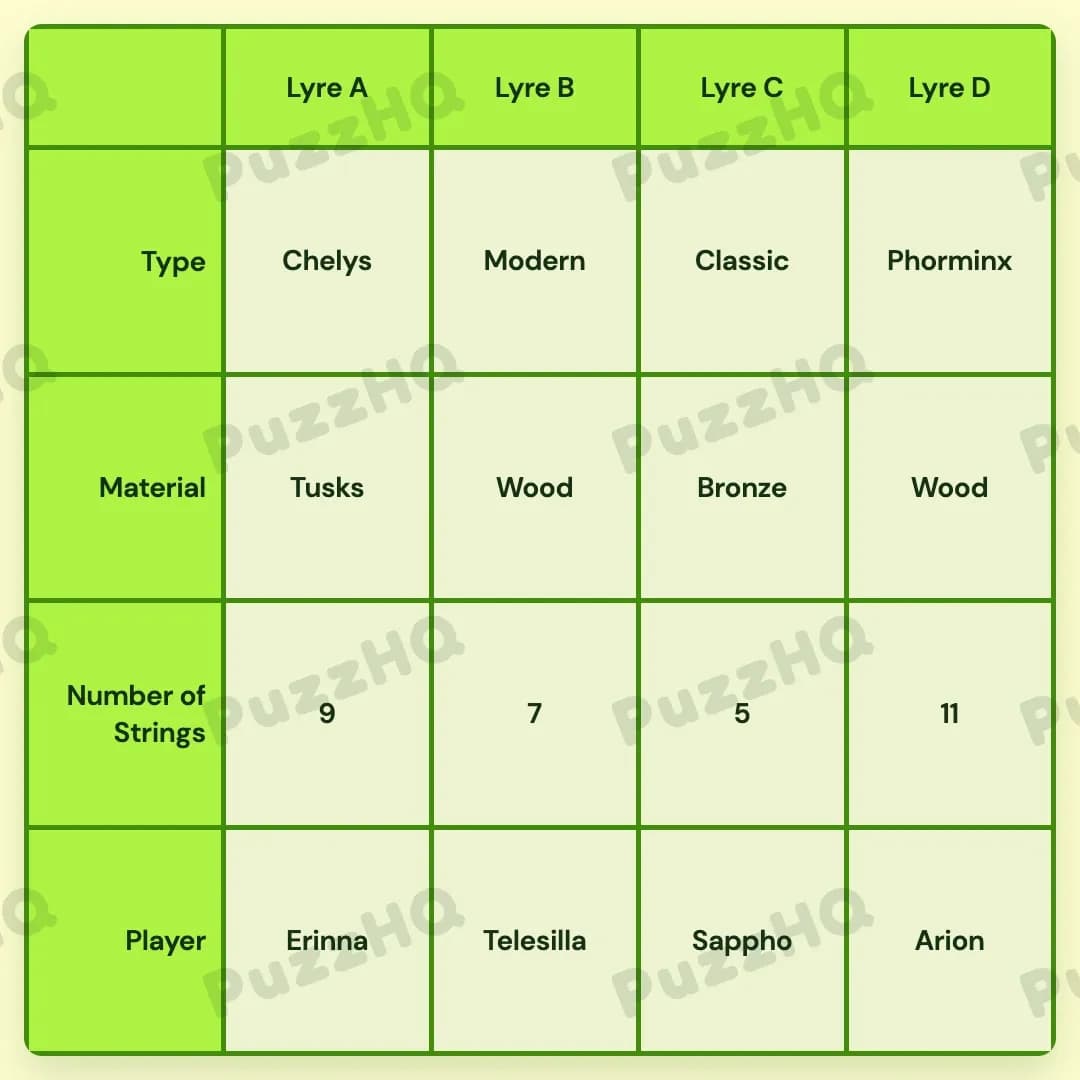
The ancient instruments arrange neatly once you realize that the duplicate wooden frames surround the central classical instrument, allowing the musicians and string counts to fall into place column by column.
| Trait | Lyre A | Lyre B | Lyre C | Lyre D |
|---|---|---|---|---|
| Type | Chelys | Modern | Classic | Phorminx |
| Material | Tusks | Wood | Bronze | Wood |
| Number of Strings | 9 | 7 | 5 | 11 |
| Player | Erinna | Telesilla | Sappho | Arion |
Building The Grid By Trait
The clearest entry point into the puzzle is the physical construction of the instruments, specifically Material and Type. Because two separate instruments share wood while the remaining two feature unique substances, locating where identical materials sit relative to specific shapes unlocks the horizontal layout immediately.
Material And Type Establish The Center Frame
The breakthrough begins with the clue stating that the Classic shape rests directly between two instruments made of the exact same material. In a four-column grid, an item placed between two others must occupy either Lyre B or Lyre C. If Lyre B were Classic, its flanking neighbors would be Lyre A and Lyre C. However, another clue reveals that Erinna's instrument uses an animal body part, meaning tusks, while also possessing a unique material unlike anyone else. Because Tusks sits at one end, Lyre A and Lyre C cannot share a material.
Therefore, the Classic instrument cannot be Lyre B. It must be Lyre C, placed directly between Lyre B and Lyre D. For Lyre C to sit between two matching materials, both Lyre B and Lyre D must be crafted from Wood. This placement immediately accounts for both wooden instruments in the puzzle.
With two wooden instruments positioned at Lyre B and Lyre D, the clue regarding the wooden instrument on the left comes into play. It notes that the wooden lyre on the left is more common nowadays, identifying Lyre B as the Modern type.
Next, we look at the remaining material assignments. Since Lyre B and Lyre D are Wood, and Erinna uses an animal body part, her instrument must be carved from Tusks. That leaves Bronze as the only remaining material, which slots directly into Lyre C alongside its Classic type designation. Lyre A takes the Tusks material, leaving its Type to be resolved alongside the final open instrument.
Player Row Anchors Through Position And Ownership
Once Material and Type establish the column structure, the Player row fills in through positional clues and direct pairings.
We learn immediately that Sappho plays the Classic instrument as part of her performance. Because Lyre C is already confirmed as the Classic type, Sappho takes her place as the musician for Lyre C.
We also know that Erinna plays the instrument crafted from an animal body part. Since Tusks belongs to Lyre A, Erinna is established as the musician for Lyre A.
Only two musicians remain unplaced: Telesilla and Arion. They must occupy Lyre B and Lyre D. The clue resolving their positions states that Telesilla has more neighbors than Arion. In a four-column line, inner columns have two immediate neighbors, whereas outer columns on the ends have only one neighbor. Lyre B has two neighbors, Lyre A and Lyre C, while Lyre D sits on the far edge with only Lyre C beside it. Consequently, Telesilla must be assigned to Lyre B, leaving Arion at Lyre D. The Player row is now completely resolved.
Number Of Strings Completes The Type Row
With the players locked and three instrument types known or constrained, the Number of Strings row helps finalize the entire layout.
A key clue notes that the Chelys instrument possesses slightly more strings than the basic model. Looking at the remaining open types, Chelys and Phorminx must be divided between Lyre A and Lyre D. Another clue states that the instrument with the longest arms is not positioned next to the Classic one. Because Lyre C is the Classic lyre, its neighbors are Lyre B and Lyre D. The only position not adjacent to Lyre C is Lyre A. This makes Lyre A the instrument separated from Classic, confirming Lyre A as the Chelys and Lyre D as the Phorminx.
Now we can assign the string counts: 5, 7, 9, and 11. The basic seven-string model represents the standard range for ancient performance. The clue notes that the Chelys lyre has slightly more strings than the basic one, which gives Lyre A 9 strings compared to the basic 7 strings at Lyre B.
Furthermore, the clue regarding ranges specifies that the lyre with the biggest range sits exactly two columns away from the standard range instrument. The biggest range corresponds to the highest string count of 11. With the standard 7 strings placed at Lyre B in the second column, counting two columns to the right lands squarely on Lyre D in the fourth column. Lyre D therefore receives 11 strings.
The final remaining value of 5 strings falls neatly into Lyre C, completing both the Number of Strings and Type rows across all four subjects.
Where The Trait Rows Intersect
Material Symmetry Unlocks Instrument Type
The deduction determining Lyre C as Classic depends on a tight intersection between Material and Type. Rather than testing each instrument name across all four columns, noting that Classic must be flanked by matching materials forced the two wooden instruments into Lyre B and Lyre D. This cross-row relationship eliminated guesswork and fixed the positions of three separate columns in a single deduction.
Ownership Clues Anchor Spatial Neighbors
The Player category interacts directly with column geometry through Telesilla's neighbor clue. Because Sappho was already tied to Lyre C through Type, and Erinna was tied to Lyre A through Material, the two remaining slots had vastly different neighbor counts. Telesilla's relationship to Arion could only be solved because the outer edges and inner slots had already been differentiated by previous trait assignments.
String Ranges Resolve The Remaining Instrument Types
The connection between string counts and historical instrument types brings the grid home. Knowing that the Chelys had slightly more strings than the standard model allowed the values of 7 and 9 to align directly with Modern and Chelys. Pairing that with the column distance rule between the standard range and the largest range verified that Lyre D held the 11-string Phorminx, tying Number of Strings directly to the Type category.
Final Grid Check
Every row confirms the validity of the others without friction. Lyre C sits centrally in Bronze with 5 strings for Sappho, nestled safely between the wooden frames of Lyre B and Lyre D. Telesilla commands the standard 7-string Modern wooden lyre with two neighbors, while Arion holds the outer 11-string Phorminx. On the far left, Erinna's 9-string Chelys carved from tusks stands entirely unique in material, verifying every condition laid out across the puzzle.
Comments