
Profile Perfect Level 640 Answer
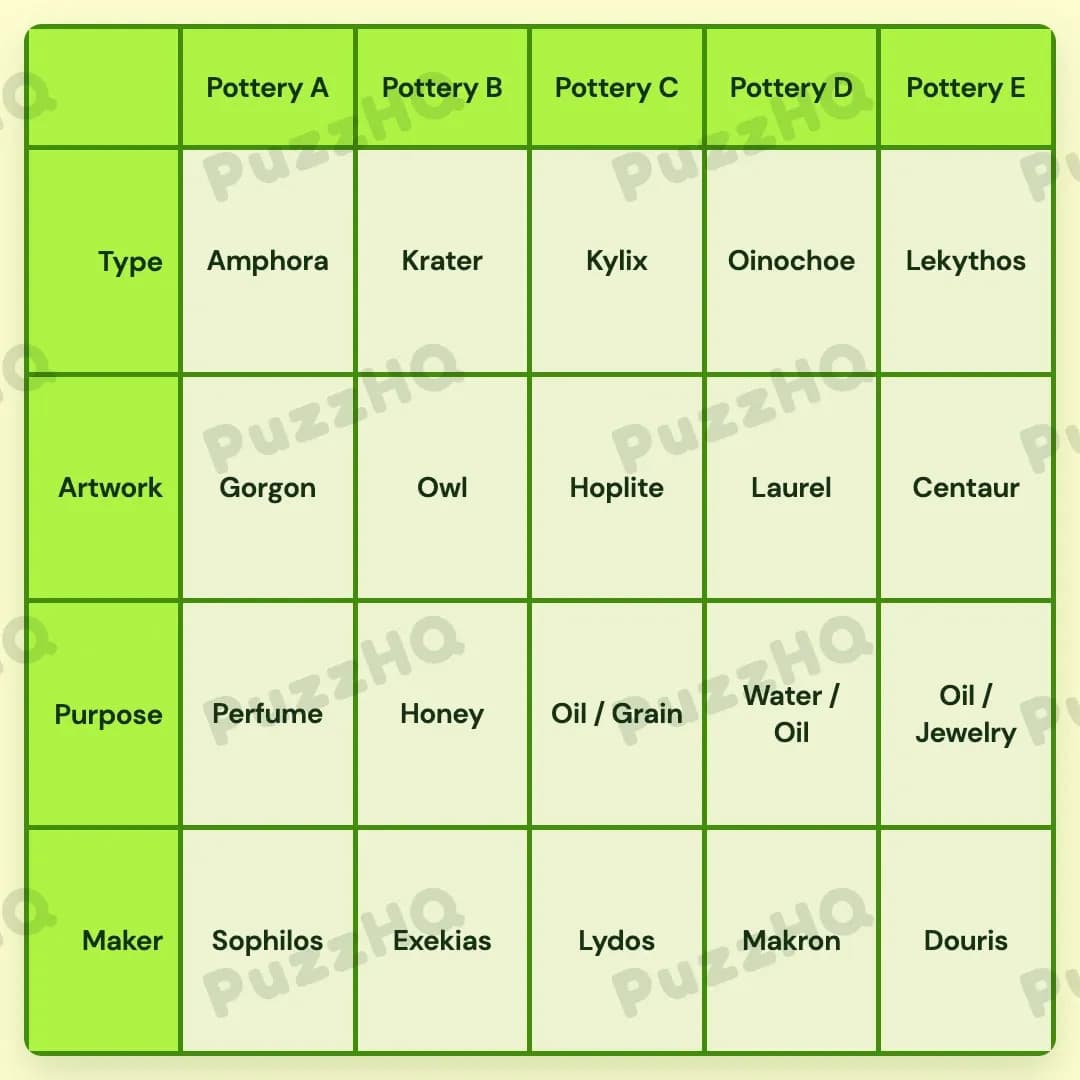
All five ancient Greek vessels can be identified by mapping the positions of Exekias and his honey pot before tracing the column spacing of the liquid contents.
| Trait | Pottery A | Pottery B | Pottery C | Pottery D | Pottery E |
|---|---|---|---|---|---|
| Type | Amphora | Krater | Kylix | Oinochoe | Lekythos |
| Artwork | Gorgon | Owl | Hoplite | Laurel | Centaur |
| Purpose | Perfume | Honey | Oil / Grain | Water / Oil | Oil / Jewelry |
| Maker | Sophilos | Exekias | Lydos | Makron | Douris |
How I Solved Profile Perfect Level 640
When scanning the board, the mention of apiary goods immediately pointed to honey, which stood out against the heavy references to oil. Because the column layout relies heavily on spatial gaps and adjacent pots, finding where that honey pot belonged became my primary target.
Apiary Goods And Pottery B Established The Center Left
The clue stating that Exekias made a pot to store products from the apiary immediately linked Exekias with Honey. Looking at the creators, another clue noted that a bald bearded young man created Pottery B, while a companion note pointed out that he already possessed plenty of oil jars and did not need a new one. That connected directly back to Exekias and his honey jar, confirming that Exekias made Pottery B specifically for Honey.
Having Honey pinned down to Pottery B gave me an immediate anchor for relative positioning. Another clue stated that an Amphora pot decorated with legendary monster art was placed beside the Honey. Because Pottery B sat in the second position, the Amphora could only be Pottery A or Pottery C. I needed something with broader reach across the columns to settle which side held the monster.
Liquid Measurements Fixed The First Four Columns
The breakthrough came from the clue noting that the fragrant liquid is three columns away from the drinking liquid. In this puzzle, perfume represented the fragrant liquid, while water represented the drinking liquid. A gap of three columns across a five vessel grid can only happen in two specific configurations: column 1 and column 4, or column 2 and column 5.
Because Pottery B was already locked in column 2 with Honey, the second column could not be either perfume or water. That eliminated the second pairing entirely, meaning the fragrant liquid had to be in Pottery A, and the drinking liquid had to sit three spots away in Pottery D.
This discovery immediately solved the placement of the legendary monster. With Pottery A holding perfume right next to Pottery B, Pottery A fulfilled the clue about being beside the Honey. As a result, Pottery A took the Amphora type, and its artwork became the Gorgon, the only legendary monster among the artwork options. Meanwhile, Pottery D took the purpose of Water / Oil to satisfy the drinking liquid requirement.
The Centaur Trio Found Its Only Remaining Home
From there, I examined the compound clue stating that the Centaur drawn on the Lekythos pot was made by Douris. This clue bundled three distinct traits together: the Centaur artwork, the Lekythos type, and Douris as the craftsman.
Such a large block of traits requires an entirely blank slot across type, artwork, and maker. Pottery A and Pottery B already had known types and creators. Pottery D was designated for the drinking liquid, and another clue mentioned that Makron needed his pot to also hold drinks. That assigned Makron directly to Pottery D, ruling him out as the maker of the Centaur pot.
That left only Pottery C and Pottery E. However, one clue stated that the plant artwork could be found to the right of Kylix, and another explained that the soldier is portrayed to the left of the royal emblem. If Pottery C took the Centaur, there would be no room to position both a soldier and a plant motif properly. More decisively, Pottery E was completely untouched. Placing the Lekythos, the Centaur artwork, and Douris into Pottery E satisfied the entire three part package neatly.
Plant Motifs And Royal Emblems Cleared The Middle
With Pottery E settled, the middle of the board opened up. A clue specified that the plant artwork was located somewhere to the right of the Kylix vessel. At the same time, another clue told me that the soldier was portrayed to the left of the royal emblem.
The available artworks left were the Hoplite, the Owl, and the Laurel. The Hoplite represented the soldier, while the Laurel represented the plant as well as the classic royal emblem. To place the soldier to the left of the royal emblem while also keeping the plant to the right of the Kylix, Pottery C had to be the Kylix depicting the Hoplite. Pottery D then naturally received the Laurel artwork, perfectly positioned to the right of Pottery C.
That left only one artwork unaccounted for, which was the Owl. Since Pottery B was the only vessel missing its decoration, the Owl went straight to Pottery B alongside Exekias and Honey.
Crafting Traditions Completed The Final Assignments
With artwork and positions largely determined, I had to sort out the remaining vessel types, makers, and purposes. A clue explicitly stated that Exekias did not shape his pot into a Lekythos or an Oinochoe. Because Amphora and Kylix were already assigned to Pottery A and Pottery C, and Lekythos belonged to Pottery E, Pottery B could only be a Krater. That left Oinochoe as the sole remaining type, which slipped naturally into Pottery D.
Turning to the purposes, a clue stated that the jewelry pottery was made by neither Lydos nor Makron. We already knew that Makron was at Pottery D, and the only makers left without vessels were Sophilos and Lydos. Pottery A needed a maker, and Pottery C needed a maker. Sophilos completed Pottery A. That left Lydos for Pottery C. Because Lydos could not make the jewelry container, Pottery C received Oil / Grain, and Pottery E was assigned Oil / Jewelry. The grid was now fully resolved.
The Point Where I Nearly Went Wrong
The clue mentioning that the fragrant liquid is three columns away from the drinking liquid nearly led me to an incorrect count early on. In casual reading, three columns away can easily be mistaken for having three intermediate columns between them, which would place the items at the extreme outer edges in columns 1 and 5. In logic grid terms, being three columns away means subtracting the column indices to get a difference of three, such as column 1 and column 4. Checking the contents of Pottery B helped me avoid that trap, because Honey in column 2 quickly narrowed the math down to columns 1 and 4 without ambiguity.
Looking Back At The Solution
Looking back at the solve, connecting the apiary reference to Honey was the initial step, but recognizing the three column mathematical distance between the liquids was the deduction that truly unlocked the grid. Once perfume and water were anchored on opposite sides of Pottery B and Pottery C, the rest of the puzzle fell into line through simple process of elimination.
Comments