
Profile Perfect Level 647 Answer
Before you tuck into this breakfast spread, be warned that the complete solution for 647 is revealed below.
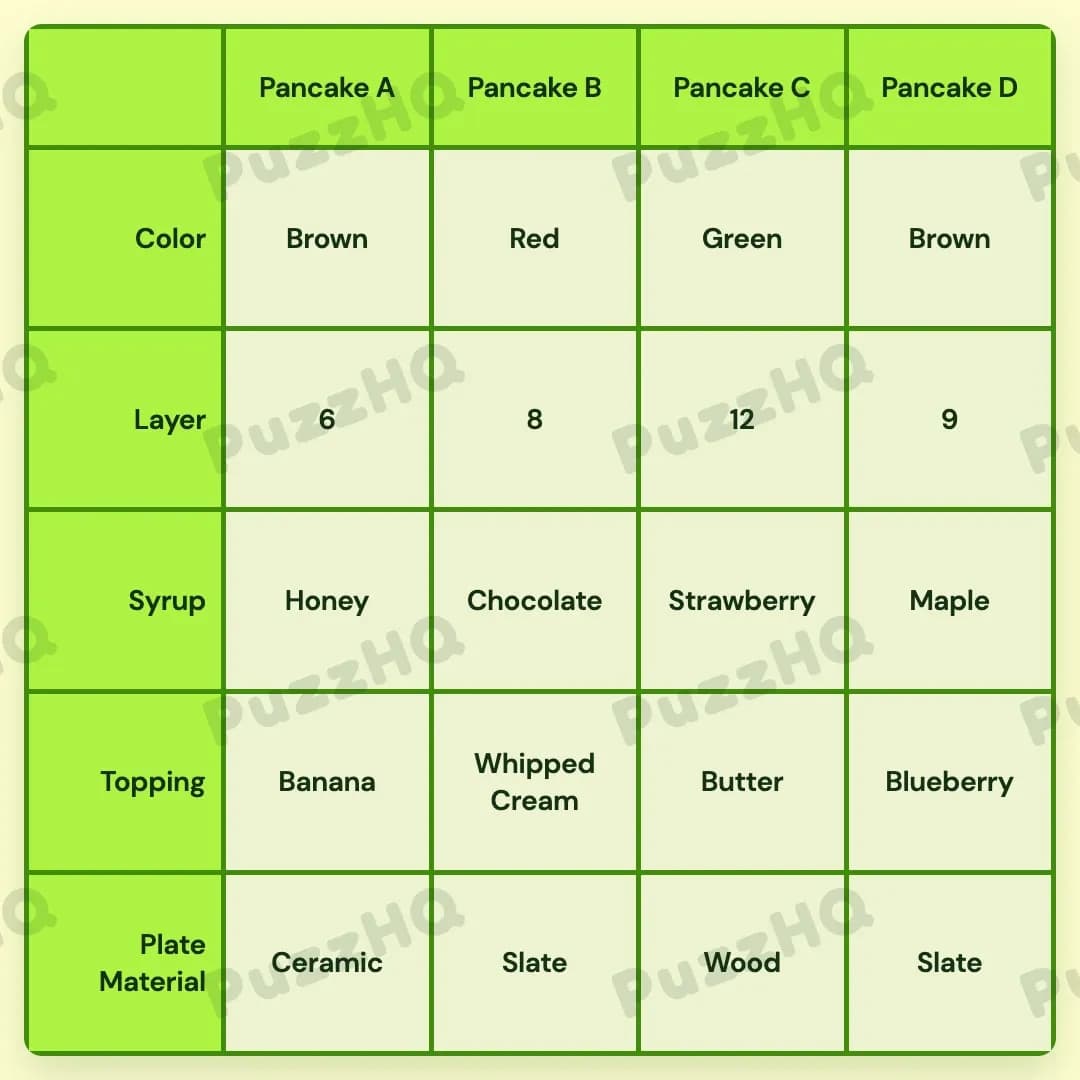
| Trait | Pancake A | Pancake B | Pancake C | Pancake D |
|---|---|---|---|---|
| Color | Brown | Red | Green | Brown |
| Layer | 6 | 8 | 12 | 9 |
| Syrup | Honey | Chocolate | Strawberry | Maple |
| Topping | Banana | Whipped Cream | Butter | Blueberry |
| Plate Material | Ceramic | Slate | Wood | Slate |
The Logic Behind Profile Perfect Level 647
Every good logic puzzle possesses a hidden center of gravity, and in 647, that pivot point is strictly spatial. While the breakfast theme invites you to think about towering stacks of flapjacks and decadent toppings, the grid remains firmly shut until you pin down who sits next to whom. Once you realize how narrow the board truly is, the physical positions of the four plates do the heavy lifting, turning an otherwise slippery set of ingredients into an orderly breakfast counter.
Butter Claims The Center Right
The initial breakthrough comes from paying close attention to the butter. We know from the clues that butter sits somewhere on the right half of the table, which leaves only Pancake C or Pancake D as eligible candidates. At first glance, that looks like an ordinary coin flip, but a companion clue complicates matters in the best possible way. The butter pancake must have both a brown pancake and a red pancake sitting right next to it.
If butter were placed on the far right edge at Pancake D, it would only have a single neighbor. That boundary constraint eliminates the corner immediately. Butter has to belong to Pancake C, nestled right between Pancake B and Pancake D. In one clean stroke, you know that Pancake B and Pancake D must be the pair of red and brown flapjacks, leaving only green and another brown for the remaining spaces. The right side of the counter suddenly has an unmistakable shape.
The Leaning Tower Sets The Distance
With Pancake C established as the butter anchor, the conversation naturally turns to height and toppings. One stack is said to rival the Leaning Tower of Pisa, sitting exactly two columns away from the banana. That two-column gap is remarkably restrictive on a four-column grid. It means the pair must occupy either the first and third positions, or the second and fourth.
The clue describing the brightest drizzle provides the link. A bright red syrup coats the tallest pancake of them all, which points straight to strawberry. Since the tallest stack is the one aspiring to be the Tower of Pisa, it makes sense that this towering creation is Pancake C, which already holds the butter. Counting two spaces to the left lands you on Pancake A for the banana.
The pieces now begin falling into place rapidly. Because the banana is the lone yellow fruit on the menu, another clue assigns Pancake A directly to a ceramic plate. Meanwhile, with Pancake C identified as the undisputed champion of layers at twelve tall, strawberry syrup claims the third column as its home.
Balancing Syrups And Slate Plates
Now that the outer frame is settled, the remaining condiments and dishware must fall into order. We are told that a wooden plate sits somewhere to the right of the chocolate syrup. Since Pancake A is already confirmed as ceramic, chocolate cannot sit there if it needs room to breathe before meeting wood. That puts chocolate syrup squarely on Pancake B, which immediately crowns Pancake C as the one served on a wooden plate.
The syrup that relies on animal labor is naturally honey, and the guidance states it cannot sit next to strawberry. Strawberry is holding court on Pancake C, meaning honey is barred from Pancake B and Pancake D. That leaves Pancake A as the only possible roost for honey. With honey at A, chocolate at B, and strawberry at C, the final syrup, maple, lands comfortably on Pancake D.
A companion clue notes that small fruits sit on top of maple syrup. That can only mean blueberries, which instantly awards blueberry topping to Pancake D. By pure elimination among toppings, Pancake B takes the whipped cream.
The puzzle wraps up with the plate materials and stack counts. The clues mention that the pancakes on slate plates are competing with each other in height. Since Pancake A has ceramic and Pancake C has wood, slate belongs to both Pancake B and Pancake D. Chocolate syrup cannot be used on the second tallest stack, which rules out the nine-layer height for Pancake B. That hands nine layers to Pancake D, leaving eight layers for Pancake B and a modest six layers for Pancake A.
Finally, we learn that there are more than a dozen brown pancakes in total. This clever wording refers to the combined layers of the brown stacks. Because Pancake B is red and Pancake C is green, brown must belong to both Pancake A and Pancake D. Adding six layers from Pancake A to nine layers from Pancake D yields fifteen brown layers in total, neatly satisfying the count and finishing the board.
The Clue I Would Read Twice
The statement that there are more than a dozen of brown pancakes is easily the most deceptive line in the entire set. On a casual read, a solver might picture a tray of thirteen or fourteen separate pancakes and wonder if the grid has quietly expanded when no one was looking.
The reality is much tighter. In the language of this puzzle, pancakes are quantified by their layer counts, and colors describe the entire stack. For brown to exceed twelve layers collectively, brown has to appear more than once across the columns. Recognizing that brown is shared between the six-layer Pancake A and the nine-layer Pancake D unlocks the final color distribution without requiring any guesswork.
Final Thoughts
What makes 647 such an enjoyable solve is the way it plays with perspective. It masquerades as a puzzle about recipes and toppings, but it really behaves like an architectural blueprint. The moment you use the physical table boundaries to trap the butter, the rest of the breakfast falls into place with remarkable neatness.
Comments