
Profile Perfect Level 649 Answer
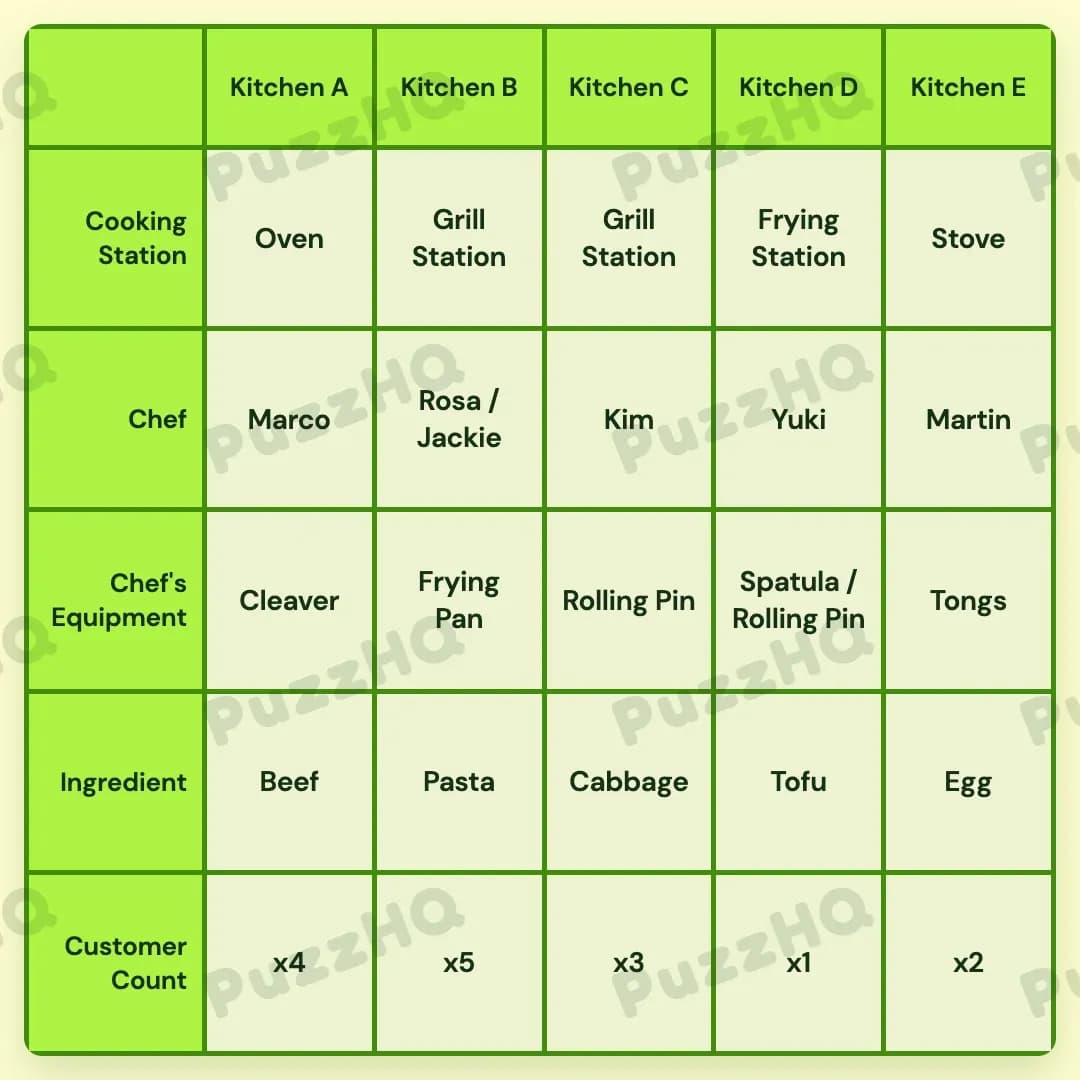
Every kitchen falls into place once you use customer traffic and equipment clues to lock down the layout extremes, allowing station menus and staff assignments to align cleanly across the line.
| Trait | Kitchen A | Kitchen B | Kitchen C | Kitchen D | Kitchen E |
|---|---|---|---|---|---|
| Cooking Station | Oven | Grill Station | Grill Station | Frying Station | Stove |
| Chef | Marco | Rosa / Jackie | Kim | Yuki | Martin |
| Chef's Equipment | Cleaver | Frying Pan | Rolling Pin | Spatula / Rolling Pin | Tongs |
| Ingredient | Beef | Pasta | Cabbage | Tofu | Egg |
| Customer Count | x4 | x5 | x3 | x1 | x2 |
Building The Grid By Trait
Customer volume and culinary equipment provide the strongest foundation for organizing the puzzle. By first mapping where tools sit along the row of kitchens and how foot traffic concentrates at each end, the remaining categories become straightforward to distribute without guesswork.
Customer Count And Chef's Equipment Establish Spatial Order
A physical layout puzzle usually unlocks through anchor clues that reference fixed positions or relative distances, and equipment does exactly that here. Kitchen C sits directly in the center, and a clue tells us that the middle kitchen holds a tool used for shaping dough. That immediately secures the Rolling Pin in Kitchen C.
From there, customer counts begin interacting directly with the kitchen lineup. We learn that the two most crowded kitchens are farthest from the Tongs. For two adjacent stations to be as far as possible from another tool across a five-bay layout, the Tongs must sit at one extreme end while the two peak traffic stations occupy the opposite end. Placing the Tongs at Kitchen E positions the two most crowded kitchens at Kitchen A and Kitchen B.
Another clue states that the kitchen equipped with a Cleaver is the second busiest overall. With customer counts spanning from x1 up to x5, the second busiest station must have a count of x4. Because Kitchen A and Kitchen B host the two highest customer counts, Kitchen A claims the Cleaver alongside count x4, leaving Kitchen B with the peak count of x5.
Next, we know that the station specializing in Tofu sees the fewest customers, which sets count x1 for that item. At the same time, we learn the Spatula sits right next to the Stove. Since Kitchen E holds the Tongs and needs a neighbor with a Spatula, Kitchen D receives the Spatula and customer count x1. Kitchen E naturally takes customer count x2, while Kitchen C settles into count x3. Finally, the remaining piece of equipment, the Frying Pan, slots into Kitchen B.
Cooking Station And Ingredient Align With The Layout
With the tools and customer counts locked across all five kitchens, cooking stations begin filling in by direct association. Kitchen D is singled out as ideal for deep frying and crispy dishes, which assigns the Frying Station directly to Kitchen D.
The neighboring equipment clues continue to pay dividends here. Because the Spatula sits next to the Stove, and Kitchen D holds the Spatula, Kitchen E must house the Stove. With the Stove confirmed in Kitchen E, an ingredient clue immediately follows: the chef at the Stove makes a delicious omelette. That detail permanently pairs eggs with Kitchen E.
The Grill Station appears twice in the puzzle. We are told that both Pasta and Cabbage are prepared at the Grill Station. Looking at the open bays, only Kitchen B and Kitchen C remain without an assigned station. Therefore, both Kitchen B and Kitchen C are Grill Stations. That leaves the Oven as the only unassigned station, which neatly falls into Kitchen A.
Resolving which grill station gets which ingredient comes down to a tool connection. Pasta is placed on teflon-coated equipment, which points directly to the Frying Pan. Since Kitchen B already holds the Frying Pan, Pasta belongs to Kitchen B. By elimination, Cabbage belongs to the Grill Station in Kitchen C. Kitchen D was already established as the Tofu-specialty kitchen with the lowest customer count, and the final ingredient, Beef, completes Kitchen A.
Chef Placements Finalize The Kitchen Staff
The kitchen personnel fall into place rapidly once the stations, ingredients, and customer counts are fixed. Martin is directly tied to the Stove because he suspects it needs maintenance. That puts Martin in Kitchen E alongside the Stove and Egg.
Next, Marco is explicitly excluded from the Grill Station today. Because Kitchen B and Kitchen C are both Grill Stations, Marco cannot work in either of them. With Kitchen E taken by Martin and Kitchen D designated for another cook, Marco must be stationed at Kitchen A.
That leaves the two Grill Stations open for the remaining culinary staff. We know that Jackie serves more customers than Kim. Comparing the counts for Kitchen B and Kitchen C, Kitchen B has count x5 while Kitchen C has count x3. Jackie must therefore work at Kitchen B, teaming up with head chef Rosa, while Kim manages Kitchen C.
With four kitchens fully staffed, Yuki takes the remaining spot in Kitchen D, completing the Frying Station alongside Tofu and the Spatula.
Where The Trait Rows Intersect
Equipment Geography Directs Customer Volume
The relationship between customer density and tool placement is the turning point of the entire deduction. Knowing that the two most crowded kitchens are farthest from the Tongs immediately restricts traffic to a specific gradient across the row. Instead of guessing how customer numbers spread out, this spatial clue forces the maximum values of x5 and x4 toward one edge and the Tongs toward the other, setting up subsequent station assignments effortlessly.
The Stove Clues Connect Three Traits Simultaneously
Kitchen E acts as a vital multi-trait junction. Martin's concern about maintenance points directly to the Stove. The neighboring tool clue positions the Spatula right next door in Kitchen D. Simultaneously, the culinary detail about an omelette links the Stove to eggs. This single hub resolves station type, equipment arrangement, ingredient, and personnel in one unified deduction.
Cookware Separates Duplicate Grill Stations
Having two identical Grill Stations could easily stall progress without cross-row links. The solution relies on intersecting the ingredient row with equipment traits. Clues indicate that both Pasta and Cabbage share the Grill Station, but only Pasta requires teflon-coated gear. Connecting that requirement to Kitchen B's Frying Pan immediately distinguishes Kitchen B from Kitchen C, preventing any ambiguity between the two grill bays.
Final Grid Check
Every row in the completed kitchen roster confirms the next. The equipment sequence correctly places the dough tool in the middle while maintaining the required spacing between the Tongs, the Spatula, and the busiest cooking bays. Customer counts rise and fall in exact accordance with chef performance, and every menu ingredient matches the specialized gear and heating element assigned to its respective cook.
Comments