
Profile Perfect Level 654 Answer
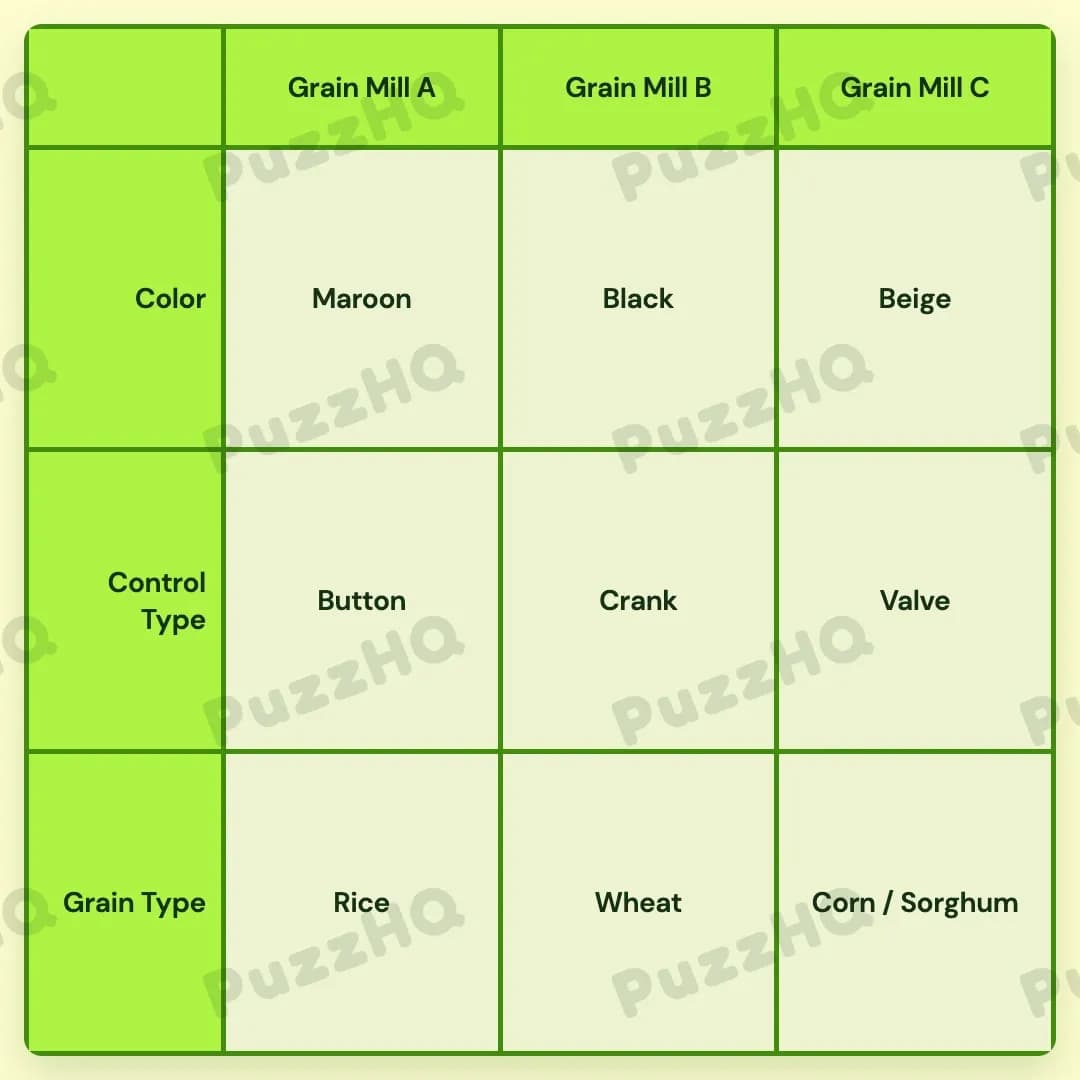
A careful look at machine spacing and multi-grain processing resolves the workshop into a tidy row of three distinct grain mills.
| Trait | Grain Mill A | Grain Mill B | Grain Mill C |
|---|---|---|---|
| Color | Maroon | Black | Beige |
| Control Type | Button | Crank | Valve |
| Grain Type | Rice | Wheat | Corn / Sorghum |
The Logic Behind Profile Perfect Level 654
At first glance, a three-subject puzzle might seem deceptively compact, but the central idea of 654 revolves entirely around spatial separation and grain variety. With only three mills lined up from Grain Mill A through Grain Mill C, the middle station sits directly adjacent to both outer stations. Because of that linear geometry, any statement about two mills not being beside one another immediately pushes those traits out to the opposite edges. Once that physical constraint is locked in, matching the control mechanisms to their respective crops unravels the rest of the board with satisfying clarity.
Opposite Flanks Anchor The Line
The fastest way to gain control over this floor plan is to look at where things cannot sit. We are told that the miller operating the automatic Button is not beside the Beige machine.
In a three-station row, Grain Mill B is beside every other machine. It neighbors Grain Mill A on its left and Grain Mill C on its right. If two elements cannot stand beside each other, neither of them can occupy the middle slot. That simple reality removes both the Button control and the Beige coat from Grain Mill B right away. They belong strictly to the outer positions.
The solved arrangement assigns the Button to Grain Mill A on the far side and the Beige finish to Grain Mill C on the opposite end. Because Grain Mill B cannot take either of those features, the remaining control types and body colors must work around these two anchors. Grain Mill B is effectively cordoned off from the Button and Beige pairing from the outset.
Blended Grains Narrow The Controls
With the layout framed, the mechanical requirements and grain varieties begin to link together. A few clues provide explicit pairs. We know that the mill processing Corn is controlled by a Valve, while crushing Wheat requires the user to rotate a Crank.
That leaves three controls: Button, Crank, and Valve. Since the Button belongs to Grain Mill A and the Valve operates the Corn, the Crank has only one spot left. It sits in Grain Mill B. By extension, because rotating the Crank is necessary to crush Wheat, Grain Mill B handles Wheat.
The grains then fall into place through a notable detail about processing capacity. We are told that the Beige mill grinds different kinds of grains, whereas Rice is strictly not processed with another grain. Grain Mill C, finished in Beige, must therefore be the multi-grain station that takes the blended Corn and Sorghum combination. Because Corn is tied directly to the Valve, Grain Mill C must also house the Valve control.
This naturally leaves Rice as the solitary grain for the only unassigned station. Grain Mill A, equipped with its automatic Button, is the dedicated Rice mill.
Color Eliminations Clear The Middle
All three stations now have their controls and grain types completely accounted for, leaving only the exterior colors to resolve. Grain Mill C is already confirmed as Beige. That leaves Maroon and Black to be distributed between Grain Mill A and Grain Mill B.
The final restriction states that the Black machine is not used to grind Rice.
Since Grain Mill A processes Rice, it cannot be painted Black. That single restriction pushes the Black exterior directly into the middle slot at Grain Mill B, which is already running the Crank for Wheat. With Black settled in the center, Maroon becomes the only available color for Grain Mill A.
Every mill now holds a unique color, a distinct control mechanism, and an appropriate grain workload, all resting cleanly on legitimate deductions.
The Clue I Would Read Twice
The clue stating that the Beige mill grinds different kinds of grains is easily the most intriguing piece of writing in 654.
In many deduction puzzles, solvers instinctively expect a neat one-to-one relationship across every category. Seeing multiple grains listed in a single space might feel like an anomaly if you skim too fast. Yet this singular line informs us that at least one mill takes on more than a single crop. Pairing that insight with the note that Rice is never processed alongside another grain immediately singles out the Corn and Sorghum combination for the Beige mill. It is a subtle linguistic cue that bridges the physical traits to the harvest varieties without needing an elaborate chain of exclusions.
Final Thoughts
What makes 654 memorable is how much mileage it gets out of a minimalist three-mill setup. Rather than overwhelming you with sprawling chains of elimination, the puzzle tests your awareness of linear positioning. Once you recognize that the center machine connects to everything, the puzzle gently nudges you to solve it from the outside in.
Comments