
Profile Perfect Level 650 Answer
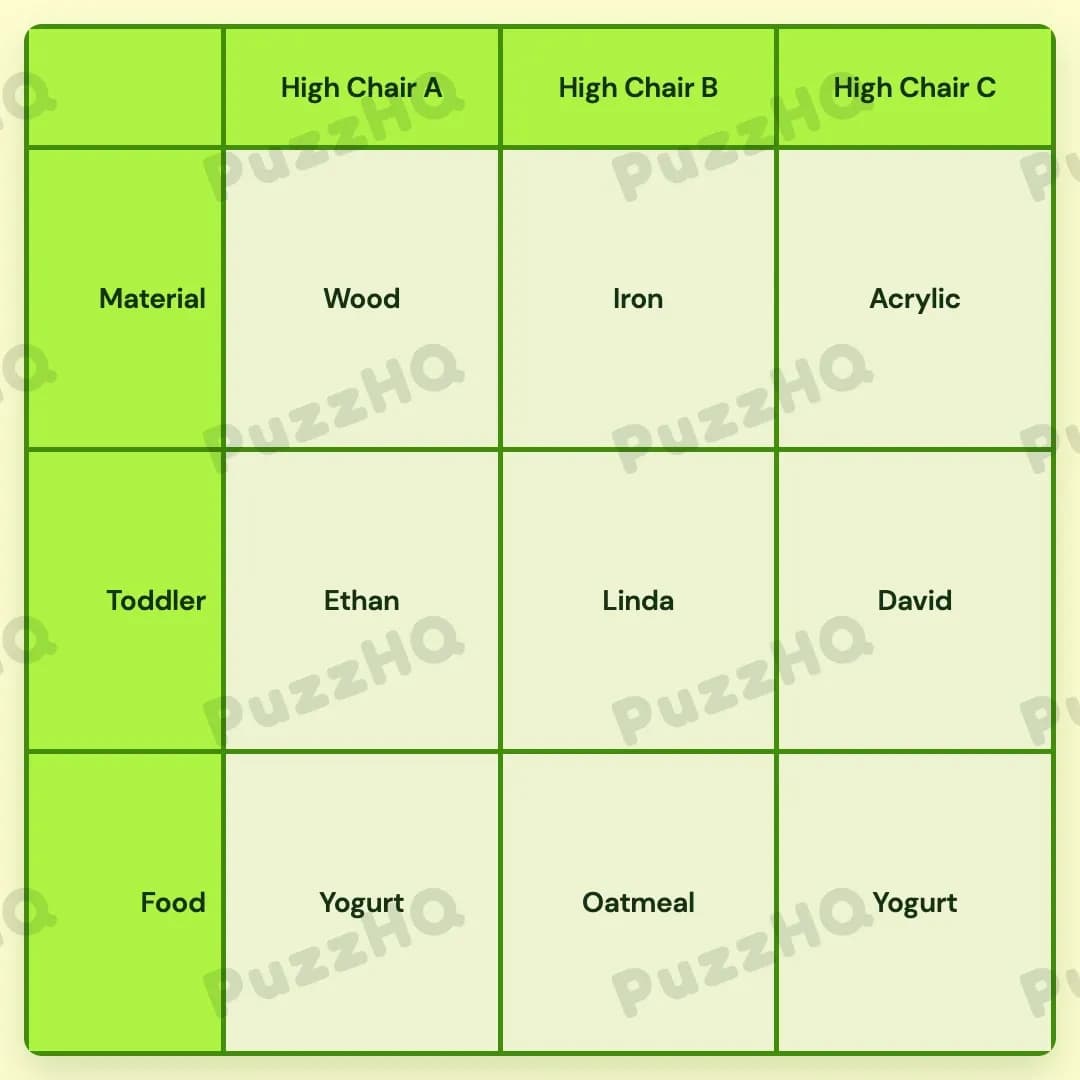
The three high chairs seat Ethan in the wooden chair eating yogurt, Linda in the welded iron chair eating oatmeal, and David in the acrylic chair eating yogurt.
| Trait | High Chair A | High Chair B | High Chair C |
|---|---|---|---|
| Material | Wood | Iron | Acrylic |
| Toddler | Ethan | Linda | David |
| Food | Yogurt | Oatmeal | Yogurt |
How To Think Through Profile Perfect Level 650
The most productive solving habit for this puzzle is locking down physical anchors before attempting relational deductions. When a puzzle gives you clear positional statements, placing those items immediately establishes a stable framework. Once you know which seats are already spoken for, complicated statements about shared preferences or fragile materials become easy to evaluate.
Start With Fixed Positions: Ethan Takes The Left Chair
Direct positional clues should always be your opening move because they remove guesswork across multiple categories. In this puzzle, you are told that Ethan is seated on the left chair.
Looking across the three seats, the left position corresponds to High Chair A. You can place Ethan into High Chair A immediately.
This simple placement achieves two things right away:
- It settles one of the three toddlers without needing any cross-referencing.
- It closes off High Chair A to the other two toddlers, which simplifies every later clue that mentions names.
When a clue hands you a fixed location, take it immediately. Leaving positional clues for later only forces you to keep unnecessary possibilities in your head.
Identify Tangible Properties: Welding Points To The Middle Chair
The next direct clue notes that welding was required to build the middle chair. High Chair B is the middle chair. Among the available materials of wood, iron, and acrylic, iron is the only material assembled through welding.
Because of this direct physical property, you can place Iron into the Material row for High Chair B.
Notice why this matters so early in the solve. You now have two separate columns partially defined:
- High Chair A holds Ethan.
- High Chair B is made of Iron.
By securing these two distinct points, you have drastically reduced the number of open slots across the grid. Every subsequent clue now has a much smaller surface area to interact with.
Link Names To Materials: David Claims The Acrylic Chair
With Ethan on the left and Iron in the middle, you can evaluate the statement about David and the acrylic chair. The clue tells you that David might damage the acrylic chair during a tantrum. This connects David directly to the acrylic material.
Now look at where David and the acrylic chair can actually fit:
- High Chair A already belongs to Ethan, so David cannot sit there.
- High Chair B is made of Iron, so the acrylic chair cannot be High Chair B.
That leaves only one possible location for both David and the acrylic chair. David must be seated in High Chair C, and High Chair C must be made of Acrylic.
This is a classic profile deduction technique: when a clue pairs two traits together, scan your board for a column that has both of those trait slots empty. Because the other two columns were already committed to a different toddler or a different material, High Chair C was the only valid spot.
Clear The Leftover Slots: Resolving Linda And Wood
Once you place David and Acrylic into High Chair C, two categories are almost completely resolved. Instead of moving on to a new clue, look at what remains unassigned in the Toddler and Material rows.
For the toddlers:
- Ethan is in High Chair A.
- David is in High Chair C.
- Linda is the only toddler without a seat.
Because High Chair B is the only chair missing a toddler, Linda must be seated in High Chair B.
For the materials:
- High Chair B is Iron.
- High Chair C is Acrylic.
- Wood is the only material not yet placed.
Because High Chair A is the only chair missing a material, High Chair A must be made of Wood.
Always take time to sweep up remaining singletons. When two out of three slots in a category are filled, the third slot resolves itself automatically. Finishing these rows gives you a completely defined roster of children and chair materials before you tackle the food clues.
Evaluate Shared Traits: Distributing The Meals
At this stage, only the Food row remains open. You have two clues left to resolve the meals:
- David eats the same food as Ethan.
- Oatmeal is not served on the wooden chair.
Start with the negative rule. High Chair A is the wooden chair. The clue states that Oatmeal is not served on the wooden chair, which means High Chair A cannot be Oatmeal.
Next, combine that restriction with the matching rule. David and Ethan eat the exact same meal. Ethan is in High Chair A, and David is in High Chair C. Since Ethan cannot eat Oatmeal, neither Ethan nor David can have Oatmeal.
If Ethan and David cannot eat Oatmeal, they must both eat Yogurt. Place Yogurt into High Chair A for Ethan and into High Chair C for David.
That leaves only one food slot open. High Chair B, occupied by Linda, must take Oatmeal. The entire grid is now complete, fully justified by step-by-step logic without a single guess.
What This Level Teaches You
Fixed Seats Create Immediate Dead Ends For Other Clues
Placing Ethan in High Chair A right away prevented you from considering High Chair A as an option for David later on. Establishing hard boundaries early eliminates false paths before they can distract you. Whenever a puzzle mentions an absolute physical position such as left, right, or middle, resolve it before reading complex interaction clues.
Paired Traits Require Fully Open Columns
The clue connecting David to the acrylic chair did not mention High Chair C by name. However, because High Chair A already had a toddler and High Chair B already had a material, High Chair C was the only column capable of accepting both traits simultaneously. Looking for open dual slots turns vague trait pairs into exact placements.
Identical Value Rules Multiply The Power Of Negative Clues
When two subjects must share the same trait, any negative rule that affects one subject automatically restricts the other. Disqualifying Oatmeal from the wooden chair felt like a small clue about High Chair A. Because Ethan and David shared a meal, that single restriction eliminated Oatmeal for two separate chairs at once. Always look for ways a negative constraint can ripple through linked subjects.
Final Thoughts
The key habit in this level was sequencing your deductions properly. Solving physical chair positions first created the framework needed to isolate David and Acrylic, which in turn forced the remaining seats to reveal themselves. When you respect the order of information and let simple anchors clear the board first, complex constraints solve themselves smoothly.
Comments