
Profile Perfect Level 656 Answer
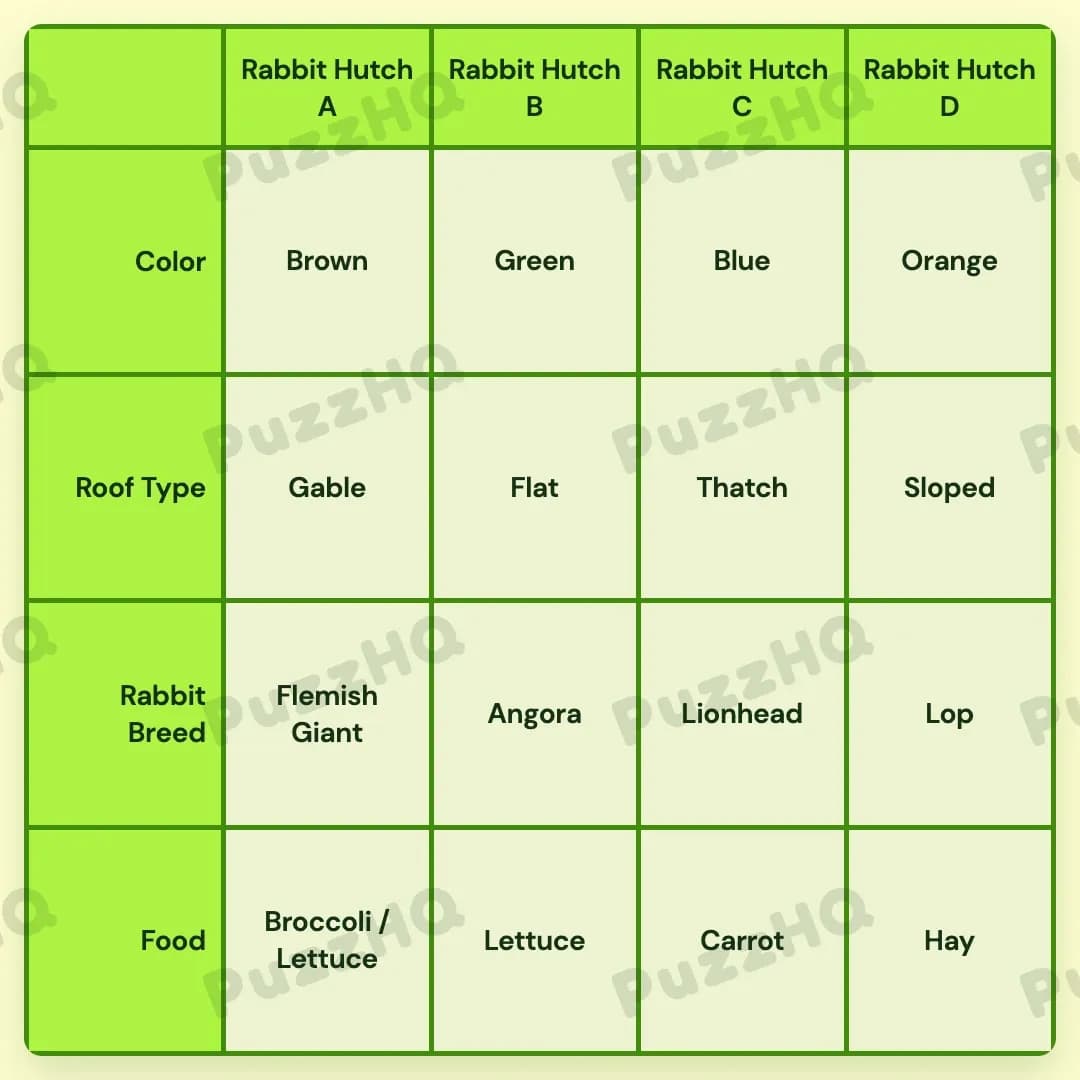
Rabbit Hutch A houses a Flemish Giant under a Gable roof eating Broccoli and Lettuce, Rabbit Hutch B houses an Angora under a Flat roof eating Lettuce, Rabbit Hutch C houses a Lionhead under a Thatch roof eating Carrot, and Rabbit Hutch D houses a Lop under a Sloped roof eating Hay.
| Trait | Rabbit Hutch A | Rabbit Hutch B | Rabbit Hutch C | Rabbit Hutch D |
|---|---|---|---|---|
| Color | Brown | Green | Blue | Orange |
| Roof Type | Gable | Flat | Thatch | Sloped |
| Rabbit Breed | Flemish Giant | Angora | Lionhead | Lop |
| Food | Broccoli / Lettuce | Lettuce | Carrot | Hay |
How To Think Through Profile Perfect Level 656
The most useful solving habit for this level is anchoring a single fixed column early, then using multi trait combinations and positional constraints to lock the remaining columns into place. When a puzzle gives you a named subject alongside spatial relationships, connecting those facts prevents unnecessary guesswork.
Direct Trait Placement: Rabbit Hutch C Takes The Carrot
Begin by finding clues that name a specific subject directly. In this puzzle, one clue states that Rabbit C only eats orange vegetables rich in beta carotene.
This clue points directly to the Carrot trait and assigns it to Rabbit Hutch C without needing any reference to neighboring hutches. Direct assignments like this are the most valuable starting points in logic grids. Rabbit Hutch C is the third column in the sequence from left to right. By immediately locking Carrot into Rabbit Hutch C, you create a concrete anchor point that nearby relational clues can reference.
Bundle Multi Trait Clues: Combine Roofs, Colors, And Food
Before attempting to place items into specific columns, identify clues that bind multiple traits together into movable blocks.
One clue notes that the Sloped hutch is painted Orange. Another clue reveals that the Green Flat hutch houses rabbits with a dominant white color. A third clue mentions that the Flat hutch rabbit likes Lettuce and sits next to the Carrot.
Notice how the Flat roof appears in two separate statements:
- It is paired with the color Green.
- It is paired with Lettuce as its rabbit food.
This tells you that Flat, Green, and Lettuce all belong to the exact same hutch. In addition, Sloped and Orange belong together. Combining these traits before placing them on the board simplifies your work because you are no longer tracking four individual variables. You are tracking composite blocks that must find an open slot where none of their traits conflict.
Positional Logic: Locate The Rightmost Hutch And The Neighbor Of Carrot
Now apply spatial clues to locate where these trait blocks must sit. The columns run from left to right as Rabbit Hutch A, Rabbit Hutch B, Rabbit Hutch C, and Rabbit Hutch D.
The clue stating that the rightmost hutch has a trapezoid shape identifies Rabbit Hutch D as the hutch with the Sloped roof. Because you already linked Sloped to Orange, Rabbit Hutch D must be painted Orange.
Next, look at the clue stating that the Flat hutch is next to the Carrot. Rabbit Hutch C already holds the Carrot. Its immediate neighbors are Rabbit Hutch B on the left and Rabbit Hutch D on the right. Rabbit Hutch D is already occupied by the Sloped roof and the color Orange. Therefore, the Flat roof cannot go into Rabbit Hutch D.
The Flat roof must belong to Rabbit Hutch B. Because Flat was already bundled with Green and Lettuce, Rabbit Hutch B instantly receives:
- Roof Type: Flat
- Color: Green
- Food: Lettuce
Distance Clues And Elimination: Position The Lop And The Remaining Colors
With Rabbit Hutch B established as the Green hutch, you can resolve the clue about column distance. The clue states that the droopy eared rabbit is 2 columns away from the Green hutch.
Rabbit Hutch B is column 2. Moving 2 columns to the left is impossible because only one column sits to its left. Moving 2 columns to the right places the droopy eared rabbit in column 4, which is Rabbit Hutch D. A droopy eared rabbit is a Lop, so Rabbit Hutch D is home to the Lop breed.
Next, look at the remaining colors: Blue and Brown. One clue states that the Blue hutch is not to the left of the Green one. Rabbit Hutch B is Green. The only hutch to the right of Green that does not yet have a color is Rabbit Hutch C, because Rabbit Hutch D is already Orange.
Therefore, Rabbit Hutch C must be Blue. By simple elimination of available colors, Rabbit Hutch A must be Brown.
Breed Comparison And Diets: Complete The Remaining Cells
Now that colors are fixed, look at the ear size clue. The rabbit in the Blue hutch has smaller ears than the rabbit in the Brown hutch.
The two remaining unassigned breeds with ear size distinctions are the Flemish Giant and the Lionhead, alongside the white rabbit in the Green hutch. The white rabbit in the Green Flat hutch is the Angora. Between the Flemish Giant and the Lionhead, the Flemish Giant is well known for massive ears, while the Lionhead has small, upright ears. Rabbit Hutch C is Blue, so it receives the Lionhead. Rabbit Hutch A is Brown, so it receives the Flemish Giant.
Finally, resolve the remaining roofs and diets. The available roof styles left to place are Gable and Thatch for Rabbit Hutch A and Rabbit Hutch C.
The clue regarding diet states that the Gable hutch rabbit has a variety of diets, excluding Hay. Rabbit Hutch C is already established as eating only Carrot. Rabbit Hutch A is the only hutch left that can accommodate a mixed diet of Broccoli and Lettuce. Therefore, Rabbit Hutch A gets the Gable roof and the Broccoli and Lettuce diet.
That leaves the Thatch roof for Rabbit Hutch C. Rabbit Hutch D, which has no assigned diet yet, takes the remaining food value, which is Hay. All sixteen cells across all four hutches are now completely solved without a single guess.
What This Level Teaches You
Build Trait Bundles Before Trying To Place Them
When clues link traits together without mentioning a subject name, treat those traits as a single combined unit. In this level, noticing that Flat connected to both Green and Lettuce created a three trait bundle. Trying to place Green, Flat, and Lettuce separately would require testing several possibilities. Recognizing that they move together meant that finding a slot for one instantly placed all three.
Positional Elimination Eliminates Alternative Neighbor Candidates
When a clue states that an object sits next to a known landmark, check whether one side of that landmark is already blocked. Rabbit Hutch C held the Carrot, leaving Rabbit Hutch B and Rabbit Hutch D as possible neighbors. Because Rabbit Hutch D was already identified as having the Sloped roof, Rabbit Hutch B was the only remaining neighbor available for the Flat roof.
Distance Constraints Restrict Column Options Rapidly
Statements describing an exact number of columns between two subjects are among the strongest tools in four column grids. A condition requiring two columns of separation from column B can only reach column D. Watching for spatial boundaries eliminates half the grid immediately.
Final Thoughts
The key habit in this level was letting positive placements guide negative elimination. Placing the Carrot in Rabbit Hutch C and identifying Rabbit Hutch D as the Sloped Orange hutch made every subsequent spatial deduction fall into place cleanly.
Comments