
Profile Perfect Level 655 Answer
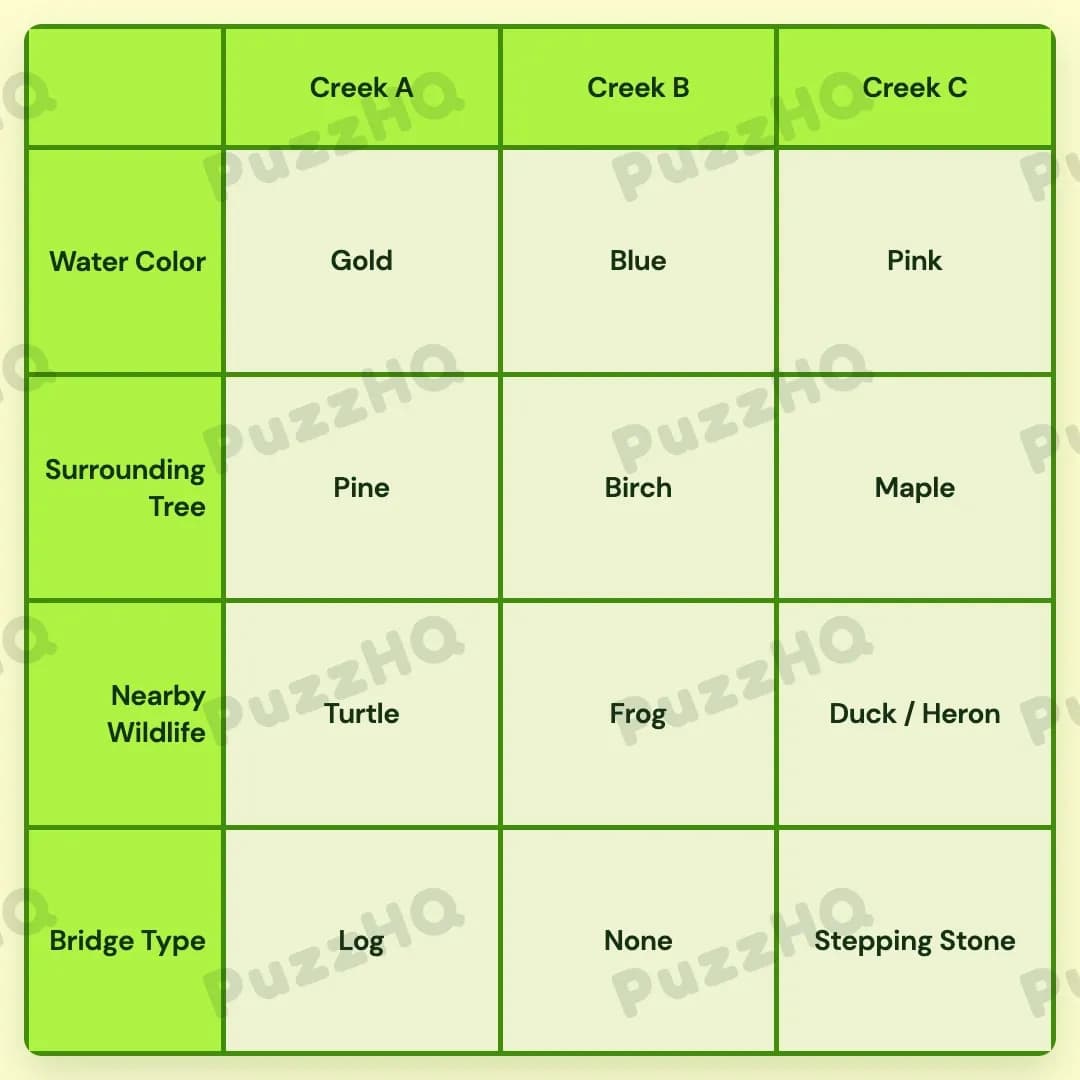
By anchoring the wildlife row across the three creeks first, every remaining category falls into place through direct environmental pairings.
| Trait | Creek A | Creek B | Creek C |
|---|---|---|---|
| Water Color | Gold | Blue | Pink |
| Surrounding Tree | Pine | Birch | Maple |
| Nearby Wildlife | Turtle | Frog | Duck / Heron |
| Bridge Type | Log | None | Stepping Stone |
Building The Grid By Trait
Starting with nearby wildlife yields the clearest path forward because spatial positioning and biological clues isolate all three animal entries immediately. Once the animal row is settled, it acts as a reliable foundation that branches cleanly into trees, bridges, and water colors.
Nearby Wildlife Establishes Spatial Anchors
The physical arrangement of the waterways runs from left to right as Creek A, Creek B, and Creek C. The first direct connection to this layout comes from the observation that the leftmost wildlife is famous for its long lifespan. Comparing the wildlife candidates across the setting, the turtle stands out as the classic symbol of longevity, easily surpassing birds or amphibians. This gives Creek A its turtle right away, securing the leftmost anchor on the board.
From there, the wildlife category resolves rapidly through a biological link. We know that the animals frequenting Creeks A and B are both cold-blooded creatures. With Creek A already housing the turtle, Creek B requires another cold-blooded inhabitant. Between frogs and waterfowl, only the frog fits this physiological description. Placing the frog at Creek B leaves just one wildlife assignment unoccupied. The ducks and heron pair naturally fills the final opening at Creek C on the far right. With all three wildlife positions locked into place within moments, this single category becomes the springboard for the surrounding vegetation.
Surrounding Tree Links To Wildlife And Bridge Difficulty
With the wildlife row fully populated, the surrounding tree category begins to take shape through an explicit interaction between fauna and flora. Ducks are known to lay their eggs beside maple trees. Because ducks were placed at Creek C during the animal deductions, Creek C immediately claims the maple tree.
The remaining two tree types are birch and pine. Resolving which tree belongs to Creek B and which belongs to Creek A requires looking at how trees interact with the crossings. The hardest creek to cross is surrounded by birch trees. Looking at the possible bridge types, which feature a sturdy log, a series of stepping stones, or no crossing structure at all, the waterway that presents the greatest challenge is clearly the one lacking any bridge whatsoever.
Because Creek C already features maple trees and Creek A must accommodate a stable crossing, Creek B becomes the site of the birch trees. That leaves pine as the only remaining option for the surrounding tree category, which neatly slots into Creek A. At this stage, the entire tree row is completely determined, matching Creek A with pine, Creek B with birch, and Creek C with maple.
Water Color And Bridge Type Lock In Together
Now that Creek A is confirmed to have pine trees, the connection between bridge structures and water color can be fully applied. A vital environmental relationship notes that the log bridge spanning the golden creek is surrounded by pines. This combines three separate traits into a single unified profile: a log crossing, golden water, and pine foliage. Because Creek A is already firmly paired with pine trees, both the log bridge and the golden water color must belong to Creek A as well.
This decisive deduction leaves only two water colors and two bridge types to place across Creeks B and C. For the water colors, pink and blue remain. The pink creek is specifically described as not being located next to the turtle. Creek A is the turtle's home, and Creek B sits directly adjacent to Creek A. Therefore, Creek B cannot be pink without violating that spacing condition. This forces the pink water over to Creek C on the far right. With Creek A claiming gold and Creek C claiming pink, Creek B takes blue as its water color.
Finally, the bridge category finishes without friction. Creek B was earlier recognized as the hardest creek to cross, which means it has no bridge at all. Creek A holds the log bridge from the pine and golden water cluster. That leaves the stepping stones as the sole bridge type left for Creek C. Every trait row has now settled into its proper column.
Where The Trait Rows Intersect
The Lifespan Clue Translates Spatial Order Into Biological Traits
Relying strictly on an empty grid can feel disorienting without a fixed point of origin. The clue identifying the leftmost creature by its impressive lifespan acts as a bridge between pure geography and biology. By translating the leftmost position directly into Creek A, the puzzle grants an immediate home to the turtle. This single insight keeps the solver from juggling abstract animal pairings, immediately providing a concrete anchor that lets the cold-blooded clue finish the remaining wildlife in one smooth pass.
The Maple Clue Chains Avian Wildlife Directly To Flora
Instead of forcing the solver to deduce trees through trial and error, the puzzle builds an explicit chain from animal habits to botanical life. The mention of ducks nesting beside maple trees functions as a direct cross-category handoff. Because ducks were already isolated at Creek C through the elimination of cold-blooded animals at Creeks A and B, the maple tree is drawn straight to Creek C without any ambiguity. This cross-trait bridge prevents any confusion between birch and maple early in the deduction process.
The Triple Link Among Bridges, Water, And Pines Resolves Creek A
The most powerful intersection in the puzzle binds three different traits together at once: log bridges, golden water, and pine trees. Rather than analyzing each row in isolation, this multi-category bundle acts as a preassembled block. Once pine trees were pinned to Creek A through the elimination of maple at Creek C and birch at Creek B, that entire block drops into Creek A simultaneously. In a single logical beat, two additional rows gain definitive answers, breaking the back of the puzzle and leaving only simple process-of-elimination choices for the remaining columns.
Final Grid Check
Every row in the finished arrangement reinforces the others without a single contradiction. The turtle rests on the far left at Creek A beneath pines and beside a log bridge over golden water. Creek B maintains its cold-blooded frog neighbor while its lack of a bridge justifies its reputation as the most difficult crossing, surrounded by birch and blue water. Creek C brings the waterfowl to their maple nesting grounds, where stepping stones provide an easy passage across pink water, safely distant from the turtle's territory. Each trait category interlocks tightly with its neighbors, proving the grid is entirely sound.
Comments