
Profile Perfect Level 660 Answer
If you want to preserve the fun of uncovering these gloomy storerooms on your own, turn back now before the full layout is revealed.
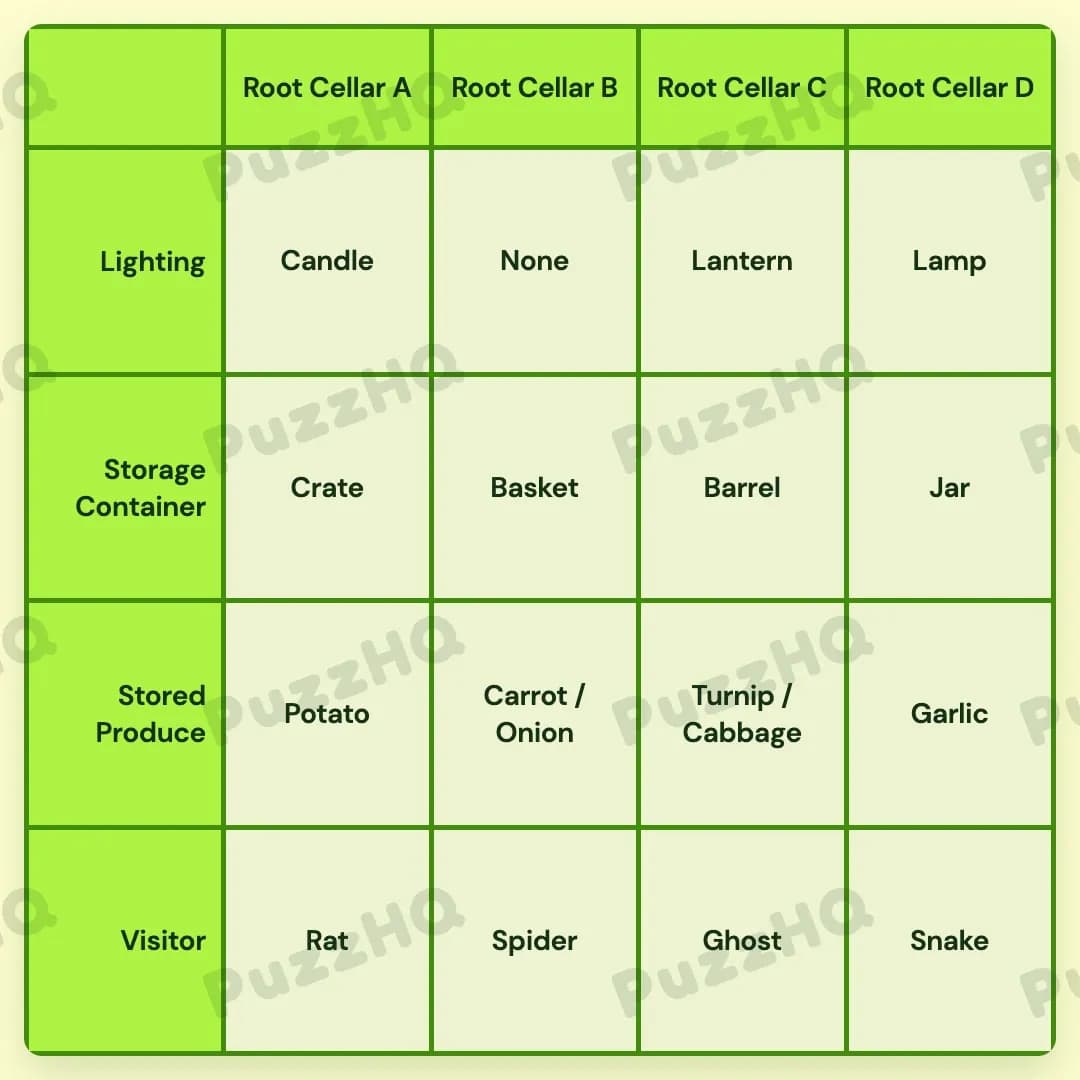
| Trait | Root Cellar A | Root Cellar B | Root Cellar C | Root Cellar D |
|---|---|---|---|---|
| Lighting | Candle | None | Lantern | Lamp |
| Storage Container | Crate | Basket | Barrel | Jar |
| Stored Produce | Potato | Carrot / Onion | Turnip / Cabbage | Garlic |
| Visitor | Rat | Spider | Ghost | Snake |
The Logic Behind Profile Perfect Level 660
At first glance, this cellar row looks like a standard spatial puzzle where objects simply line up from left to right. The real pivot of the solve lies in how the grid handles physical distance. Several clues speak of items lying between other items, but because certain cellars hold multiple crops at once, counting steps across the floor is not merely a matter of counting rooms. Once you realize that the architecture balances single-crop rooms on the outside against packed pantries in the middle, the entire underground corridor falls into line.
Anchoring The Outer Walls
The first task is establishing where the underground row begins and ends. We have four root cellars lettered A through D, and two distinct clues immediately draw our focus to opposite extremes. We are told that the jar collection under the lamp sits farthest from the crate. In a simple row of four adjacent spaces, the greatest possible distance can only exist between the two outer ends, which places the crate at one wall and the jar with its lamp at the other.
To decide which end belongs to which container, look at the spiders. The crates can be found to the left of the room filled with the spider. If the crate were positioned in Root Cellar D on the far right, it could not be to the left of anything. That simple directional restriction anchors the crate securely in Root Cellar A on the far left.
With the crate locked into Root Cellar A, the jar and its overhead lamp take their place in Root Cellar D. We also learn right away that visitors need to bring their own lighting to Cellar B, which instantly settles the lighting trait for that room as none. Just three pieces of guidance give the entire row its physical boundaries and resolve two of the four illumination types before we even look at the produce.
Mapping The Wandering Visitors
With the outer containers fixed, attention shifts naturally to the pests and spirits roaming the corridor. A hungry rat is trying to eat in the room with only potato. Because Root Cellar D is already dedicated to the jar and lamp, and because later clues establish multiple crops in the interior rooms, Root Cellar A is the natural home for this lone potato and its rat. That leaves Candle as the only logical source of light for Root Cellar A, while Lantern must illuminate Root Cellar C.
Now consider the remaining creatures. The slithering snake visits the room right next to the cabbage, while the cabbage itself must be stored in either the jar or the barrel. If the cabbage were in the jar at Root Cellar D, the snake would have to be in Root Cellar C to be next to it. That arrangement quickly collapses when we look at the visitor from another realm.
The ghost sits to the right of the onion. If the ghost is in Root Cellar C, it cleanly occupies the space to the right of an onion kept in Root Cellar B. That leaves Root Cellar D for the snake, exactly where it can visit the adjacent room holding the cabbage. Tracing back to the spiders mentioned earlier, their room to the right of the crates must be Root Cellar B. In one connected sequence, the entire visitor row settles into place: Rat in A, Spider in B, Ghost in C, and Snake in D.
Stocking The Shelves And Baskets
The final stage is sorting out the containers and crops that occupy the center rooms. Since the cabbage cannot go into the jar at Root Cellar D, it must reside in the barrel at Root Cellar C. That leaves the basket for Root Cellar B, completing all four storage containers across the board.
We are told that garlic is not inside the basket in Cellar B. With Root Cellar A dedicated entirely to a lone potato and Root Cellar C holding the cabbage, garlic can only belong in the jar at Root Cellar D.
This brings us to the dual crop rooms in the center. The puzzle notes that two kinds of stored items sit between the carrot and the garlic. Since garlic is out at Root Cellar D, the two intervening items are the turnip and cabbage sharing the barrel in Root Cellar C. That pushes the carrot straight into Root Cellar B alongside the onion, completing the inventory without any guesswork.
The Clue I Would Read Twice
The third clue, which mentions that two types of crops sit between the snake and the spider, is extraordinarily easy to misunderstand on a first pass. Anyone accustomed to standard logic puzzles will reflexively assume that two whole cellars must separate these two creatures. If you read it that way, you will search in vain for a way to push the spider and the snake to opposite ends of the board.
The wording does not say two rooms sit between them. It specifically says two types of crops. Because Root Cellar C houses both turnip and cabbage together in a single barrel, that one intermediary room contains both required crops. Recognizing that crop counts do not always equal room counts is the master key that keeps the solve moving forward.
Final Thoughts
What makes this level stand out is how gracefully it blends spatial directions with room contents. By allowing Root Cellar B and Root Cellar C to store paired harvests, the puzzle subverts the assumption that every room is identical in scale. Once you let the physical layout guide your deductions, the damp corridor becomes remarkably straightforward to navigate.
Comments