
Profile Perfect Level 661 Answer
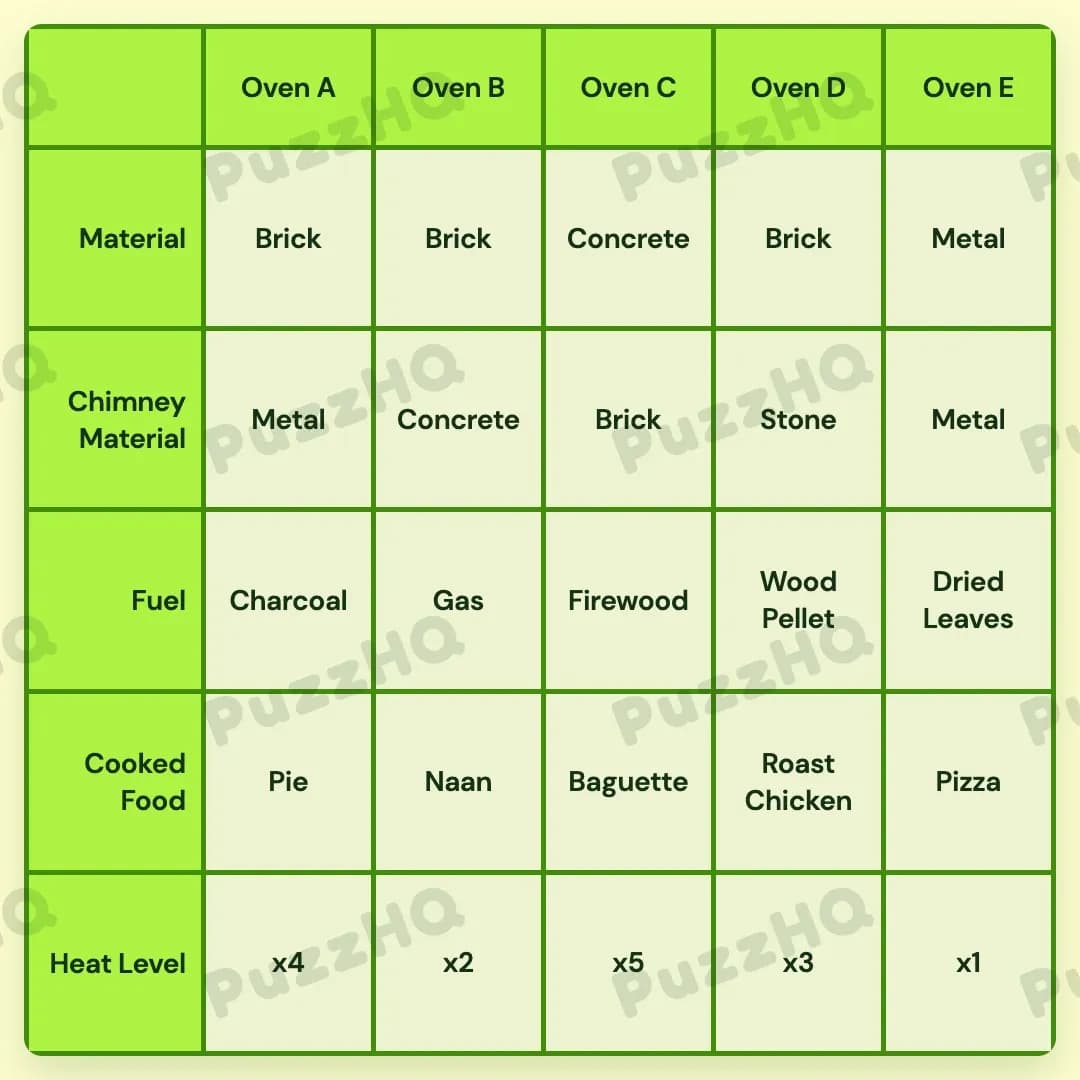
Every oven along the line pairs distinct structural materials, chimneys, fuels, foods, and heat ratings, culminating in Oven C reaching the maximum heat level of x5 for baking French bread while Oven E runs coolest at x1.
| Trait | Oven A | Oven B | Oven C | Oven D | Oven E |
|---|---|---|---|---|---|
| Material | Brick | Brick | Concrete | Brick | Metal |
| Chimney Material | Metal | Concrete | Brick | Stone | Metal |
| Fuel | Charcoal | Gas | Firewood | Wood Pellet | Dried Leaves |
| Cooked Food | Pie | Naan | Baguette | Roast Chicken | Pizza |
| Heat Level | x4 | x2 | x5 | x3 | x1 |
Building The Grid By Trait
Starting a puzzle like this works best when we identify which trait provides absolute anchors across the five columns. Here, the chimney materials offer immediate physical footholds on the board, especially when combined with the specific foods prepared inside each chamber.
Chimney Material And Cooked Food Form The Primary Anchor
We begin with the chimney materials because several clues immediately limit their possible locations. We learn that Oven E and its chimney both use a highly conductive material. Among traditional building options, metal is the standout conductive material, which immediately fixes Metal as Oven E's chimney material as well as Oven E's main build material.
From there, we look at the neighbor condition stating that Stone and Metal chimneys are neighbors. With Oven E using a Metal chimney, its immediate neighbor to the left, Oven D, is primed to receive the Stone chimney. This assignment is reinforced by the clue connecting Stone chimneys directly to the menu: the oven with a Stone chimney roasts Chicken. Thus, Oven D secures both the Stone chimney and Roast Chicken.
The remaining chimney choices include Concrete, Brick, and another Metal chimney. We are told that iconic French bread, which is a Baguette, is baked in an oven with a Brick chimney. Because Oven D already roasts Chicken and Oven E has a Metal chimney, the Brick chimney must belong to an earlier column. Furthermore, Indian food, represented by Naan, must sit immediately to the left of an oven that burns Firewood. This positional pairing leaves Oven C as the only logical home for the Brick chimney and the Baguette, while Naan settles into Oven B. The final chimney materials fall into place naturally, giving Concrete to Oven B and Metal to Oven A.
Fuel Placements Establish The Linear Framework
Once the food items and chimneys begin defining individual stations, the fuel traits establish the exact horizontal spacing between the ovens. A key relationship states that Wood Pellet is three columns away from Charcoal. In a five-column layout, a gap of three columns means the two fuels must occupy either columns 1 and 4 or columns 2 and 5.
We can resolve this spacing by examining the foods tied to these locations. We know that the dish in the Charcoal-fueled oven is not a meat dish. Oven D already holds Roast Chicken, which is a meat dish. Consequently, Oven D cannot use Charcoal. This forces Wood Pellet into Oven D and places Charcoal three columns to the left in Oven A.
With Oven A burning Charcoal and Oven D burning Wood Pellet, only three fuel options remain: Firewood, Gas, and Dried Leaves. The clues tell us that the oven to the right of the Indian food uses Firewood, and the fuel with no fixed shape sits to the left of Firewood. Because Gas is the fuel with no fixed shape, Gas must be located directly to the left of Firewood. Oven B holds the Indian food (Naan), meaning Oven C must use Firewood. That leaves Oven B to burn Gas, perfectly fulfilling the requirement that Gas is to the left of Firewood. The remaining fuel, Dried Leaves, automatically fills the final opening in Oven E. With the fuels locked down, the leftover food items resolve cleanly: Pie goes to Oven A, which satisfies the condition that its Charcoal oven does not bake meat, and Pizza lands in Oven E.
Heat Level Distributes Temperatures Across The Line
With every oven now identified by its food and fuel, the Heat Level trait organizes the temperatures from x1 through x5. The clue specifying that the two hottest ovens are among the three leftmost ovens sets a hard ceiling on the right side of the layout. This means that heat levels x4 and x5 must be split between Oven A, Oven B, and Oven C.
We also know that Pizza and Baguette are both baked at odd-numbered heat levels. The odd heat levels available in the set are x1, x3, and x5. Since Baguette is inside Oven C, and Oven C is one of the leftmost ovens that must capture one of the two hottest ratings, Oven C must take the highest odd rating of x5. Oven A then takes the second hottest rating of x4 to fulfill the leftmost heat condition.
This leaves heat levels x1, x2, and x3 for the remaining ovens. Pizza is located in Oven E and must operate at an odd heat level. The only odd levels left are x1 and x3. Because Oven D is already occupied by Roast Chicken, assigning the odd heat level of x3 to Oven D leaves x1 for Pizza in Oven E. Finally, Oven B receives the remaining even heat level of x2, which cleanly matches the requirement that Naan is prepared at a lower heat level.
Material Finalizes The Construction Details
The last trait row to complete is the main oven material. We already determined early on that Oven E is built from Metal due to its highly conductive nature. We are also informed that more than one oven uses Brick, which indicates that Brick is the dominant material across the lineup.
Looking at the remaining subjects, Concrete and Brick are the options to distribute. Concrete claims Oven C, contrasting with its Brick chimney. Meanwhile, Oven A, Oven B, and Oven D are all constructed from Brick. This satisfies the rule that Brick appears multiple times across the row and solidifies the structural profile for the entire kitchen line.
Where The Trait Rows Intersect
The Stone Chimney Bridge Between Food And Position
The deduction linking the Stone chimney to Roast Chicken serves as the primary bridge between physical architecture and the food menu. When the clue places Stone and Metal chimneys as neighbors, knowing that Oven E is made of conductive Metal immediately confines the Stone chimney to Oven D. This single spatial connection instantly locks the food row by assigning Roast Chicken to Oven D, eliminating meat from every other station before the fuel layout is even fully solved.
How Fuel Spatial Clues Constrain Menu Selections
The three-column distance separating Charcoal and Wood Pellet interacts directly with the menu restriction barring meat from the Charcoal oven. Because Oven D was already designated as the chicken roaster, Charcoal was barred from Oven D, instantly forcing Charcoal into Oven A and Wood Pellet into Oven D. This cross-row interaction prevented guesswork regarding which end of the board hosted the pellet fuel.
The Intersection Of Bread Types, Brick Chimneys, And Temperature Maximums
Baking French bread requires a Brick chimney, which anchors Baguette to Oven C. Once Baguette is positioned in Oven C, the heat rules take over. The rule requiring the two hottest ovens to sit in the first three columns combined with the rule that Baguette requires an odd heat level forces Oven C to claim the absolute highest heat level of x5. Here, a chimney clue, a food clue, and a heat clue converge to lock down the peak temperature of the entire puzzle.
Final Grid Check
Every row in the finished arrangement harmonizes with the clues provided. The fuels align with the strict three-space interval between Charcoal and Wood Pellet, the gas sits directly beside the firewood, and the Indian food is positioned immediately beside the wood-fired chamber. Furthermore, the odd heat levels neatly accommodate the Baguette, Chicken, and Pizza, while the two hottest ovens remain comfortably within the three leftmost columns. The resulting grid forms a completely stable, logical solution.
Comments