
Profile Perfect Level 2 Answer
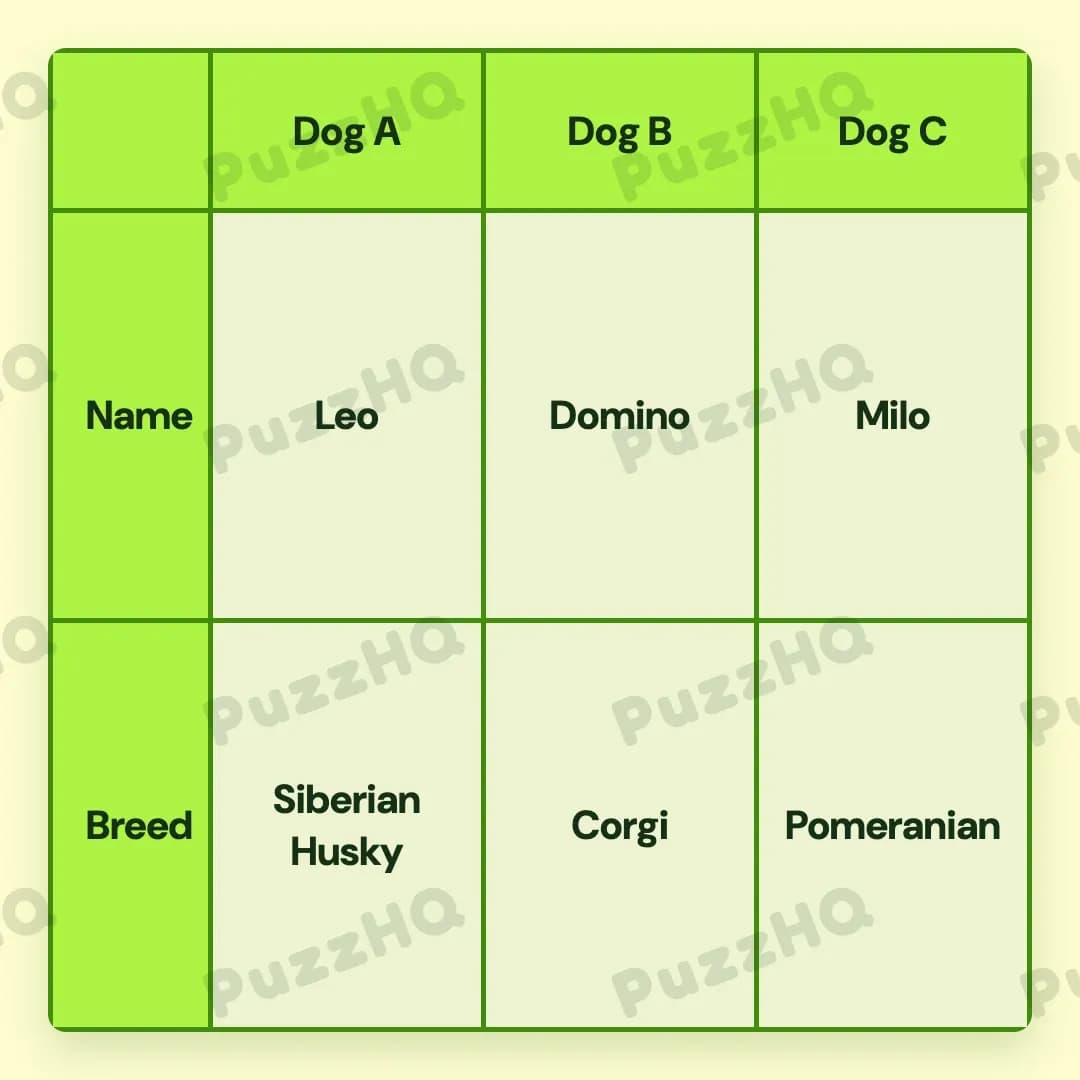
Dog A is Leo the Siberian Husky, Dog B is Domino the Corgi, and Dog C is Milo the Pomeranian.
| Trait | Dog A | Dog B | Dog C |
|---|---|---|---|
| Name | Leo | Domino | Milo |
| Breed | Siberian Husky | Corgi | Pomeranian |
Building The Grid By Trait
When approaching this challenge, tracking how the Name category unfolds across the board provides the most reliable foundation. While the clues distribute pieces of information across individual dogs, the identity labels establish firm coordinates early. Once the names settle into place, the Breed row responds almost immediately, because several clues create direct bridges between names and specific breeds. By analyzing each trait category systematically, we can watch the entire board organize itself from an initial anchor to a fully solved lineup.
Names Establish The Primary Grid Anchors
The Name trait offers an immediate direct anchor that grounds our initial column coordinates. We learn straight away that attached to Dog B is a tag reading Domino. Because this is an unambiguous, direct identification, Dog B immediately claims the Domino identity in our Name row.
With Domino secured at Dog B, the remaining names to place across the row are Milo and Leo. The clue structure gives us two distinct angles on these remaining names. First, we are told that Milo is next to Domino. In a three-subject lineup where Dog B sits in the middle position, any dog adjacent to Dog B could theoretically be either Dog A or Dog C. This means Milo must occupy either Dog A or Dog C, but the adjacency clue alone cannot distinguish between the two outer positions.
To resolve this ambiguity, we look at the third name in play: Leo. We are told that the Husky is called Leo by his owner. This statement bundles a name with a breed, which tells us that whoever is named Leo must also be a Husky. Because Dog B is already confirmed as Domino, Dog B cannot be Leo. Therefore, Leo must belong to either Dog A or Dog C.
The division between Milo and Leo across Dog A and Dog C depends entirely on cross-checking with the Breed row. As we look at the breed clues, we discover that Dog C is explicitly identified as a Pomeranian. Since Dog C is a Pomeranian, Dog C cannot possibly be the Husky named Leo. This single deduction forces Leo out of Dog C's column. With Dog B already holding Domino and Dog C disqualified from holding Leo, Leo has only one possible home: Dog A.
Once Dog A is established as Leo and Dog B is confirmed as Domino, the final open slot in the Name row belongs to Dog C. By process of elimination, Dog C must be Milo. This placement also perfectly satisfies the spatial condition requiring Milo to sit adjacent to Domino, because Dog C is directly beside Dog B. The entire Name row is now complete, providing firm anchors for Dog A, Dog B, and Dog C.
Breeds Consolidate Across The Identified Dogs
Now that the Name row is completely settled, the Breed trait falls into place with remarkable clarity. We are working with three distinct dog breeds across the grid: Siberian Husky, Pomeranian, and Corgi.
The initial anchor for the Breed trait comes from the direct clue stating that Pomeranian is Dog C's breed. This gives us an immediate, undeniable entry for Dog C, establishing Pomeranian at the far end of the lineup.
Next, we look back at the cross-trait condition connecting the Husky to the name Leo. During our analysis of the Name row, we proved that Dog A must be the dog named Leo. Because the owner calls the Husky by the name Leo, Dog A must carry the breed of Siberian Husky. This cleanly resolves the second breed slot without any ambiguity.
At this stage, two of the three subjects possess confirmed breeds. Dog A is the Siberian Husky, and Dog C is the Pomeranian. Only one breed remains unclaimed in the entire category: Corgi. Looking down the Breed row, Dog B is the only subject without an assigned breed. Therefore, Corgi naturally populates Dog B's breed cell.
By allowing the Name trait to dictate where the Husky relationship landed, the Breed row resolved Dog C directly, assigned Dog A through an identity link, and settled Dog B through straightforward process of elimination.
Where The Trait Rows Intersect
Solving this puzzle smoothly relies on watching how separate categories inform one another rather than treating each trait as an isolated list. Several key moments demonstrate how these category boundaries overlap to eliminate false possibilities.
The Exclusion That Separates Leo And Pomeranian
The most powerful intersection in the puzzle occurs between the clue naming Dog C as a Pomeranian and the clue linking Leo to the Husky. On its own, the Name clue merely tells us that a dog named Leo is also a Husky, without specifying which column holds that pair. Similarly, knowing Dog C is a Pomeranian does not immediately explain what happens to Dog A or Dog B.
However, when these two clues intersect, they create an immediate negative deduction. A single dog cannot simultaneously be a Siberian Husky and a Pomeranian. Because Dog C is locked in as a Pomeranian, Dog C cannot be the Husky, which instantly means Dog C cannot be Leo. This cross-category exclusion prevents Leo from drifting into the rightmost column and directs the Leo and Husky pairing straight into Dog A.
Adjacency Constrained By Identity
Another critical cross-trait moment involves the relationship between Milo and Domino. The clue stating that Milo is next to Domino appears purely spatial at first glance. Since Domino is Dog B, an adjacent position could belong to Dog A on the left or Dog C on the right.
Rather than guessing between those two positions, we wait until the Name and Breed intersection resolves Dog A as Leo the Husky. Once Dog A is confirmed to hold the name Leo, the left-hand position next to Domino is permanently occupied. This forces Milo into the right-hand position at Dog C. The intersection of spatial logic with Name assignment ensures that Milo fits into Dog C while effortlessly satisfying the adjacency rule.
Completing Domino The Corgi Through Elimination
The final intersection brings together every remaining element in the grid. With Dog B already holding the tag reading Domino from our very first step, Dog B waited for the other two columns to finalize their breeds. Once Dog A absorbed the Siberian Husky via the Leo connection, and Dog C claimed the Pomeranian directly, the Breed row had only one remaining option left to distribute.
The trait rows intersected so cleanly that Dog B never needed a dedicated clue describing its breed. The identity of Domino, combined with the complete resolution of the surrounding breeds, locked Corgi into Dog B by pure deduction.
Final Grid Check
Every row and column now reflects an airtight set of relationships that satisfy all given conditions. Dog A sits as Leo the black and white Siberian Husky. Dog B sits in the middle as Domino the Corgi, wearing his identified name tag. Dog C sits on the right as Milo the Pomeranian, positioned directly next to Domino just as required. Each trait row fully corroborates the other, leaving a completely harmonious and verified grid.
Comments