
Profile Perfect Level 646 Answer
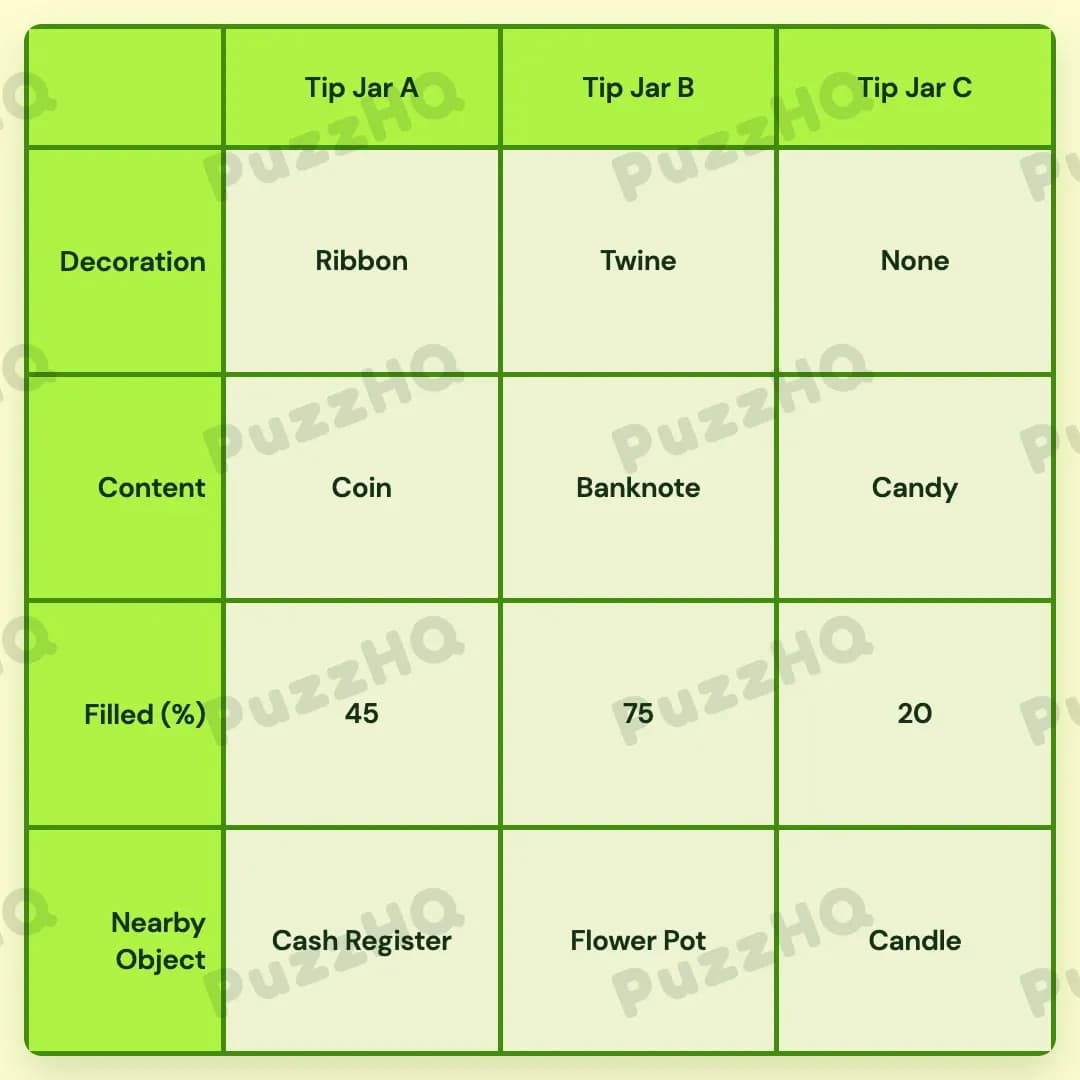
Here is the complete arrangement of all three tip jars with their decorations, contents, fill percentages, and nearby counter items.
| Trait | Tip Jar A | Tip Jar B | Tip Jar C |
|---|---|---|---|
| Decoration | Ribbon | Twine | None |
| Content | Coin | Banknote | Candy |
| Filled (%) | 45 | 75 | 20 |
| Nearby Object | Cash Register | Flower Pot | Candle |
How I Solved Profile Perfect Level 646
Looking at the layout of the three jars from left to right, the spatial references immediately caught my eye. The jars are arranged in a row across the counter, and several clues specifically referred to relative positions like the right jar, the middle spot, or being to the left of another item. Because three columns give you very little wiggle room, anchor clues that mention absolute positions can unlock a huge portion of the board right away.
Locking Down The Right And Middle Positions
I began with two straightforward placement clues that did not require any guesswork. One clue told me that the right jar does not have any decorations. That gave me a direct match for Tip Jar C, allowing me to write down None for its decoration category immediately.
Right next to that in my notes was the clue stating that the middle one is placed in front of the Pot. Because the middle column is Tip Jar B, that immediately assigned the Flower Pot as the nearby object for Tip Jar B. Having two definite entries on the board within the first minute gave me an immediate framework to build upon.
Tracing The Cashier And The Ribbon
With the middle jar anchored to the Flower Pot, another positional clue suddenly became very easy to resolve. The clue mentioned that the jar placed at the cashier is to the left of the Flower Pot. Since the Flower Pot is in the middle slot at Tip Jar B, the only jar to its left is Tip Jar A. That settled Tip Jar A's nearby object as the Cash Register.
Because Tip Jar A had the Cash Register and Tip Jar B had the Flower Pot, the only nearby object left to place was the Candle. By process of elimination, the Candle belonged to Tip Jar C on the far right. That completely resolved the entire nearby object row.
From there, I looked at the clue stating that the ribbon jar by the cashier is around half full. We already established that the jar by the cashier is Tip Jar A. This clue therefore tied two new details directly to Tip Jar A at the same time: its decoration is the Ribbon, and its fill percentage is the value closest to half full, which was 45 percent.
Filling in the Ribbon for Tip Jar A also wrapped up the decorations row. Tip Jar A had the Ribbon and Tip Jar C was already marked as having None. That left only Twine, which naturally went into Tip Jar B.
Comparing Fill Levels Across The Remaining Spots
At this stage, only two fill percentages were missing from the board: 20 percent and 75 percent. To place them, I turned to the clue stating that the most packed jar is to the left of the least filled one.
Between 75 percent and 20 percent, 75 percent is clearly the most packed jar, while 20 percent is the least filled jar. The clue dictated that the 75 percent jar had to sit to the left of the 20 percent jar. Since the only open slots for fill level were Tip Jar B and Tip Jar C, Tip Jar B had to be the one on the left, receiving 75 percent. Tip Jar C, sitting to its right, received 20 percent. With that deduction, all three fill percentages were locked in place.
Sorting The Contents Across The Counter
That left only the contents row to figure out: Coin, Banknote, and Candy.
I looked at the clue stating that the banknote is inside the jar next to the coins, alongside the clue stating that the candy jar is next to the one with paper. A banknote is paper currency, so both clues were talking about items adjacent to the banknote. If the jar with paper is next to both the coin jar and the candy jar, the banknote jar had to sit directly in the middle between them. That meant Tip Jar B had to hold the Banknote.
Now I only needed to figure out which side had the Coin and which side had the Candy. I checked the clue stating that the plain jar is not filled with coins. Earlier, I established that Tip Jar C was the jar with no decorations, meaning it was the plain jar. Because it could not contain the Coin, Tip Jar C had to hold the Candy. That left the Coin for Tip Jar A, completing the final open cell on the board.
The Point Where I Nearly Went Wrong
The phrasing around the paper jar was the one spot where a quick misreading could have caused trouble. When reading the clue stating that the candy jar is next to the one with paper, my first instinct was to scan the traits list for an item labeled paper. Because the items in the contents row are Coin, Banknote, and Candy, there was no literal trait simply named paper.
It took a second look to realize that paper was a descriptive reference to the Banknote. Once I recognized that paper simply referred to paper money, it aligned smoothly with the companion clue about the banknote being next to the coins. Had I assumed paper referred to a label, decoration, or note attached to the jar, I could have stalled out waiting for information that was not there.
Looking Back At The Solution
The breakthrough that made everything fall into place so quickly was identifying the middle jar's nearby object as the Flower Pot. That single anchor immediately identified the Cash Register on the left, which in turn unlocked the Ribbon jar and its 45 percent fill level. Once those early physical placements were settled, the remaining fill levels and contents fell into place through clean adjacency eliminations.
Comments