
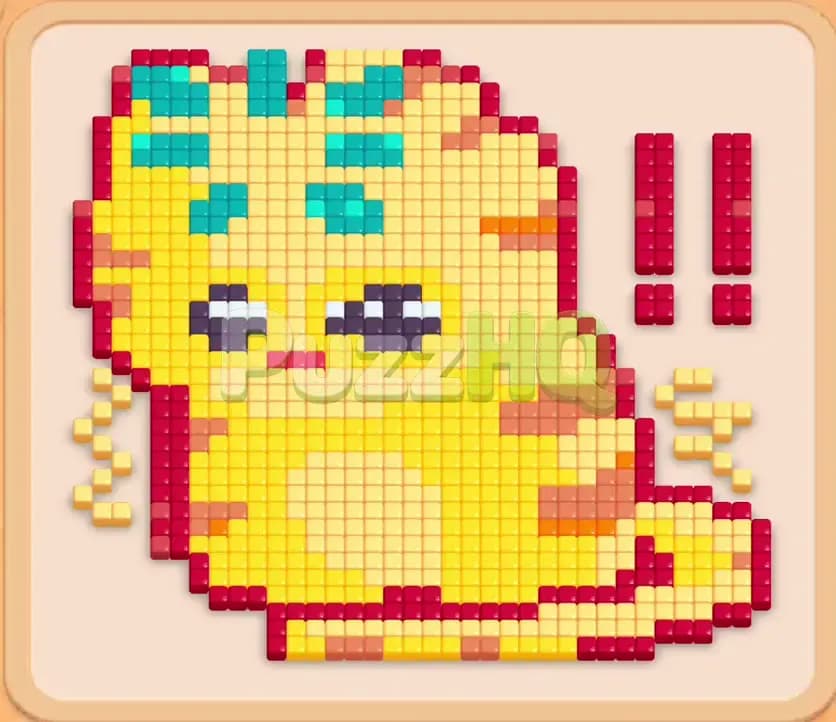
Colony Flow Level 1010 presents a charming pixel art puzzle featuring a striped cat alongside two bold exclamation marks. Your primary challenge is navigating a dense layout where bright yellow, warm orange, and cyan food tiles conceal deeper sections of the image. Success requires careful queue management and precise timing to prevent your five waiting slots from overflowing before the perimeter opens up.
Colony Flow Level 1010 Board Breakdown
Starting Colors and Blocks
The puzzle board displays a sitting cat rendered in colorful food tiles, flanked on the right by a pair of tall red exclamation points. Most of the cat body consists of yellow tiles, broken up by orange stripes across the cheeks, back, and tail. The tips and inner folds of the ears feature cyan tiles, while dark purple tiles form the eyes. Surrounding the entire figure is a thick maroon outline that connects down toward the tail.
At the bottom of your screen, the block tray holds numbered colored blocks that summon matching ants when moved into the five waiting slots. The front row starts with a single maroon block of one, a large yellow block of forty, an orange block of five, a yellow block of thirty five, and another orange block of five. Below these top options, you can see additional blocks queued up, including white, cyan, and deeper rows of maroon. Noticeable cables connect certain blocks in the queue, meaning selecting one will influence or drag its paired partner forward.
Paths, Obstacles, and Limited Space
The main nest sits near the bottom center of the board, sending ant trails upward toward whatever food tiles are currently exposed. At the start of the level, the vast majority of the cat interior is completely blocked by the outer edge tiles. Ants cannot reach the dark purple eyes or the central yellow belly until the outer perimeter and tail are chipped away.
Your greatest operational hazard is the waiting area, which contains exactly five slots. If you fill all five slots with blocks that have no clear path to matching food, your colony stalls out and the attempt fails. Connected boxes in the lower tray add another layer of friction, because pulling a needed color might automatically draw an inactive block into your active reserve. You must clear the tail and crown first, creating enough surface area for high count yellow blocks to drain continuously without freezing your line.
Colony Flow Level 1010 Complete Solution
Step 1: Open the Tail and Crown with Starting Blocks
Begin by tapping the maroon block with a value of one on the far left. This sends a lone red ant directly toward the exposed tip of the tail, clearing the initial contact point immediately and freeing up that slot. Next, tap the orange five block and the yellow thirty five block from the top row. These summon orange and yellow ants that start chewing along the lower tail and the crest of the head where yellow tiles are exposed.
Bring in the yellow forty block that sits near the left side. This block is tethered by a link to a white four block directly underneath it, but the high yellow count gives your yellow ants plenty of work along the cat back and upper ears. As the yellow ants clear the top edge, you expose more cyan patches on the ears. Move the cyan seven block into the waiting area to let cyan ants start dismantling the ear highlights. Keep an eye on your waiting slots, ensuring that every color currently resting above the tray is actively sending ants to the board.
Step 2: Clear the Outer Tail and Expand the Lower Opening
With the top of the head and the tail tip under attack, focus on eroding the curved tail on the lower right. Select the next available orange block and allow the orange ants to strip away the stripes along the tail curve. This exposes more of the underlying yellow tiles on the lower body.
Pull the white and cream blocks that become accessible as the top row clears out. White ants travel toward small accent tiles near the head and base. Watch the number counters on your active yellow blocks decline steadily as a continuous stream of workers carves into the rear flank of the cat. Clearing these outer edge tiles is vital because it establishes a wide highway from the nest straight into the dense yellow midsection.
Step 3: Chew Through the Yellow Torso and Flank
Now that the tail is mostly cleared and the back is wide open, select the large yellow blocks remaining in your active tray. Dozens of yellow ants will stream out of the nest hole, swarming across the flank, the back, and the lower belly of the cat. As the outer wall of yellow tiles falls away, the internal structure of the puzzle begins to hollow out.
While the yellow ants are busy, introduce the cyan blocks to finish off the remaining ear patches on the upper left and upper right. Because cyan occupies only a small total tile count, these blocks count down quickly and vanish from your waiting slots, keeping your buffer clean. Introduce the orange blocks that match the body stripes across the torso. Removing these stripes prevents your yellow ants from hitting dead ends, allowing their counters to tick down smoothly without stalling.
Step 4: Break into the Inner Core and Reveal the Eyes
With the torso heavily carved out, the dark purple tiles that make up the eyes are finally accessible to pathfinding ants. Look at your tray and select the dark purple block showing a count of twenty three. Dark purple ants immediately march up through the newly cleared hollow in the cat face and start eating the eye tiles.
At the same time, keep feeding yellow and orange blocks into the waiting slots whenever an open space appears. You need to clear the forehead and the bridge between the eyes to give the ants full freedom of movement. Because the dark purple block requires multiple visits to fully deplete, pair it with rapid clearing colors like remaining white accents or small orange stripes. This keeps at least three or four slots cycling while the longer tasks finish their run.
Step 5: Strip the Face Clean and Prep the Final Boundary
Continue cycling blocks to clear the remaining food on the cat head. Tap the small dark purple block to finish off the last few eye tiles, followed by the final cyan and white blocks that mop up stray pixels near the crown. Yellow ants will sweep through the remaining forehead and cheek tiles, leaving behind only the outer silhouette.
By the time this phase concludes, the entire inner portion of the cat is completely gone. You will see a hollow frame composed solely of the maroon outline, accompanied by the untouched red exclamation marks standing on the right. Make sure your waiting slots are completely empty or down to their final few counts before touching the outline blocks, giving you maximum space for the final push.
Step 6: Deploy Red Blocks to Devour the Outline and Exclamation Marks
The final stage of the board requires clearing the massive maroon border and the two exclamation points. In your tray, a series of heavy maroon blocks showing counts of twenty six, twenty five, twenty six, and twenty six will now be exposed and ready for selection. Tap these maroon blocks in steady succession to fill your waiting slots with active red units.
A massive swarm of red ants erupts from the nest, flooding across the bottom edge and splitting into multiple streams. One stream travels up the left perimeter, another traces the right spine and tail base, and a third stream marches straight up the right side of the board to consume the exclamation marks. Because the entire inner board is clear, the ants have completely unobstructed travel paths. Watch the numbers on all four maroon blocks tumble rapidly until the final red pixel vanishes and the stage completes.
Key Moments in Colony Flow Level 1010
The Move That Opens Up the Board
The critical turning point occurs when you remove the yellow and orange tiles along the lower right tail curve. Early on, the tail acts as a barrier that prevents ants from accessing the right side of the cat belly. By prioritizing the orange stripe blocks alongside the initial yellow thirty five block, you puncture that outer shell. Once the tail disappears, ants can approach the cat from both the left flank and the bottom right, which prevents bottlenecks and lets high value blocks drain twice as fast.
Finishing the Remaining Food
The final sequence works cleanly because the level designers concentrated nearly all the red maroon food into the outer frame and the exclamation marks. Leaving this color for the end ensures that once you pull the four large maroon blocks, every single ant has an immediate, legal target. Because there are no interior obstacles left to navigate, the swarm operates at peak efficiency, clearing the remaining boundary in one continuous, sweeping motion.
How to Avoid Getting Stuck on Level 1010
The primary risk on this board is pulling the dark purple eye blocks before the surrounding yellow face has been sufficiently cleared. If you drop a dark purple block into your waiting slots while the eyes are still shielded by yellow forehead tiles, that block will sit completely idle. With one slot permanently jammed, your operational space shrinks to four slots, making it remarkably easy to suffer a board lock when connected boxes force another unplayable color into your active row.
Another common mistake involves mismanaging the cyan ear tiles. Cyan appears in very limited quantities at the very top of the cat head. If you select cyan blocks while the ear tips are still out of reach, those blocks cannot dispatch ants and will clog your line. Always verify that an ant path actually exists from the nest to the target color before committing a block from your tray.
Finally, pay close attention to the connected cables linking blocks in the lower queue. When you take a block that is tied to another tile underneath, you must anticipate what color is about to rise into view. If pulling a needed yellow block drags an unplayable color into your active choices, ensure you have at least two empty waiting slots available to absorb any temporary delays without bringing your colony to an abrupt halt.
Final Thoughts
Patience and perimeter control are the twin keys to conquering Colony Flow Level 1010. By steadily dismantling the cat tail and ears before digging into the high density yellow core, you keep your ant highways open and your waiting slots fully functional. If you want to review the exact timing of each block selection or see the movement paths in action, take a moment to watch the complete solution video above this guide.
Comments