
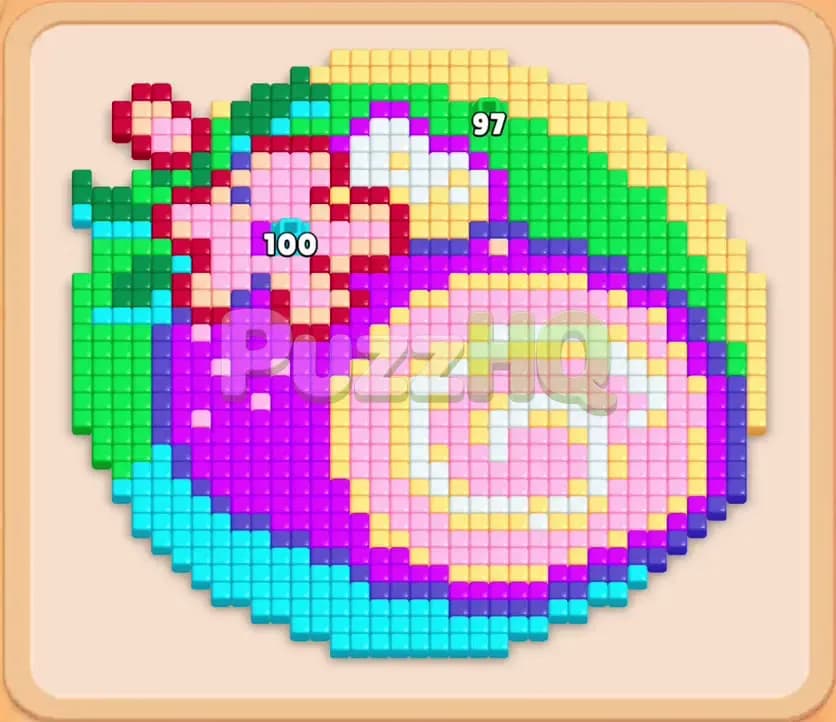
Colony Flow Level 130 presents a dense pixel art roll cake surrounded by vibrant frosting flowers and leafy decorations that can easily overwhelm your queue. The challenge lies in managing the tight pathways around the pastry while keeping all five waiting slots flowing freely. To conquer this stage, you must focus on clearing the outer boundary layers first so your ants can tunnel toward the inner spiral without jamming your tray.
Colony Flow Level 130 Walkthrough
Understanding the Starting Board
The board displays an intricate pixel art roll cake garnished with decorative fruit and floral toppings. At the very top, a dense green leaf canopy rests above the dessert, featuring an prominent tile count of ninety seven food units. Just beneath the foliage on the upper left, a vibrant bouquet of red and magenta flowers forms a large crown with a starting counter of one hundred units. The base of the cake sits on a wide cyan frosting plate, while a bold purple outline defines the exterior curve of the pastry. Tucked inside this boundary is a pink decorative swirl, which encloses the central spiral filled with soft cream, beige, and white food tiles. The nest sits at the bottom center of the board, requiring your ants to travel upward along whatever routes you open.
Below the playing field sits the block queue, which supplies colored numbered blocks into your five waiting slots. The initial row displays a red block of fifty, a peach block of twenty five, a white block of twenty five, and a pink block of sixty five. Directly beneath them, you can spot cyan, purple, and green options, as well as a pair of Hidden Boxes marked with mystery question marks. These Hidden Boxes conceal their true colors until you clear away obstructing tiles and establish a valid route to matching food. The main obstacle on this board is the tight concentric layering. The most enticing tiles in the center of the cake roll are completely walled off by the outer green leaves, red blossoms, cyan plate, and purple boundary. Selecting blocks for interior colors before carving a clear path will leave your ants idling at the nest, rapidly blocking your five waiting slots and triggering an immediate loss.
The Key to Clearing Level 130
Finding a reliable Colony Flow Level 130 solution requires an outside inward clearing order. Because you only have five waiting slots, you cannot afford to park blocks that lack active paths. If all five slots become occupied by colors trapped behind outer walls, the flow stops completely. Your primary goal is to strip away the outer green leaves and the exterior purple frame along the right flank while chipping away at the cyan base.
Once you establish an opening along the right side of the dessert, the Hidden Boxes in your tray will reveal their identity and integrate smoothly into your clearing sequence. As outer food tiles disappear, new paths branch out toward the inner pink swirl and the pale center of the roll. By maintaining at least one or two open waiting slots during every transition, you ensure that new blocks drawn from the lower tray can instantly deploy their ants. Never pick a block simply because its number is high. Always verify that a path exists from the nest to that specific color before tapping it into your waiting tray.
How to Beat Colony Flow Level 130
Step 1: Open the right boundary with purple and green selections
Begin by targeting the fully exposed exterior edges on the right flank and upper canopy. Select the visible purple and green blocks from the tray to dispatch swarms directly from the nest. Purple ants travel along the right side of the roll cake, steadily carving through the dark outline, while green ants march upward toward the massive green leaf cluster at the top. This initial move immediately reduces the green counter from ninety seven down to forty two. Because both colors have open, unobstructed paths from the outset, your five waiting slots remain fluid. As the purple perimeter begins to crumble, queue up the white and pink blocks from the top row of the tray so your ants stand ready to push into the newly exposed interior layers.
Step 2: Hollow out the right side to expose the pink swirl
With the outer purple boundary on the right flank stripped away, the pink swirl of the cake roll is completely accessible. Select the pink blocks to send a large pink swarm into the exposed curve of the pastry. The green counter continues to drop into the low thirties while the purple ants finish clearing the remainder of their assigned perimeter section. As these paths widen, the two Hidden Boxes in the queue reveal themselves to be a white block of twenty five and a pink block of sixty five. Because your earlier selections are actively finishing their runs, the waiting slots open up just in time to absorb these newly revealed colors without stalling your progress.
Step 3: Attack the red floral crown and inner cream core
Now that the right side of the cake is hollowed out, the inner cream and yellow spiral is reachable. Select the yellow fifty one block along with the white blocks to direct pale ants straight into the central spiral of the roll. At the same time, select the red thirty block to begin dismantling the dense red flower bouquet sitting at the top left. Red ants scale the left side of the frame and drop the flower counter from one hundred down to eighty seven, while the top green leaf canopy dwindles to just five remaining food tiles. Dividing your ants across the central swirl and the upper floral crown keeps multiple paths active, ensuring that blocks in your waiting slots count down concurrently.
Step 4: Dismantle the cyan base and peel away the purple lining
With the interior swirl substantially reduced, turn your attention toward the wide cyan plate resting underneath the dessert. Select the cyan thirty five block and the purple twenty six block from the tray. Cyan ants sweep across the lower portion of the board, breaking down the foundation that supports the entire structure. Simultaneously, red ants continue hammering the upper blossom, dropping its counter to fifty four, while pink ants erase the remaining border fragments. Your waiting slots will temporarily hold red twenty two, purple twenty six, white thirteen, green three, and pink four. Even though all five slots are occupied, every single ant group has an unobstructed line to food, allowing all counters to decrease rapidly and preventing a game ending jam.
Step 5: Strip the remaining cyan plate and reduce the flower
The cyan foundation quickly dissolves under the steady pressure of the cyan ants, wiping out the entire bottom layer of the board. Pull the red eleven block into the queue to keep whittling down the stubborn flower cluster, bringing its counter down to fifty. Next, bring the blue nine, pink seven, and white seven blocks into the waiting slots to address the exposed spine and remaining floral accents. Removing the cyan plate completely clears the left flank, creating an open corridor from the nest straight up toward the top left corner of the screen without forcing ants through narrow interior gaps.
Step 6: Clear the upper red flower and transition to the stem
The red flower crown finally collapses as the red ants consume its remaining petals. With the top left corner completely cleared, only the central supporting stalk and a few isolated green leaves remain on the board. Select the peach one block to instantly clear the tiny accent, followed by purple seventy one and green forty four. Green ants consume the final leaf tiles on the upper right, while purple ants gather around the central structural spine, which displays a remaining counter of fifty. Watching the numbers in your waiting slots drop into single digits gives you ample room to prepare your final set of blocks.
Step 7: Consume the central spiral spine to finish the level
Only the slender yellow and white curve remains on the board, marked with a thirty two counter near its bend, alongside small patches of purple and green. Select the yellow forty seven, white forty six, white fifteen, green nine, and purple four blocks to dispatch the final cleanup wave. Yellow and white ants surge upward from the nest, chewing through every remaining food tile along the central stem. The remaining counters reach zero in rapid succession, clearing the entire board and completing Colony Flow Level 130 with empty waiting slots to spare.
Why This Solution Works
The primary reason this approach succeeds on Colony Flow Level 130 is its strict adherence to concentric peeling. The puzzle board is constructed like an onion, where the most valuable inner spiral tiles are completely blocked by the outer green leaves, purple border, and cyan plate. If you make the mistake of pulling inner colors like yellow or deep pink during the opening seconds, those blocks become dead weight in your waiting slots. By systematically carving away the outer right flank first, you open clean entryways for ants to reach deeper layers without waiting on blocked paths.
Managing the five waiting slots also depends heavily on how you handle the Hidden Boxes. When mystery blocks sit in your tray, you cannot predict how they will fit into your future combinations. By clearing the right side of the cake roll early, you trigger the path conditions required to reveal those Hidden Boxes into standard white and pink blocks. This transformation lets you plan multiple moves ahead, preventing unwanted surprises that could clog your remaining open slots.
Finally, this sequence creates balanced ant traffic that never overburdens a single corridor. Opening both the right perimeter and the cyan bottom creates two separate highways out of the nest. When your cyan, red, purple, and pale ants are all moving along distinct paths simultaneously, block numbers tick down at maximum speed. This constant turnover keeps your waiting slots free of stagnant blocks, ensuring a steady, reliable victory.
Final Thoughts
Learning how to beat Colony Flow Level 130 becomes straightforward once you respect the board boundaries and peel the layers from the outside inward. Keeping your five waiting slots open by clearing the green leaves, purple border, and cyan base first ensures that your ants never stall on their way to the sweet center. If you encounter an unexpected bottleneck or want to review the precise ant paths, take a moment to watch the video above the article to see the winning sequence played out in real time.
Comments