
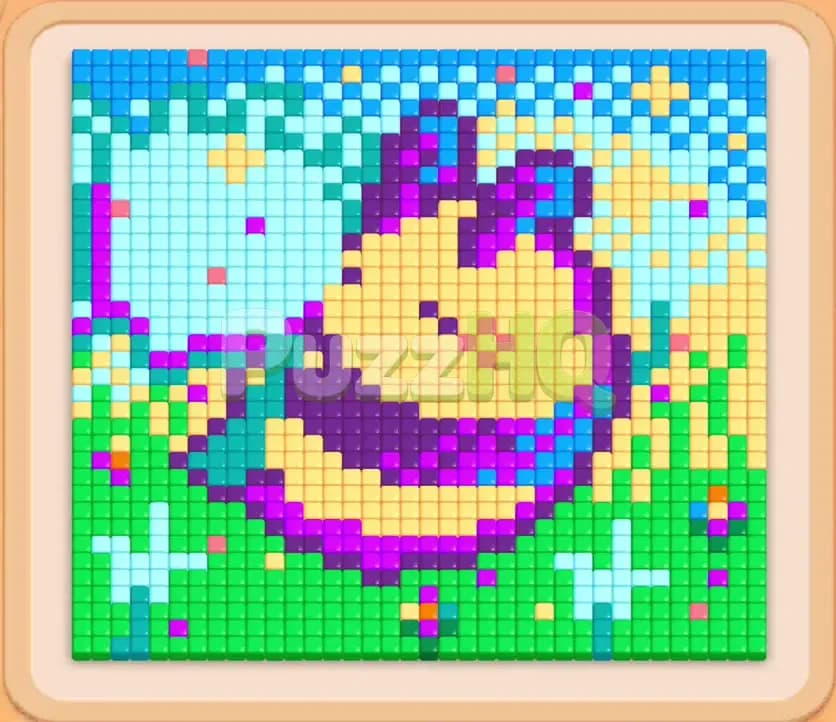
Colony Flow Level 1544 presents an intricate pixel art puzzle featuring a charming bumblebee resting above a lush patch of flowers and grass under a bright sky. Your primary challenge is navigating through dense outer borders of green foliage and sprawling blue sky before you can safely chip away at the central insect. Managing your five waiting slots becomes tricky because connected boxes and hidden mystery boxes demand precise planning so your ants never stall out.
Colony Flow Level 1544 Walkthrough
Understanding the Starting Board
When you open this stage, the playing field is packed with a colorful mosaic of food tiles forming a bumblebee among flowers. The outer perimeter is dominated by lime green and dark green grass across the bottom half, while the upper portion is covered in bright blue and pale cyan sky tiles. Inside this perimeter sits the bumblebee, constructed from yellow and purple segments with light orange accents and small pink spots. The bottom tray presents several active blocks, including green blocks of value twenty, thirteen, thirty five, purple thirty eight, and another green thirty five, backed by yellow, blue, cyan, and orange options underneath. The ants emerge from a central nest entrance located just below the board, meaning their quickest paths lead directly upward into the lower grass or around the side margins toward the sky. Connected boxes tied together by colored links and gray hidden boxes marked with question marks sit waiting in the tray, creating serious roadblocks if you tap them before matching tiles become reachable. The main obstacle is the sheer density of the grass and sky, which completely block access to the yellow and purple tiles that form the core of the bee.
The Key to Clearing Level 1544
Success on this board requires systematically stripping away the outside boundaries before attempting to clear the interior colors. If you pull a yellow or purple block too early, those tiles will sit idle in your waiting slots because the outer green grass and blue sky seal off all paths to the bee. You must prioritize the grass along the bottom and the sky tiles along the top edges to create wide avenues for your workers. As you clear paths, you also reveal the true colors of hidden boxes and activate connected pairs that free up multiple spaces simultaneously. Balancing the five waiting slots is your constant concern. You should always ensure that at least two slots remain open or are actively draining down toward zero, allowing you to cycle through the required queue without getting stuck.
How to Beat Colony Flow Level 1544
Step 1: Open the bottom border with green blocks
Begin by selecting the active green blocks from the tray to target the large wall of grass right above the nest entrance. Your ants quickly stream into the bottom green tiles, chewing through the outer perimeter and carving an entrance directly into the lower meadow. This initial burst takes down a substantial chunk of green food tiles, reducing the green counter from twenty down to single digits and opening up side routes toward the lower corners. Clearing this initial green foundation is necessary because it gives the colony room to turn left and right, exposing additional color groups along the edges of the board.
Step 2: Establish access to the upper sky with cyan and blue
With the initial path open, tap the available cyan and blue blocks from the tray to dispatch ants along the left and right borders toward the sky. The ants march along the edges and begin breaking apart the light cyan clouds and the darker blue background tiles near the top corners. As these tiles vanish, the top boundary of the board starts to hollow out, creating space around the upper wings and antennae of the bee. This step also allows you to draw down high count cyan numbers without overcrowding your tray, keeping multiple slots moving concurrently.
Step 3: Draw down the orange and yellow border tiles
Now that the left edge and top corners are partially cleared, tap the small orange block and introduce a yellow block into your active slots. Ants move immediately into the exposed orange flowers and the earliest exposed edges of the bee body. The orange block counts down rapidly and clears completely, vacating an essential slot. Meanwhile, the yellow block begins feeding ants into the outer edges of the bee face and abdomen, peeling back the outer layer of yellow food tiles and preparing the board for the deeper purple segments.
Step 4: Handle the first set of connected purple and blue boxes
Select the connected purple and blue boxes from the tray once paths to both colors are fully open. Because these boxes are linked, they enter the waiting area together, placing demands on your available space. Ants split their efforts, with one stream heading into the newly exposed purple bee stripes and antennae, while another stream finishes off remaining dark blue patches across the sky. The purple tiles begin shrinking as the ants carve out the upper wings, and the blue counter steadily approaches zero. Clearing these connected pieces relieves pressure on your queue and pulls forward new blocks from the reservoir.
Step 5: Uncover the hidden box while expanding the green clear
Continue clearing the lower section by tapping the next green block and using a light blue block to scour the remaining upper cloud. As these ants dismantle the dense green patches on the bottom left and bottom right, the gray hidden box in your tray reveals its true color. In this stage, opening paths along the lower left edge unlocks the mystery color, allowing you to integrate it safely into your rotation without risking a dead slot. Keep an eye on your remaining green count as it drops, ensuring the meadow is whittled down to isolated clumps.
Step 6: Carve out the bee body with purple and yellow
Focus your worker ants on the core of the bee by selecting the large purple and yellow blocks. The ants march straight up the middle corridor, consuming the dark purple stripes that form the bee body and wings. Yellow ants swarm the rounded cheeks and forehead of the insect, rapidly reducing both block counts. As these main body sections vanish, tiny pink accent tiles become isolated, and the remaining green patches along the bottom corner shrink into small clusters. Your waiting slots stay fluid because both yellow and purple ants have uninterrupted access to massive clumps of food.
Step 7: Clear the remaining grass clusters and sky remnants
Tap the incoming green blocks and the light cyan blocks to eliminate the final lingering elements of the background. Ants fan out to the far bottom corners to finish the last lime green tiles and consume the small stray green dots around the meadow. Simultaneously, cyan ants sweep across the top edge, clearing out the last few tiles of the cloud. This leaves the board almost completely empty except for a small cluster of purple stripes and stray accent dots near the center.
Step 8: Finish the remaining purple tiles to complete the board
Select the final purple blocks from your tray to send the last swarm of ants directly into the lingering purple food tiles. The ants work through the remaining bee wing fragments and tail stripes, counting down the purple numbers until the blocks vanish from your waiting slots. With the last purple tile consumed, the board clears entirely, and your colony marches back into the nest in victory.
Why This Solution Works
The primary reason this approach succeeds is that it respects the physical geography of the puzzle board. The bee is completely surrounded by green foliage on the bottom and sides, as well as blue and cyan tiles across the top. Attempting to clear purple or yellow early in the run would immediately congest your five waiting slots because no open pathway exists from the nest to the interior of the bee. By treating green and blue as your initial priority, you peel away the protective shell of the image and establish broad highways that multiple ant streams can travel simultaneously.
Another crucial factor is how connected boxes and hidden boxes are integrated into the sequence. Connected boxes force two colors into your slots at the same moment, which can instantly trigger a failure if one of those colors cannot reach its target tiles. By waiting until both purple and blue have clear, accessible targets before touching their connected pair, you ensure that neither half of the linked set becomes dead weight in your tray. Similarly, delaying interaction with the hidden box until surrounding green tiles are cleared prevents you from gambling on unknown colors while slot space is tight.
Finally, managing the rhythm of your slot turnover prevents the tray from jamming. Every time you bring in a high value block, you balance it by including a low count block or one that targets an easily reachable color cluster. This guarantees that slots empty out at regular intervals, granting you the breathing room required to pull the next layer of blocks from the bottom tray without locking up the puzzle.
Final Thoughts
Patience along the outer edges is what transforms Colony Flow Level 1544 from a frustrating bottleneck into a smooth, satisfying clear. Focus on excavating the green grass and blue sky first, and keep your waiting slots open until the bee itself is fully accessible to your workers. If you want to see the exact ant routes and tray timing in real time, be sure to watch the complete walkthrough video above to help guide your moves.
Comments