
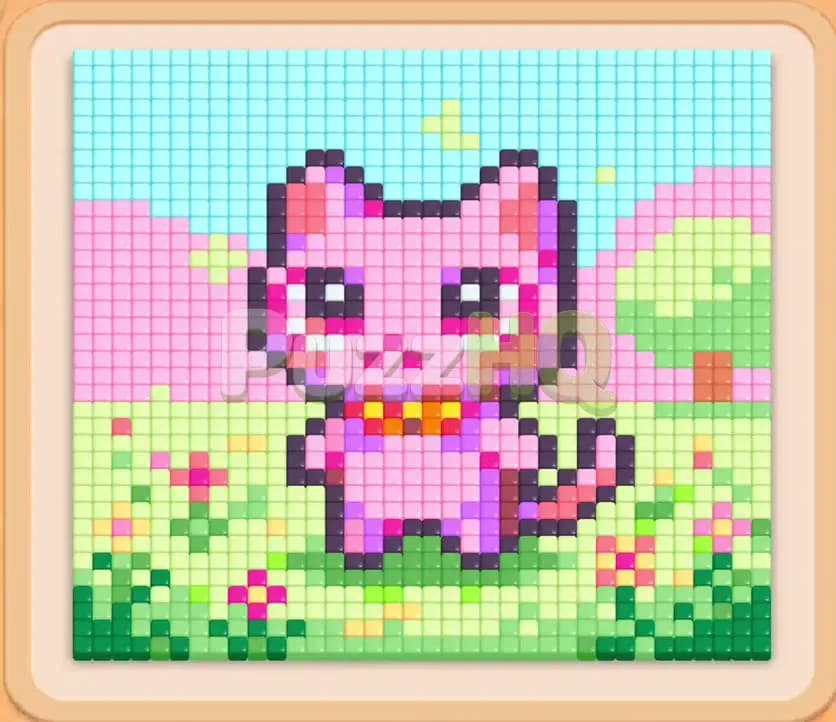
Colony Flow Level 1124 presents a dense pixel art board depicting a colorful cat sitting in a grassy meadow under a bright sky. Your main objective is to dismantle the entire picture layer by layer while ensuring your five waiting slots never become overcrowded with stalled blocks. Success on this stage depends on opening up clear perimeter paths through the outer landscape so your worker ants can steadily reach the deeper interior colors.
Colony Flow Level 1124 Walkthrough
Understanding the Starting Board
When you open the board, you see a charming pixel art illustration of a pink cat with dark outlines, bright yellow eyes, a yellow bow, and pink cheeks. The cat sits directly on a vibrant lawn of light green and darker green grass dotted with small flowers in pink and yellow. Behind the cat rests a background of soft pink hills beneath a wide expanse of light blue sky across the upper border. The food tiles on the outer rim consist primarily of light blue at the top and various shades of green along the lower edge and corners. These exterior tiles protect the cat body and prevent ants from reaching the pink, purple, and yellow tiles in the center.
Looking down at the selection tray, you find an assortment of colored numbered blocks arranged in stacked rows. The initial visible row features light green, pink, dark green, and light blue blocks. Directly underneath them sit several hidden boxes displaying question marks, alongside connected boxes joined by horizontal metal bars. These connected boxes must be managed carefully because choosing one block pulls its linked partner into your active waiting slots as well. The main obstacle on this stage is the tight perimeter access. The interior colors composing the cat cannot be eaten until you clear enough surrounding sky and grass tiles, meaning any premature pick of pink, purple, or dark brown will clog your waiting slots and end your run quickly.
The Key to Clearing Level 1124
The winning formula for this level revolves around stripping the outer frame before attempting to touch the cat itself. Light blue and green tiles form the outermost shell of the pixel art. By prioritizing light blue tiles at the top and light green tiles along the bottom edge, you establish broad open lanes on both sides of the board. This allows large colonies of ants to travel freely without running into bottlenecks.
Managing your five waiting slots is equally critical. Because several blocks in the lower tray rows are connected by metal linkages, tapping a connected pair uses two waiting slots simultaneously. If your active slots are already carrying two or three idle colors, pulling a connected pair can instantly push you to the five slot maximum. You must ensure that at least three slots are completely vacant or actively emptying before you engage any connected boxes. Keep your focus on clearing one single color group entirely off the outer edges before you start picking the pink and dark outline blocks that make up the cat portrait.
How to Beat Colony Flow Level 1124
Step 1: Clear the outer sky and bottom lawn
Begin by selecting the light blue block alongside the primary light green block from the top row of your tray. The blue ants immediately pour out toward the upper edge of the board, chewing through the light blue sky tiles that span the top corners. At the same time, your light green ants rush the bottom boundary, devouring the lowest rows of grass tiles. This initial dual push is vital because it establishes entry corridors along both the northern and southern borders of the board. Watch as the numbers on these active blocks rapidly count down toward zero. As the light green tiles along the baseline disappear, several hidden boxes directly below the first tray row reveal their true colors, giving you fresh options for your next move.
Step 2: Expand the perimeter with dark green and secondary greens
Once the first batch of light green tiles is nearly consumed, select the dark green block to continue chewing through the meadow. The dark green ants target the deeper clumps of foliage and the patches surrounding the scattered flower blossoms. Bringing in the dark green block prevents your lower ants from stalling and clears the terrain right up to the cat paws. In addition, pick up any secondary light green block that appears as the top row clears out. By clearing both shades of green in close succession, you completely strip the lower third of the board. The ants now have broad, unobstructed space to navigate around the bottom of the cat without bumping into lingering grass tiles.
Step 3: Strip the upper blue sky to uncover the ears and background hills
Shift your attention back to the upper half of the board where sky tiles still linger. Tap the remaining light blue block to send another stream of blue ants across the top. These ants consume the rest of the blue sky, stripping the backdrop away from the cat ears and exposing the soft pink landscape tiles beneath. Clearing the sky accomplishes two major goals. First, it completely exhausts the light blue supply on the board, allowing any remaining blue block to clear out of your tray slots permanently. Second, it exposes the outer perimeter of the pink hills and the dark outline along the top of the cat head, unlocking pathways for the darker tones you will need soon.
Step 4: Dismantle the pink background hills and reveal hidden tray boxes
With the blue sky completely gone and the grass cleared away, select the soft pink blocks that correspond to the background landscape. Your pink ants stream across the upper left and upper right quadrants, rapidly clearing away the pink hill tiles that flank the cat. Be careful to distinguish between the background pink and the darker magenta shades that form the cat face and body. Eating away the background hills shrinks the active board area down to just the central cat figure and a few stray flower stems. In the tray below, this sustained progress uncovers more connected pairs and hidden boxes, unlocking fresh numbers without cluttering your available holding area.
Step 5: Chip away the dark outlines and feet
Now that the cat figure is fully exposed on all sides, you can safely select the dark brown or black outline blocks. Your dark ants march directly onto the silhouette, consuming the boundary tiles that frame the paws, ears, and cheeks. Removing these dark borders is essential because they act as physical fences holding the interior pink, yellow, and red tiles locked inside. As the dark outline around the legs and belly dissolves, paths directly into the cat chest and face open up. Ensure you only pull outline blocks when you see open access points, as picking them too early while outlines are buried behind other colors will leave them sitting idle in your tray.
Step 6: Consume the cat body and facial features
With the dark framing broken apart, bring in your primary magenta and deep pink blocks, followed by the bright yellow block for the eyes and collar bow. A massive swarm of ants converges on the center of the board, devouring the cat face, ears, and torso. The yellow ants work through the bow tie and the bright eyes, while the pink ants rapidly eat through the cheeks and forehead. Because you cleared the surrounding landscape earlier, your ants enjoy direct straight line travel from the nest directly to the central cluster of tiles. Watch your waiting slots closely during this phase, making sure every block you tap begins counting down immediately upon entering the top tray row.
Step 7: Clean up remaining accent tiles to finish the board
Only small clusters of residual tiles remain scattered across the board, including tiny flower petals, collar accents, and isolated outline fragments. Tap the final matching blocks from the tray, including any remaining white or light cream pieces that correspond to the inner ear highlights. The final waves of ants sweep across the nearly empty canvas, polishing off the remaining scattered pixels. Once the last food tile is eaten, the final block counts down to zero, leaving all five waiting slots completely clear as the victory stars erupt over the clean board.
Why This Solution Works
The primary reason this sequence leads to victory is strict adherence to outside inward board progression. In puzzle games with perimeter pathing, selecting interior colors before clearing the outer frame almost always results in failure. The cat body contains a large portion of the overall tile count, which tempts many players into picking pink and magenta blocks right at the start. However, those interior tiles are physically blocked by the sky, grass, and dark outlines. By dedicating the early moves exclusively to light blue and various green shades, you systematically open the board and provide your ants with wide avenues of approach.
Another key strategic advantage comes from carefully managing the connected boxes in your tray. Connected boxes present a unique hazard because tapping one inevitably claims two of your five precious waiting slots. If you select connected pairs while your slots are already congested with waiting blocks, you lose the ability to adapt when a path becomes temporarily blocked. By keeping your active slots down to one or two working blocks during the middle phase of the game, you always retain enough empty space to absorb connected blocks without risking an instant game over.
Finally, opening the dark outlines at the precise moment between clearing the background and tackling the cat core ensures continuous ant flow. Dark border tiles protect the interior colored fills. If you do not remove the silhouette tiles when the landscape disappears, your ants cannot penetrate the cat face and body. Timing the dark outline blocks to match the exact moment the borders become reachable keeps the ant streams moving at full capacity, allowing you to breeze through the final stages of the level without stalling.
Final Thoughts
Patience on the outer perimeter is the single most important habit that makes this stage simple to conquer. When you resist the urge to tap bright interior colors early and instead methodically clear the grass and sky, the cat portrait naturally falls apart without jamming your tray. If you find yourself unsure about which path is currently open or want to double check the exact timing of a connected box pull, take a moment to watch the video above this walkthrough to see the complete ant flow in action.
Comments