
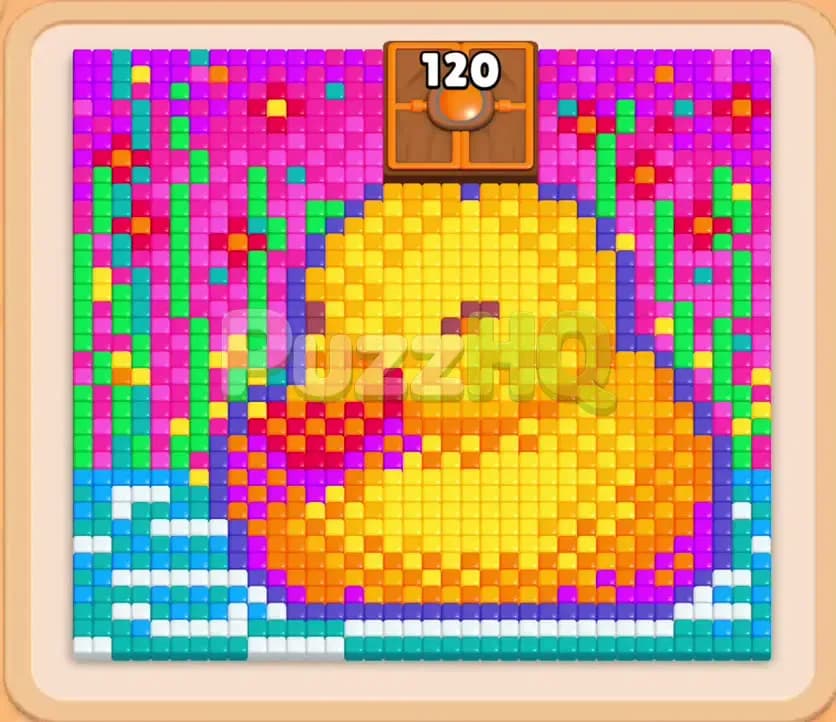
Colony Flow Level 567 presents a vibrant mosaic featuring a bright yellow duck resting on blue water ripples surrounded by lush pink and green flora. Your primary challenge is navigating through heavy layers of outer border tiles and clearing enough central food to unlock the top barrier. By keeping your waiting slots clear and systematically exposing the interior duck from the bottom upward, you can clear the entire board without risking a gridlock.
Colony Flow Level 567 Walkthrough
Understanding the Starting Board
The puzzle displays a charming pixel art image of a yellow rubber duck with an orange beak, framed by red accents, cyan and white water ripples at the bottom, green vertical stems along the flanks, and a dense canopy of pink and magenta flower tiles. A purple perimeter runs along the lower boundary to hem in the scene. At the top center sits a wooden Hungry Door displaying the number 120. This door acts as a major barrier, preventing your ants from accessing the upper middle section of the board until you consume one hundred twenty matching tiles across the accessible areas.
Your bottom tray begins with five active blocks on the top row, including orange 30, white 30, yellow 30, a second white 30, and blue 20. Directly beneath these visible blocks sit layers of pink 25, yellow 28, yellow 30, magenta 24, red 25, green 35, and further reserves of yellow, blue, and purple. The main obstacle is the tight clustering of colors. The yellow duck dominates the center of the board, but its tiles are completely insulated by the water below and the flowers on top. You only have five waiting slots, meaning that selecting blocks for colors that lack an open, accessible path from the nest will instantly waste space and risk an early defeat.
The Key to Clearing Level 567
Success on Colony Flow Level 567 depends on disciplined bottom up clearing. You must not touch the green or pink blocks stored in the tray until their matching tiles on the board have clear pathways leading to them. The natural entry point is the lower left corner where the blue and white water ripple lines sit completely exposed to the ant nest. By removing those water tiles first, you establish an open corridor that touches the bottom of the duck and the lower boundary.
Once that corridor is established, you can rotate between yellow, orange, and red blocks to eat away the center of the image. Clearing the central duck serves a dual purpose. It hollows out the middle of the board so your ants have vast open avenues to move across, and it feeds the counter on the Hungry Door at the top. You must carefully monitor the five waiting slots so that you never bring in a second inactive color while another block is waiting for tiles to open up.
How to Beat Colony Flow Level 567
Step 1: Clear the exposed water tiles at the bottom left
Begin the level by selecting the blue 20 block and the first white 30 block from your active tray. The ants emerge from the nest and immediately attack the exposed water ripples located in the lower left corner of the board. The blue tiles vanish quickly, dropping your blue block number into single digits while the white tiles along the water ripple lines disappear in rapid succession. This clean opening immediately frees up space directly beneath the duck and exposes both the lower yellow body tiles and the adjacent purple border pieces.
Step 2: Clear the lower purple border and engage the yellow duck
With the water tiles gone, select the purple block and the yellow 30 block from the tray. Purple ants travel along the newly opened lower edge to consume the purple boundary tiles on both corners of the board. At the same time, yellow ants surge into the bottom of the duck body where the water previously blocked access. As the yellow counter drops from 30 down into the twenties, the base of the duck dissolves, widening the path into the center and uncovering the orange base and red float details.
Step 3: Consume the orange beak and lower red details
Tap the orange 30 block and the exposed red block to send ants into the colorful accents in the middle of the duck. The orange ants target the bill and the lower orange trim, rapidly chewing through those tiles and decreasing the block value. Meanwhile, the red ants latch onto the red outline tiles bordering the duck. This move carves a deep path directly into the core of the art piece and contributes significant progress toward the wooden barrier at the top, bringing the Hungry Door number down from 120 toward 90.
Step 4: Whittle down the yellow body and clear lingering water patches
Select the next yellow block and the secondary blue block to keep your workers active. Yellow ants consume the bulk of the duck head and chest, creating a massive hollow area in the middle of the board. The secondary blue block cleans up the remaining water squares on the lower right and along the bottom border. By the time this step concludes, the duck is more than halfway consumed, your waiting slots remain completely manageable, and the Hungry Door ticks down further toward 60.
Step 5: Dismantle the remaining duck tiles and central accents
Pull the next yellow, orange, and red blocks that have surfaced in your tray. Your ants will systematically finish off the remaining fragments of the yellow head and the final stray orange tiles near the center. Because the duck was the primary barrier separating the left and right sides of the board, clearing it creates open transit routes across the entire layout. The countdown on the Hungry Door drops below 30, setting up the complete removal of the top obstacle.
Step 6: Unlock the Hungry Door and invade the upper flower canopy
Continue selecting the active yellow and pink blocks until the final required tiles are consumed, bringing the Hungry Door counter to zero. The wooden door at the top center vanishes entirely, exposing the dense cluster of pink, magenta, and green tiles at the top of the board. Immediately select the magenta and pink blocks from your tray. A massive wave of pink ants floods through the open doorway and upward from the hollow center, rapidly eroding the thick canopy of flowers across the upper third of the board.
Step 7: Strip away the green stems and outer corner foliage
With the pink flowers largely cleared away, the tall green stems that run vertically along the left and right edges are now accessible from both their inner and outer boundaries. Select the green blocks from your tray. Green ants quickly march up both sides, stripping away the long vertical columns of foliage. At the same time, select any remaining purple or red blocks to pick off the isolated edge tiles along the outer borders, ensuring no stray pieces are left trapped in the corners.
Step 8: Clean up the final scattered tiles across the board
Choose the final small count blocks from your tray, including the remaining green, blue, and yellow blocks with single digit counts. Ants disperse in all directions across the wide open board to pick up the few leftover water dots at the bottom, the remaining leaves near the top corners, and any stray petals. Each block counter ticks down to zero and disappears from your waiting slots one after another, leaving the board entirely empty and completing the level.
Why This Solution Works
The primary reason this strategy succeeds is that it respects the strict physical access requirements of the board. Colony Flow Level 567 hides its largest mass of tiles, the yellow duck, behind outer water ripples and edge borders. If you try to select yellow or pink blocks right at the start without clearing the blue and white water tiles first, your ants have no valid route to reach those colors. The selected blocks would simply sit idle in your waiting slots, drastically reducing your room for error and inevitably triggering a board lock.
Furthermore, this sequence smoothly integrates the requirement of the Hungry Door. The door requires 120 tiles to be cleared before it opens up the upper garden. Rather than trying to chip awkwardly at the extreme edges of the flowers, focusing all your early ant power on the water, the duck, and its orange accents fulfills the 120 count naturally. By the time the duck is gone, the door vanishes automatically, providing an expansive gateway into the upper canopy right when you are ready to tackle pink and green blocks.
Finally, keeping your tray clear relies on pairing block selections with active clearing phases. By alternating between the primary color of a region and its bordering accent colors, you guarantee that every block you pull into the waiting slots begins counting down immediately. This constant turnover keeps at least two or three waiting slots open at all times, giving you the flexibility needed to cycle through the multi layered tray without ever getting stuck.
Final Thoughts
Colony Flow Level 567 can look overwhelming due to the sheer density of the floral background and the giant duck, but breaking the puzzle down into bottom water, central duck, and upper canopy makes the entire process straightforward. Maintaining empty waiting slots by opening paths before tapping matching blocks is the true secret to victory. If you find yourself unsure about which path is currently open or want to double check an ant movement, take a moment to watch the accompanying video walkthrough above the article to guide your next move.
Comments