
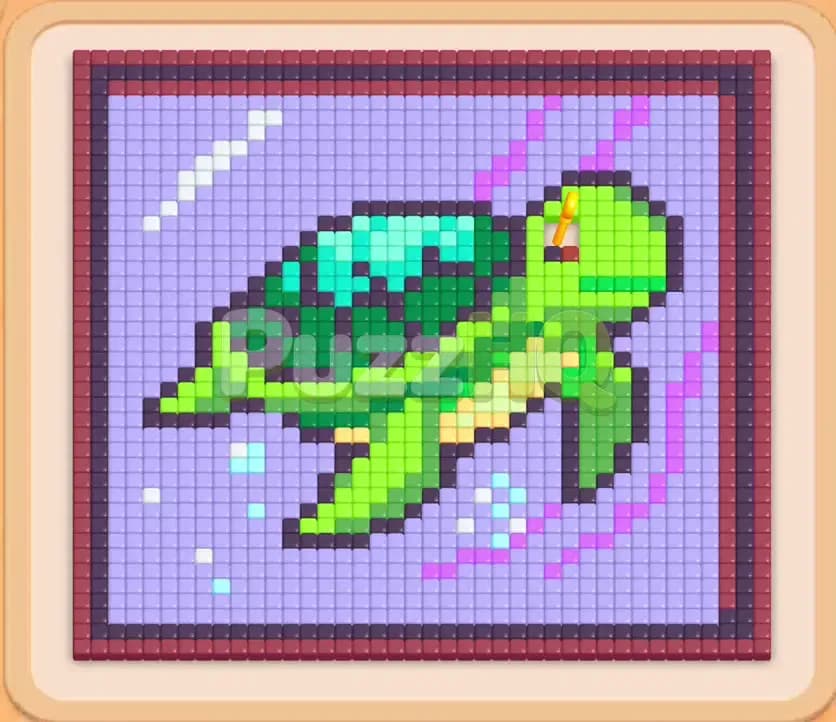
Colony Flow Level 727 presents an intricate pixel art puzzle shaped like a sea turtle swimming through an ocean background. Your goal is to guide your ant colony across the board by picking the correct colored blocks from the bottom tray without overcrowding your waiting slots. With tricky side channels, a golden lock, and connected boxes in play, success depends on maintaining an open path for your worker ants.
Colony Flow Level 727 Board Breakdown
Starting Colors and Blocks
The pixel board displays a colorful sea turtle surrounded by lavender background water tiles. The turtle itself consists of multiple shades of green, bright cyan highlights on its shell, black outline segments, and pale cream belly tiles hidden beneath the main structure. Encasing the outer edge of the water is a thick border of dark maroon tiles running along the left, top, and right boundaries.
Down in the selection tray, you start with several high value numbered blocks. Visible options in the front row include white nine, lavender fifty eight, black sixty five, green forty five, and another lavender fifty eight. Behind these initial blocks rest dark grey twenty, purple sixty, maroon forty five, and black thirty. Deeper in the stack, you can spot locked and connected blocks waiting for path access. The ants emerge from a central nest hole just below the playfield, ready to stream upward as soon as matching colors are selected.
Paths, Obstacles, and Limited Space
The central challenge on this board is the severe bottleneck at the bottom entry point. Because the lower border of lavender tiles blocks access to the turtle, your ants cannot reach the greens, blacks, or cyans right away. Picking colors that have no open path will cause those blocks to sit completely idle in your five waiting slots.
Special elements on this stage add further complexity. A golden key rests on top of the turtle, which must be collected by clearing neighboring tiles before you can open the golden lock block in your tray. Additionally, connected boxes tied together by colored energy beams appear deeper in the tray. Clearing one end of a connected pair demands that you also account for its partner, requiring strict control over slot space. With only five waiting slots available, one wrong tap on an inaccessible color can fill your tray and instantly end your run.
Colony Flow Level 727 Complete Solution
Step 1: Open the Lower Ocean and Retrieve the Golden Key
Begin by selecting the lavender fifty eight block from the front row. Because lavender forms the wide open floor of the ocean directly facing the nest, your ants immediately pour onto the bottom edge of the board. They start devouring the light purple background, expanding your walking lanes upward along both sides of the turtle.
While the lavender tiles clear, tap the white nine block. The ants rush to the white highlights around the turtle and the light reflective spots on the shell. As the ants consume these tiles, follow up with the second lavender block to keep the purple swarm moving toward the upper half of the board. Clearing this central passage exposes the golden key sitting on the upper part of the turtle. As soon as the surrounding tiles vanish, an ant picks up the key and carries it toward your tray, which instantly unlocks the golden lock block nestled in the second row.
Step 2: Unlock the Golden Tray and Clear the Outer Flippers
With the golden lock open, you gain access to vital blocks beneath it, including connected cyan and green pieces. At this point, select the green forty five block. The ants now have a clear path to the lower rear flipper and the underside of the front flipper.
Watch the green flipper tiles dissolve as the number on your green block rapidly counts down. Since green tiles are widespread across the turtle limbs, you should pull the smaller green blocks to ensure the flippers clear completely. You will notice your waiting slots holding a couple of partially finished blocks, such as a black outline block and a white block with low numbers. Keep your remaining slots free by letting the green ants finish their route before introducing any new colors that lack broad surface contact.
Step 3: Strip Away the Dark Maroon Border
Now that the lower flippers no longer obstruct the outer perimeter, paths open toward the thick maroon border lining the edges of the tank. Tap the maroon forty five block from your tray. Ants immediately split into two columns, marching up the left and right exterior tracks to eat the dark red framing tiles.
This movement is essential because the maroon border constricts the outer lanes. As your ants chew upward through the border, tap the adjacent black block with a value of twenty. The ants will peel off the dark outline running along the back edge of the turtle shell and flipper base. Clearing these black lines creates direct cross paths, allowing ants to cut across the board rather than walking all the way around the outside frame.
Step 4: Expose the Cream Belly and Clear the Neck
With the black outlines broken, the pale cream tiles forming the turtle belly and throat become fully accessible. Select the green and pale blocks that target the neck and chest area. As your ants eat through these inner layers, you will uncover hidden food tiles that sit underneath the central chest.
During this stage, your tray reveals several connected boxes linked by a glowing green beam. Tap the connected green thirteen and cyan nine combination. Because both green flipper remnants and cyan shell patches are now exposed to the open pathways, ants begin feeding on both colors simultaneously. This dual action rapidly drains the counters on both connected boxes without stalling in your five waiting slots.
Step 5: Dismantle the Top Maroon Wall and Upper Ocean
Look toward the top of the frame where a dense line of maroon border and light lavender tiles remains. Select the purple nineteen and black fifteen blocks from your tray. The worker ants travel up the cleared side channels and attack the ceiling of the board.
As the top maroon wall dissolves, the final pockets of lavender water vanish from the top corners. This clears away the entire background frame, leaving only the central mass of the turtle shell and head. Your waiting slots should now hold very low numbers, freeing up room for you to address the final clusters without any danger of an overflow.
Step 6: Empty the Connected Shell Blocks and Clear the Final Teal
The only food left on the board is the dense pixel cluster making up the upper shell, composed of vibrant teal, bright cyan, and dark green plates. In your tray, you have large elevated connected blocks in teal and lavender, along with small numbered cleanup blocks like black thirteen and cyan one.
Tap the teal and green blocks to send a concentrated wave of ants directly into the center of the shell. The numbers on the final blocks plummet as the ants strip away the dark green plates, exposing the brilliant teal core. Finally, select the cyan block to clean up the last few floating food tiles in the center. Once the final cyan pixel is consumed, the board clears completely and you secure your victory on Colony Flow Level 727.
Key Moments in Colony Flow Level 727
The Move That Opens Up the Board
The critical turning point in this puzzle occurs during Step 1 when you clear the path directly to the golden key. Leaving the key locked behind purple ocean tiles prevents you from using the golden lock block in the tray, which in turn traps the connected green and cyan pieces underneath it. By prioritizing the central lavender tiles and guiding the ants straight to the key, you open up the entire lower tray and gain the flexibility needed to manage your five slots safely.
Finishing the Remaining Food
The endgame requires careful coordination with connected boxes. Because connected boxes occupy tray space together and pull ants across different colored tiles at the same time, activating them when only one color is accessible will clog your waiting area. Waiting until both the green limbs and the cyan shell tiles are fully exposed ensures that both linked blocks drain at the same speed, leaving you with an empty tray right as the final turtle pixel disappears.
How to Avoid Getting Stuck on Level 727
The biggest danger on this board is picking the black outline blocks or cyan shell blocks too early. At the start of the level, the sea turtle is completely surrounded by lavender water. If you choose black or cyan blocks during your first two moves, those blocks will immediately sit in your waiting slots with zero ants moving toward them. With only five slots available, wasting two slots on inaccessible colors leaves you with almost no room to cycle through the necessary background colors.
Another frequent hazard involves the dark maroon border along the outer rim. Players often ignore this border to focus purely on the turtle body. However, leaving the maroon walls intact keeps the side lanes narrow, forcing all your ants into a single vertical stream up the center. When multiple ant streams try to use the same central path, traffic slows down and food clears much more slowly. Take out the maroon border as soon as your side channels connect so your colony can move along the edges freely.
Keep a close eye on the numbers displayed on your blocks before tapping them into the waiting line. If you pull a block with a count of sixty when only twenty tiles of that color are currently reachable, that block will remain stuck in your waiting area at forty until you clear another blocking layer. Always verify that the visible tile count on the board matches or exceeds the block number, or that clearing those tiles will immediately reveal enough matching food to empty the block completely.
Final Thoughts
Patience and path planning are everything when tackling Colony Flow Level 727. By systematically peeling away the ocean background, securing the golden key, and saving your connected boxes for the moment both colors are exposed, you can guide your colony through the turtle smoothly. If you want to see the exact pacing and ant routes in real time, take a moment to watch the video above the article to perfect your run.
Comments