
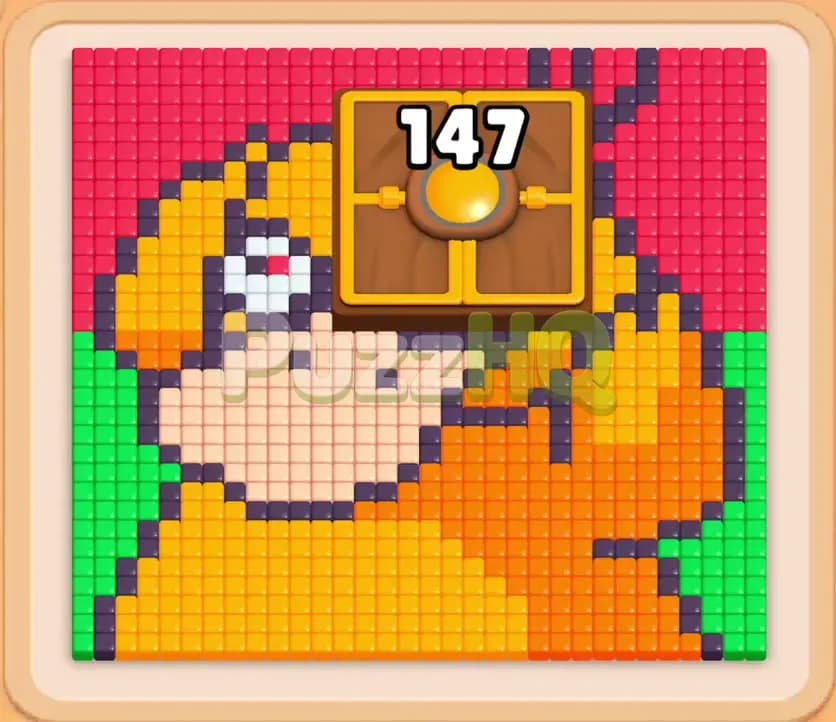
Colony Flow Level 380 tests your ability to balance broad outer paths while breaking down a massive central objective. You are tasked with clearing a colorful duck portrait framed by dense borders and trapped beneath a sturdy vault. Managing your five waiting slots is the entire key to survival here because a single premature pull will easily jam your tray and force a loss.
Colony Flow Level 380 Overview
What You Are Working With
The board features a detailed pixel art portrait of a yellow duck clutching its head in distress. The duck has a bright yellow head and body, a wide peach bill, orange hands gripping its cheeks, white eyes with dark pupils, and dark purple boundary outlines. Framing the duck are bright red tiles across the upper boundary and green tile pillars along the side edges. Right in the middle of the board sits a large locked chest displaying a counter of 147. This chest blankets the central portion of the artwork and keeps the underlying tiles out of reach until your ants eat enough surrounding food to reduce that counter to zero.
Directly beneath the board sits the central nest hole where your ant workers emerge. Below the nest hole is a row of five empty waiting slots. Below those waiting slots rests your tray of colored numbered blocks. You have access to red, green, yellow, peach, orange, white, and dark purple blocks. This stage includes Connected Boxes in your tray. These blocks are physically tethered to one another with thick colored link cords. When you interact with Connected Boxes, you have to account for both linked colors because moving one piece drags its partner along or alters your queue sequence. If all five waiting slots fill up and no ants can reach a valid color match on the board, your run ends on the spot.
What It Takes to Clear Level 380 Board
Winning Level 380 requires stripping away every single colored tile until the canvas is totally clear. You cannot access the tiles hidden beneath the central chest right away. Instead, you must carve away the accessible red borders, side green pillars, peach bill sections, and outer yellow plumage. Every tile your ants consume subtracts points directly from the chest counter, ticking it down from 147 through 70, 42, 20, and 6 until it bursts open.
Your main challenge is slot discipline. With Connected Boxes present in the tray, pulling a pair without an open feeding route will instantly steal two of your five available waiting slots. You must always maintain at least one clear feeding lane between the nest hole and the picture so your ants never stop moving. The winning route relies on chipping away the outer edges first, exposing the face, unlocking the chest, and finally finishing the core body tiles and dark purple outline frame.
Colony Flow Level 380 Step by Step Solution
Step 1: Open paths along the outer borders using red and green blocks
Start by pulling the red block and green block from the front of your tray into your waiting slots. The red ants immediately stream out of the nest hole, marching up the right flank and wrapping across the upper boundary to devour the red border tiles. At the exact same time, green ants crawl up the left edge to consume the vertical green wall. These outer routes are wide open and grant your ants immediate access without any path obstructions. As the red and green ants chew through their targets, the chest counter drops rapidly from 147 toward 70. Watching the red block count down ensures that you do not overload your slots early. You keep three full waiting slots completely vacant while these two border paths clear.
Step 2: Feed the duck forehead and bill using yellow and peach blocks
Pull a yellow block and a peach block into your open waiting slots to begin clearing the primary facial features. Yellow ants charge straight up toward the top of the duck head, stripping away the yellow crown and forehead tiles above the eyes. Meanwhile, a line of peach ants travels along the lower face to eat the large bill. Consuming these facial blocks opens up critical space right against the edges of the central chest. The chest counter continues to fall quickly, tumbling down from 70 toward 42. You keep a strict eye on the peach counter, allowing the ants to finish eating before you reach for any deeper blocks. This leaves plenty of room in your queue so you never risk a dead end.
Step 3: Clear the raised arms and head outlines with orange and dark purple blocks
Select an orange block and a dark purple block to clear the side limbs and outer facial borders. Orange ants route directly to the arms on the right and left, eating away the bright orange hands resting on the duck cheeks. Dark purple ants target the crisp border lines separating the bill, eyes, and cheek patches. Eating these boundary lines frees up the board layout and shaves the chest number all the way down to 20. Because both the orange hands and dark purple outlines are readily accessible to the ant trails, both blocks drain steadily in your waiting slots. This rapid consumption ensures that your waiting slots never back up with idle blocks.
Step 4: Dismantle the Connected Boxes to strip the lower cheeks and bill base
Target the Connected Boxes sitting in your lower tray by committing their matched colors to the waiting area. Moving these tethered boxes places both components into your active queue, making it essential to have open target tiles for each color. Direct the peach ants to eat the remaining tiles along the base of the bill, while the green ants sweep through the secondary green wall patches along the lower left corner. The ants work through both color assignments smoothly, preventing the connected pair from clogging your line. This coordinated push drops the chest counter to 6. You preserve an empty waiting slot throughout this sequence to guarantee steady ant flow.
Step 5: Crack open the central chest to reveal the hidden inner tiles
Draw the final peach and white blocks to consume the remaining bill corner and the white eye highlights. The ants clear the last target tiles required to exhaust the chest counter completely. The chest pops open with a bright burst of light and stars, vanishing from the center of the board. Opening this central space reveals a dense cluster of yellow body tiles and orange chest feathers that were completely covered before. With the center wide open, the ants now possess direct lines of travel through the heart of the canvas. You now have full access to every remaining section of the picture.
Step 6: Clear out the newly exposed chest feathers with orange and green blocks
Pull the fresh orange block and green block into your waiting queue to attack the central body cavity and the remaining side borders. Orange ants rush into the newly uncovered middle area, stripping away the orange chest feathers that sat underneath the vault. Green ants peel away the final green fragments lingering on the outer walls. The numbers on your active blocks tick downward with zero delay because the ants have short, unobstructed walking paths from the nest hole into the center. Keeping these trails moving frees up your waiting slots rapidly, giving you clean access to the final layer of tray blocks.
Step 7: Consume the final yellow body tiles and dark purple frame to complete the stage
Pull the heavy yellow block and the remaining dark purple blocks to finish the entire picture. Yellow ants swarm the remaining torso and crown, clearing every patch of yellow feathers across the duck form. Dark purple ants march in a continuous line along the outermost edge of the artwork, eating away the final structural border tiles. The waiting slot numbers drop to zero one by one, your ants finish the board, and the screen clears completely to secure your victory on Level 380.
Final Thought
Colony Flow Level 380 requires sharp attention to the central chest counter and careful management of Connected Boxes so your waiting slots stay clear. If you find any color transition tricky to time while playing, watch the video above this article to follow the exact visual route.
Comments